



Table of contents: Maintenance free battery ↓ Regular battery ↓
Maintenance free battery
The batteries, which require virtually no maintenance, do not have unscrewable cell plugs. Checking the electrolyte level and density is not necessary for these batteries, because the electrolyte does not evaporate.
Such batteries usually have a so-called "magic eye" (see arrow in illustration 9.0), which is an optical electrolyte level indicator. The electrolyte level and the battery charge level are determined by the change in color of the optical indicator.
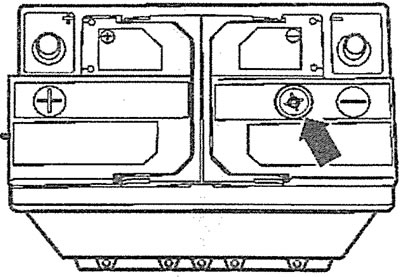
9.0. Optical electrolyte level indicator
Before checking, it is recommended to lightly tap the indicator with the handle of a screwdriver to remove air bubbles that affect the color of the indicator.
- the color of the optical indicator is green - the battery status and charge are normal;
- the color of the optical indicator is black - the battery is not charged or the charge is too weak;
- the color of the optical indicator is yellow or the optical indicator is colorless - the critical electrolyte level has been reached. The battery must be replaced.
Regular battery
A regular battery differs from a maintenance-free battery in that it has unscrewable cell plugs or a bar on the top cover that covers the cell openings. This battery requires regular checking of the electrolyte level in the cells, for which follow these steps.
The electrolyte should cover the battery plates. The thickness of its layer above the plates should be approximately 5 mm. In some batteries, the electrolyte level is visible through the transparent case. In this case, it should be between the MIN and MAX marks on the case. In batteries with an opaque case, the electrolyte level should be at the lower edge of the protrusion in the ventilation hole.
1. Unscrew the cell plugs using a wide screwdriver or remove the plug strip by carefully prying it off with a screwdriver.
2. Add distilled water through a funnel if necessary, bringing the electrolyte level in all cells to the norm.
3. Screw in the cell plugs or close them with a strip.
4. Charge the battery and check its voltage under load.
[The article was copied from the website AUDIMANUAL]