
Repair Chevrolet Repair Toyota Repair Honda Repair AvtoVAZ Repair Mercedes-Benz Repair BMW Repair Opel
Home  |  Contacts  |  Sitemap  |    
English Русский
Български
Беларускі
Український
Српски
Hrvatski
Română
Polski
Slovenský
Magyar
AudiManual.ru


  • AUDI 80
  • AUDI 100
  • AUDI A3
  • AUDI A4
  • AUDI A6
  • AUDI A8
  • AUDI Q
  • OTHER
  • ARTICLES
B8 (2007-2015) B7 (2004-2008) B6 (2000-2006) B6 (2000-2006, petrol) B5 (1994-2001) B5 (1994-2001, petrol)

Starting the engine from an auxiliary battery (Audi A4 B6)

  • Home
  • Audi A4
  • B6 (2000-2006)
  • General information
  • Vehicle Description
  • Starting the engine from an auxiliary battery
            0
Table of contents: Connecting the positive terminals… ↓ Connecting the negative terminals… ↓ Starting the engine ↓
If the battery is discharged, the engine can be started using jumper cables and another vehicle's battery. Both batteries must have a nominal voltage of 12 V.

capacity the current of a charging battery should not be much less than that of a discharged one.

Only cables with a sufficiently large value can be used as auxiliary cables section. Pay attention to the parameters provided by the cable manufacturer.

Use auxiliary cables with insulated terminal clamps.

Positive cable - usually red in color.

Negative cable - usually black.

There should be no contact between the cars. Otherwise, the circuit will close when the positive terminals are connected.

There is a risk of chemical burns!


Do not lean over the battery pack while starting with the auxiliary battery pack.

There is a risk of explosion!


Do not work with open flame, do not smoke, avoid sparks near the battery.

Starting with an auxiliary battery is possible with a cold engine and cooled catalytic converter. However, multiple and prolonged starting attempts should be avoided.

It is not permitted to start the engine using a device for rapid charging of batteries.

Charging the battery is discussed in Chapter Routine care and maintenance.

The discharged battery must be properly connected to the vehicle's electrical system.

If necessary, switch off the car phone. For more information, please refer to the phone's operating manual.


Connect auxiliary cables in the specified sequence!


Connecting the positive terminals with the positive cable (red)


1. Attach one end of the cable to the positive terminal (1) of the discharged battery (A)

2. The other end of the cable is connected to the positive terminal (2) of the current-conducting battery (B).

Jump starting the engine from another car's battery
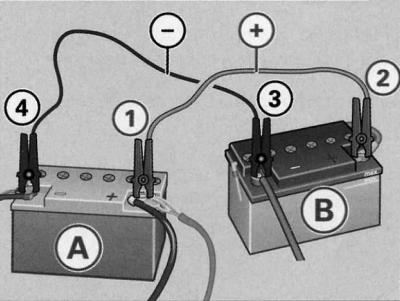
Jump starting the engine from another car's battery

  • A - Discharged battery
  • B - Current-coupling battery

Connecting the negative terminals with a negative cable (black)


1. Secure one end of the cable to the negative terminal (3) of the current-conducting battery (B).

2. The other end of the cable is connected to the negative terminal (4) of the discharged battery (A).

Starting the engine


1. Start the engine of the current-carrying vehicle. The engine remains idling.

2. Start the engine of the car with a discharged battery.

3. If the engine does not start, stop trying to start after 10 seconds and repeat the starting process after 30 seconds.

4. When the engine starts, disconnect both cables, acting strictly in reverse order.

Your car battery is equipped with an external ventilation system. The gas formed in the battery is thereby removed from the car. Ensure that the connected terminal clamps have sufficient metallic contact.


This sequence of connecting auxiliary cables is used to start your car. If your battery is used to start the engine of another car, the negative cable (-) is connected not to the negative terminal of the discharged battery (4), but to a massive part firmly screwed to the engine block or to the block itself. If there is no ventilation of the discharged battery, explosive detonating gas accumulates.

The original article is posted on the resource AudiManual.ru
The article was checked by auto expert Elisey Ermolaev
This article is available at russian, bulgarian, belarusian, ukrainian, serbian, croatian, romanian, polish, slovak, hungarian

Share information:
Previous articles
Audi A4 B6: Vehicle Description
Next articles

Vehicle specifications and dimensions
Troubleshooting
Automotive chemicals, oils and lubricants
Jacking and towing


Similar articles on other Audi car models:
Starting the engine from an external battery Audi 80 B2 (1979-1986)
Starting an engine with a dead battery Audi 100 C4 (1990-1994, petrol)
Starting the engine from an auxiliary power source Audi A3 Type 8L (1996-2003)
Starting the engine using an auxiliary battery Audi A6 C5 Allroad (1999-2005)
Starting the engine Audi A8 D2 (1994-2002)
Starting the engine from an auxiliary power source Audi Q7 Typ 4L (2005-2015, diesel)
Teiematik — replacement of emergency battery Audi A2 (1999-2005)
Link to this page in different formats


Visitor comments

No comments yet


How much will 44 + 22 =


A4(B8, 2007-2015) 
  • General information
  • Operating instructions
  • Power unit
  • Petrol engines 1.8 l
  • Petrol engines 1.8/2.0 l
  • Petrol engines 3.0 l
  • Petrol engines 3.2 l
  • Fuel system (petrol)
  • Diesel engines 2.0 l (CA*)
  • Diesel engines 2.0 l (CJCB)
  • Diesel engines 2.7/3.0 l
  • Diesel engines 3.0 l
  • Fuel system (diesel)
  • Transmission
  • Manual gearbox 0B1
  • Manual gearbox 0B2
  • Manual gearbox 0B3
  • Manual gearbox 0B4
  • Automatic transmission 0B5
  • Automatic transmission 0B6
  • Automatic transmission 0AW
  • All-wheel drive system
  • Chassis
  • Front suspension
  • Rear suspension
  • Brake system
  • Steering system
  • Body
  • Exterior
  • Interior
  • Seats
  • Doors, locks and windows
  • Security system
  • Heating and air conditioning
  • Electrical equipment
  • Audio system
  • Power devices
  • Equipment and devices
  • Lighting and lamps
  • Electrical circuits
 
A4(B7, 2004-2008) 
  • General information
  • Introduction to manual
  • Troubleshooting
  • Operating instructions
  • Maintenance
  • Power unit
  • Petrol engines 2.0 (ALT)
  • Petrol engines 2.0 (TFSI)
  • Petrol engines 1.8 (MPI)
  • Diesel engines
  • Cooling system
  • Air conditioner
  • Fuel and exhaust system
  • Ignition system
  • Starting and charging
  • Transmission
  • Clutch
  • Manual gearbox
  • Automatic gearbox
  • Drive shafts
  • Chassis
  • Brake system
  • Front suspension
  • Rear suspension
  • Steering
  • Body
  • Exterior
  • Interior
  • Electrical equipment
  • Equipment and devices
  • Lighting and signaling
  • Windscreen wipers and washers
  • Electrical diagrams
  • Electrical diagrams (since 2007)
 
A4(B6, 2000-2006) 
  • General information
  • Vehicle Description
  • User manual
  • Maintenance
  • Power unit
  • Gasoline engine
  • Diesel engine
  • Lubrication system
  • Cooling system
  • Supply system
  • Injection system
  • Exhaust system
  • Ignition and control
  • Transmission
  • Gear box
  • Clutch and drive shafts
  • Chassis
  • Brake system
  • Car suspension
  • Steering
  • Body
  • Heating and ventilation
  • Exterior (external elements)
  • Interior (internal elements)
  • Electrical equipment
  • Power devices
  • Lighting and appliances
  • Electrical circuits
 
A4(B6, 2000-2006, petrol) 
  • General information
  • Introduction to the guide
  • Car care
  • Power unit
  • Engine repair
  • Lubrication system
  • Cooling system
  • Injection and control system
  • Ignition system
  • Power and exhaust system
  • Transmission
  • Clutch and drive shafts
  • Car gearbox
  • Chassis
  • Suspension and wheels
  • Steering
  • Brake system
  • Body
  • Interior
  • Exterior
  • Electrical equipment
  • Equipment and devices
  • Lighting and signaling
  • Power devices
  • Electrical circuits
 
A4(B5, 1994-2001) 
  • General information
  • Introduction to the guide
  • Car care
  • Maintenance (gasoline)
  • Maintenance (diesel)
  • Power unit
  • Gasoline engines
  • Diesel engines
  • Engine overhaul
  • Cooling system
  • Fuel injection (gasoline)
  • Fuel system (diesel)
  • Exhaust system
  • Ignition system
  • Transmission
  • Clutch
  • Mechanical gearbox
  • Automatic gearbox
  • Drive shafts
  • Chassis
  • Brake system
  • Car suspension
  • Steering
  • Body
  • Exterior
  • Interior
  • Doors, locks and windows
  • Heating and ventilation
  • Electrical equipment
  • Power devices
  • Equipment and devices
  • Electrical circuits
 
A4(B5, 1994-2001, petrol) 
  • General information
  • Vehicle description
  • Maintenance
  • Power unit
  • Engine repair
  • Turbocharging
  • Exhaust system
  • Cooling system
  • Ignition system
  • Fuel system
  • Motronic injection system
  • MPI and MPFI injection system
  • Transmission
  • Clutch
  • Gearbox and shafts
  • Chassis
  • Steering
  • Car suspension
  • Brake system
  • Wheels and tires
  • Body
  • Heating and ventilation
  • Body parts
  • Electrical equipment
  • Fuses and relays
  • Power devices
  • Lighting and lamps
  • Tools and devices
  • Electrical circuits
 
AudiManual.ru © 2017-2026 · Mobile version · Feedback · Sitemap: EN BG BY UA RS HR RO PL SK HU · Site search · News and articles
80 B2 · 80 B3 petrol · 80 B3 · 80 B4 · 100 C3 diesel · 100 C3 petrol · 100 C3 · 100 C4 petrol · 100 C4 · A3 Type 8L · A4 B5 petrol · A4 B5 · A4 B6 petrol · A4 B6 · A4 B7 · A4 B8 · A6 C4 · A6 C5 · A6 C5 Allroad · A8 D2 · Q5 Type 8R · Q7 Typ 4L · Audi A2 ·
This site uses cookies 🍪. Click the button to accept this fact.