



Table of contents: Economically and environmentally… ↓ Technical conditions ↓ Driving on bad roads ↓ Braking ↓ Anti-lock brake system (ABS) ↓ Electronic Differential Lock (EDS)* ↓ Anti-Slip Regulation (ASR)* ↓ Electronic Stability Program (ESP)* ↓ All-wheel drive (quattro)* ↓ Driving on dirt roads ↓ Winter tires ↓ Application of anti-skid chains ↓
Economically and environmentally optimal driving
Fuel consumption, environmental pollution, engine, brake and tire wear are affected by various factors.
Driving style largely determines fuel economy, emissions and noise levels.
Do not warm up the engine by idling.
Warming up at idle takes a lot of time. And it is at the warm-up stage that the intensity of engine wear and the level of toxic emissions are especially high. Therefore, as soon as the engine starts, immediately start driving, while avoiding high revs.
Avoid accelerating with the accelerator pedal fully depressed.
By precisely dosing the pressure on the pedal, you can significantly reduce fuel consumption, while simultaneously reducing environmental pollution and the intensity of wear of rubbing parts.
When driving, avoid uselessly high revs. Shift up as early as possible and downshift only when otherwise the engine may malfunction.
For example, fuel consumption in 2nd gear is more than twice as high as when driving in the highest gear. At the same time, due to the reduction in engine speed, its noise level decreases.
If possible, do not exceed maximum speed.
As speed increases, fuel consumption, emissions and noise levels increase disproportionately.
The movement should be as smooth as possible, based on the ability to anticipate the situation on the road.
Useless maneuvering with acceleration and braking is paid for by increased fuel consumption and environmental pollution.
Turn off the engine when traveling due to traffic conditions.
Specific operating conditions also affect fuel consumption.
For example, the following situations are unfavorable in terms of fuel consumption:
High traffic intensity, especially on the streets of large cities, with numerous traffic lights.
Driving with frequent stops, starting and warming up the engine before each subsequent trip.
Driving in a column in low gears, with a relatively high number of engine revolutions per unit of distance traveled.
When planning your trips in advance, avoid stop-and-go traffic, convoys, and similar situations whenever possible.
Of course, fuel consumption also depends on factors that the driver cannot influence. It is normal, for example, if consumption increases in winter or when operating in difficult conditions (poor road conditions, driving with a trailer, etc.).
Technical conditions
economical fuel consumption and economy are incorporated into the car during its development and production. Particular importance was attached to reducing environmental pollution. For optimal implementation and preservation of these qualities, follow the recommendations below:
Perform scheduled maintenance according to the maintenance plan
Maintenance according to plan ensures not only constant operational readiness, but also economy, reduced environmental pollution and durability.
Check your tire pressure every 4 weeks.
When the pressure drops below the norm, rolling resistance increases. As a result, not only fuel consumption increases, but tire wear accelerates. At the same time, the dynamic properties of the car deteriorate.
Don't carry useless ballast in your trunk.
Especially when driving in the city, when there is a need for frequent conversations, the weight of the car significantly affects fuel consumption.
Remove the roof rack immediately after use.
Particularly at high speeds, fuel consumption increases due to increased aerodynamic drag.
Turn on current consumers only if it is really necessary.
The rear window heating, additional lights, heater fan and air conditioning* are characterized by significant power consumption. The corresponding increase in the load on the generator increases fuel consumption.
Monitor your fuel consumption regularly.
Check fuel consumption at every refueling. This will allow you to promptly identify problems that lead to its overconsumption.
Check the oil level when refueling.
Oil consumption depends significantly on the load and engine speed.
It is possible to accurately judge oil consumption only after the first 5,000 km.
The same applies to fuel consumption and engine power.
The normal operation of the catalytic converter of the exhaust gases is a decisive condition for the operation of the vehicle.
Therefore, it is essential to comply with the following rules:
Use only unleaded fuel in vehicles with a catalytic converter.
Even a single fill with leaded gasoline leads to a deterioration in the converter's performance.
If the vehicle has been running on unleaded fuel, be sure to replace the catalytic converter.
Never run the fuel tank empty on a vehicle with a catalytic converter.
A fuel supply failure can cause misfires. This allows unburned fuel to enter the exhaust system. This can cause the catalytic converter to overheat and become damaged.
If misfiring, loss of power and uneven engine operation occur while driving, the cause may be a malfunction in the ignition system. In this case, unburned fuel may enter the exhaust system and from there into the atmosphere. In addition, the catalytic converter may fail due to overheating. Reduce speed immediately and have the malfunction repaired at the nearest Audi service station.
Do not overfill the engine with oil above the maximum mark.
Do not tow the vehicle for the purpose of starting the engine for a distance greater than 50 m.
When leaving your car in a parking lot, remember the following:
Warning: Because the catalytic converter becomes very hot, do not park the vehicle on dry leaves or other flammable materials.
Driving on bad roads
To avoid damage to your vehicle, remember the following:
When driving onto a platform, curbstone, driving on bad roads, etc., make sure that the components and parts located under the bottom, for example, the spoiler and exhaust pipe, are not damaged.
This is especially true for vehicles with low suspension (sports version) and when the vehicle is fully loaded.
Braking
New brake pads need to be worn in and therefore do not provide optimal braking for the first 400 km after replacement. The reduction in braking efficiency is compensated by a corresponding increase in the force on the brake pedal.
During the running-in period, avoid heavy braking, especially at very high speeds, as well as braking on steep ascents and descents (for example, passes).
Under certain operating conditions, such as driving through water, in heavy rain or after washing, the braking effect may be reduced due to moisture, and in winter even icing of the brake pads or discs may occur. In this case, dry the brakes by light braking. Reduced braking effect is also possible after a long break in using the brakes when driving on roads sprinkled with salt. First of all, remove the layer of salt from the brake discs and pads by light braking.
The appearance of corrosion of brake discs and contamination of linings is facilitated by prolonged idle time of the car, low mileage and low loads of the brake system.
In case of prolonged low load of the brake system, as well as in case of corrosion, in order to restore smooth operation of the brakes, it is recommended to clean the brake discs and pads by sufficiently strong repeated braking at an average vehicle speed.
This braking should only be carried out under favourable road conditions and provided that it does not pose a danger to other road users.
A sudden increase in the brake pedal travel is possible if one of the circuits of the dual-circuit brake system fails. In this case, you should slowly move to the nearest Audi service station, taking into account the increase in the force on the brake pedal and the braking distance.
Check the brake fluid level regularly.
A drop in the fluid level below the norm is indicated by the lighting of the brake system indicator lamp or the indication of the vehicle's fault monitoring system* (refer to the subsection Control and measuring devices. Warning and diagnostic systems).
Brake booster
The brake booster only works when there is a vacuum created by the engine running. Therefore, never allow the vehicle to coast with the engine off.
When the brake booster does not work, for example because it is damaged or the vehicle needs to be towed, the force on the brake pedal must be much greater in order to compensate for the missing boost effect.
Use of additional mats under the driver's feet
The use of the pedals must never be obstructed by anything. Therefore, no objects should be placed under your feet that could slide under the pedals.
If the brake system is faulty, it may be necessary to increase the pedal travel to achieve braking.
It must be possible to fully depress the clutch and accelerator pedals at any time.
It must be possible to return all pedals to their original position without hindrance.
There should also be no foot mats or other additional floor covering items in the pedal area.
Therefore, only mats that do not extend into the pedal area and that can be secured to prevent them from shifting are permitted for use.
Warning: Under no circumstances should any objects be placed in the footwell, as they could end up in the pedal area during sudden maneuvering or braking, making it impossible to operate the brake, clutch or accelerator pedals!
Anti-lock brake system (ABS)
ABS significantly contributes to the increased safety efficiency of the vehicle. The decisive advantage of a brake system with ABS compared to a conventional system is that the wheels do not lock even during emergency braking on a slippery road. Thanks to this, the vehicle's controllability and stability are maintained to the maximum extent.
However, you cannot count on the fact that the braking distance will be shorter under all circumstances thanks to ABS. When driving on gravel or freshly fallen snow lying on a slippery road, when it is already necessary to drive extremely carefully and at a minimum speed, the braking distance may even increase slightly.
Operating principle of ABS
When the vehicle reaches a speed of approximately 6 km/h, an automatic control process occurs. The noise of the pump can be heard.
If a wheel tends to lock, the pressure in the brake drive of that wheel decreases. This regulation process is noticeable by the pulsation of the brake pedal and is accompanied by characteristic noise manifestations. Thus, the driver is specifically given a warning signal about the operation of one or more wheels in a mode close to skidding. To ensure the optimal effect of regulation in this mode by means of ABS, keep the brake pedal pressed, and under no circumstances brake in several pumps!
Warning: No ABS can go beyond the limits of what is physically possible. Keep this in mind, especially on slippery or wet roads. At the first signs of wheel slippage, immediately reduce speed in accordance with the traffic situation.
Increased security must not create dangerous risks.
A malfunction of the anti-lock brake system is indicated by a warning light - contact subsection Control and measuring devices. Warning and diagnostic systems.
Electronic Differential Lock (EDS)*
EDS works together with ABS. EDS operates automatically – i.e. without driver intervention.
Using sensors, ABS controls the speed of the drive wheels up to a speed of about 40 km/h (front wheel drive) or 80 km/h (all wheel drive).
ABS brakes slipping wheels (for example, on a slippery road surface), and increased torque is transmitted to the wheels with better traction.
The following recommendations must be followed:
When starting off, press the accelerator pedal according to the road conditions. When the wheel slips (for example, one wheel on ice) press the accelerator pedal so that the car starts moving.
When accelerating on a road that is equally slippery across the entire width, for example in ice and snow, press the accelerator pedal carefully. Particularly on front-wheel drive vehicles, there is a risk of the drive wheels slipping despite the EDS, and thus the stability of the vehicle is impaired.
EDS is switched off for a short time to prevent the disc brake of the braking wheel from overheating under unusually high load. At the same time, the car is ready for use and has the same dynamic properties as a car without EDS.
Warning: The driving mode must be adapted to the road conditions and traffic situation. The increased driving safety provided by EDS must not cause a dangerous risk!
Anti-Slip Regulation (ASR)*
ASR prevents the drive wheels from slipping when starting off and accelerating by reducing engine torque.
ASR works together with ABS in the entire speed range. If ABS fails, ASR will not work either.
ASR is switched on automatically when the engine is started. If necessary, it can be switched on and off by pressing the key in the row of switches - refer to the subsection Switches and switches.
When the system is disabled, the ASR indicator lamp lights up. Refer to the subsection Control and measuring devices. Warning and diagnostic systems.
Normally, ASR should always be switched on. Only in certain exceptional cases, when slippage is necessary, should it be switched off, namely:
- when driving with the emergency wheel installed*
- when driving with snow chains
- when driving on deep snow or loose ground
- when trying to get out by rocking after getting stuck, and also
- when entering hills with extremely different degrees of adhesion of the drive wheels (for example, there is ice under the left wheel, and dry asphalt under the right one).
After this, turn on the device again.
Warning: The driving mode must be adapted to the road conditions and traffic situation. The increased driving safety provided by ASR must not cause a dangerous risk!
Warning: To ensure trouble-free operation of the ASR, the same tires must be installed on all four wheels of the vehicle. Using different tires may result in a reduction in engine power.
Electronic Stability Program (ESP)*
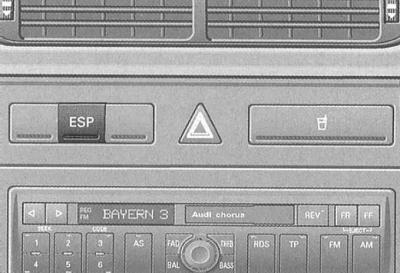
ESP improves the effectiveness of control over the vehicle's driving dynamics in unusual situations, such as when accelerating and cornering.
ESP expands the functions of ABS/ASR and reduces the risk of skidding under all driving conditions. This improves the vehicle's stability while driving.
ESP works in combination with ABS in the entire speed range. If ABS fails, ESP will not work either.
ESP is activated automatically when the engine is started and carries out self-diagnostics.
If necessary, ESP can be switched on and off by pressing the (ESP) key.
When the ESP is disabled, its indicator lamp lights up. Refer to the subsection Control and measuring devices. Warning and diagnostic systems.
Normally, ESP should always be switched on. Only in certain exceptional cases, when slippage is necessary, should it be switched off, namely:
- when driving on deep snow or loose ground
- when trying to get out of a rocking motion after getting stuck.
After this, turn the ESP back on.
When ESP is disabled, ABS and EDS remain in operating mode.
Operating principle
The electronic stability program includes ABS, EDS and ASR. Along with the data obtained from these devices, the ESP control unit requires additional parameters obtained using highly sensitive sensors. The vehicle's rotation speed around its vertical axis, lateral acceleration, brake pressure and steering angle are measured.
The driver's intended direction of travel is determined by the angle of rotation of the wheels and the speed of the vehicle, which is continuously compared with the actual operating mode of the vehicle. In case of discrepancies, for example, the beginning of a skid, the ESP automatically brakes the corresponding wheel.
As a result of the effective forces acting on the wheel during braking, the vehicle is stabilized. If the rear axle of the vehicle tends to skid, the braking force acts mainly on the outer front wheel relative to the turning center. If the front of the vehicle tends to skid, the rear wheel closest to the turning center is braked. ESP operation is accompanied by noise.
Warning: No ESP can go beyond the limits of what is physically possible. Remember this, especially on slippery or wet roads.
The driving mode must correspond to the road conditions and the traffic situation. The increased safety provided by ESP must not provoke a dangerous risk!
All-wheel drive (quattro)*
Your car's all-wheel drive operates automatically.
Torque is distributed automatically, in optimal accordance with the vehicle's driving dynamics and specific road conditions.
Thanks to the all-wheel drive configuration, designed to take advantage of the engine's high power, your Audi is an extremely efficient vehicle with excellent driving characteristics, both under normal road conditions and in extreme conditions, such as snow or ice.
Be sure to follow these safety rules:
Warning: The driving mode must correspond to the road conditions and the specific traffic situation. The increased safety level of the models with all-wheel drive and ABS must not provoke a dangerous risk!
Braking capabilities are limited by the tires' grip on the road and are no different from the braking capabilities of a two-wheel drive vehicle.
Therefore, high acceleration dynamics, which are maintained even on slippery surfaces, should never provoke the abuse of high speeds.
When driving on wet roads, remember that if you drive too fast, you may float (aquaplaning) front wheels. However, unlike front-wheel drive vehicles, the onset of surfacing is not characterized by a sudden increase in engine speed. Therefore, avoid excessively high speeds, choosing them in accordance with specific road conditions.
Driving on dirt roads
The Audi is not a cross-country vehicle. The ground clearance is too low for that.
Winter tires
All-wheel drive vehicles, even with standard tires, have good traction and dynamic qualities in winter conditions. However, to improve driving performance and increase braking efficiency, install winter tires or all-weather tires on all four wheels. See also the subsection Checking the condition of tires and pressure in them. Designation of tires and wheel disks.
Application of anti-skid chains
The rules requiring the use of snow chains also apply to all-wheel drive vehicles. More detailed information on the use of snow chains is provided in the subsection Wheel rotation and replacement. Anti-skid chains.
[The original article is located on the online resource: AUDIMANUAL.ru]