



Table of contents: Checking glow plugs ↓ Checking current consumption ↓ Checking glow plugs ↓ Checking the glow plug relay ↓ Glow plugs with burnt electrodes ↓
Checking glow plugs
Note: First check the spark plug fuse plate for damage (cracks), tightness of fit and reliability of contacts, if necessary clean the contacts, tighten the bolts or replace the fuse. The fuse plate is located in the relay box.
Test condition: engine cold (ambient air temperature), the battery is fully charged, the battery voltage is at least 11.5 V.
Checking current consumption
To check the current consumption of a single spark plug, an indirect ammeter is used in the workshop. The probe is connected to an insulated wire and measures the current value by induction.
Connect the probe, if available, to the glow plug wire.
Disconnect the engine temperature sensor.
1.6L Engine:
Turn on the ignition, preheat the engine for at least 15 seconds and measure the current consumption. It should be 48 A.
Note: Current consumption after stabilization is 12 A per spark plug. If current consumption is:
- 36 A - 1 spark plug is faulty,
- 24 A - two,
- 12 A— three,
- 0 A—all spark plugs are faulty.
1.9L Engine:
Warm up, start the engine and let it idle.
During the heating operation (120 seconds) measure the current consumption when the engine is running.
- Should be 40A
- At 30 A - 1 spark plug is faulty.
- At 20 A - 2 spark plugs are faulty.
- At 30 A - 3 spark plugs are faulty.
- At 30 A, all spark plugs are faulty.
Checking glow plugs
Remove the connection cable and the spark plug current bus.
Connect the voltage tester to the positive terminal of the battery and connect it to each spark plug in turn.
If the LED lights up, the spark plug is OK.
If the LED does not light up, the spark plug is faulty, replace it. Tightening force: 30 Nm.
Caution: The tightening force must not be exceeded, otherwise the ring between the glow plug and the threaded part will be crushed and the spark plug will fail prematurely.
Connect the current cable.
Connect the temperature sensor cable.
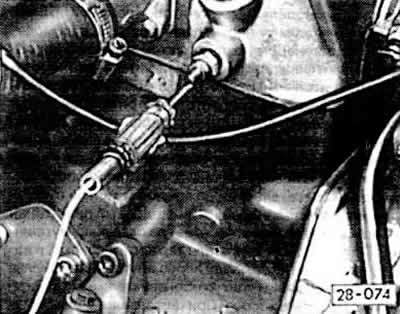
Note: If no faults are found, but the engine starts poorly, visually check the spark plugs with the heater off. To do this, remove the injectors and inspect the spark plugs through the holes.
Checking the glow plug relay
Remove relay #10 in the relay box.
Connect a voltage tester to terminal 30 (terminal 48 in the relay socket) and ground. The LED should light up, otherwise replace the relay board.
Connect a voltage tester to terminal 15 (terminal 46 in the relay socket) and ground. Turn on the ignition. The LED should light up, otherwise replace the relay board.
If the LED is on, check the red/white wire from the spark plugs to the relay board for a break, replace if necessary. Otherwise, replace the relay.
Glow plugs with burnt electrodes
The reason for the burning of glow plug electrodes is often a faulty injector.
If glow plugs with such damage are found -arrow-, then you cannot limit yourself to just replacing them. It is necessary to check the injectors for injection pressure and tightness.
In this case, special attention should be paid to the fact that the jet is short and fast in short strokes (4-6 cycles/sec) was interrupted and sprayed well.