
Repair Chevrolet Repair Toyota Repair Honda Repair AvtoVAZ Repair Mercedes-Benz Repair BMW Repair Opel
Home  |  Contacts  |  Sitemap  |    
English Русский
Български
Беларускі
Український
Српски
Hrvatski
Română
Polski
Slovenský
Magyar
AudiManual.ru


  • AUDI 80
  • AUDI 100
  • AUDI A3
  • AUDI A4
  • AUDI A6
  • AUDI A8
  • AUDI Q
  • OTHER
  • ARTICLES
Q7 Typ 4L (2005-2015, diesel) Q5 Type 8R (2008-2017)

Removal an outer CV joint with a diameter of 89 or 94 mm (Audi Q5-8R)

  • Home
  • Audi Q
  • Q5 Type 8R (2008-2017)
  • Chassis
  • Rear suspension
  • Removal an outer CV joint with a diameter of 89 or 94 mm
            0
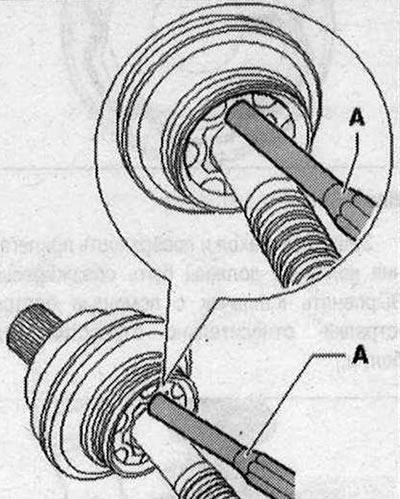
Clamp the drive shaft in a vice with protective jaw pads. Loosen the clamps. Move the joint boot back. Remove the CV joint from the drive shaft using mandrel "A". Install mandrel "A" exactly on the CV joint sprocket. If there is a disc spring, remove it.

Clamp the drive shaft in a vice with protective jaw pads. Loosen the clamps. Move the joint boot…


Remove the joint and joint boot. Remove the retaining ring "1".
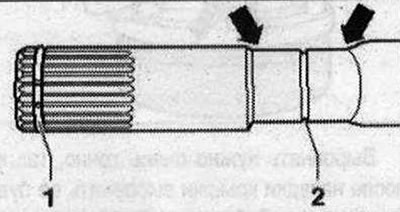
Remove the joint and joint boot. Remove the retaining ring «1».


Installing an outer CV joint with a diameter of 89 mm or 94 mm: Install the joint boot with a new clamp on the drive shaft. There should be no grease on the joint boot and the drive shaft. Install the joint boot between the "arrows" in the groove "2".
  • 1. Always replace the retaining ring (lock ring).
  • 2. Centering groove, push the joint boot so that it is fixed in the groove.

If present, properly install the disc spring onto the drive shaft.
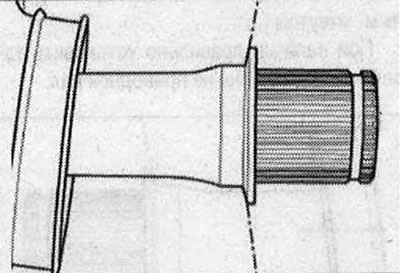


If present, properly install the disc spring onto the drive shaft.


Outer CV joint with a diameter of 89 mm: Insert into the joint and evenly distribute 70 g of consistent grease inside.

Outer CV joint with a diameter of 94 mm: Insert into the joint and evenly distribute 80 g of consistent grease inside.

All


Before installing the joint, the teeth "A" must be coated with a thin layer of grease used for the joint. Insert the retaining ring into the groove of the shaft.
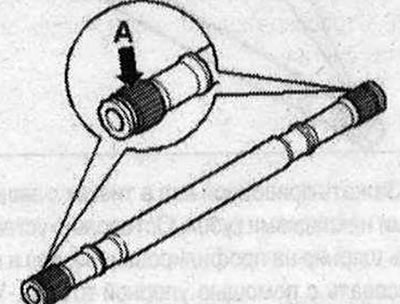
Before installing the joint, the teeth «A» must be coated with a thin layer of grease used for the…


Slide the constant velocity joint up to the retaining ring. Align the retaining ring with the hole facing up and in the center "see arrows".
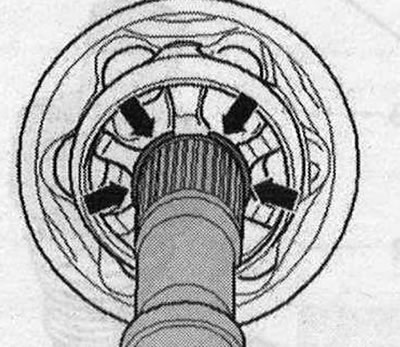
Slide the constant velocity joint up to the retaining ring. Align the retaining ring with the hole…


Screw the old bolt into the hinge as shown in the picture.
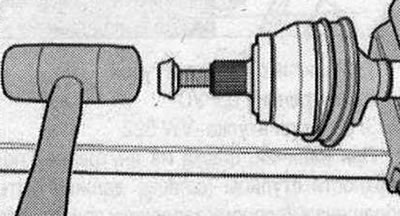


Screw the old bolt into the hinge as shown in the picture.


Tap the joint onto the drive shaft with a plastic hammer until the locking ring snaps into place. Install the boot onto the steel cap. Release air from the protective boot of the joint. Press the clamp onto the outer joint. Press the clamp onto the outer joint. Install and press the stainless steel clamps using crimping pliers "V.A.G 1682", as shown in the figure.
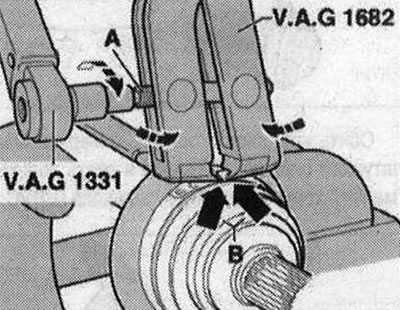
Tap the joint onto the drive shaft with a plastic hammer until the locking ring snaps into place.…


In doing so, make sure that the jaws of the pliers fit tightly against the corners of the "arrow B" of the clamp. Tighten the clamp by turning the lead screw with a torque wrench (do not tilt the pliers). Due to the rigidity of the material (compared to rubber) boot and the need to use a stainless steel clamp for this reason, it can only be crimped with crimping pliers "V.A.G 1682". Tightening torque: 20 Nm. Use a torque wrench with an adjustment range of 5...50 Nm (e.g "V.A.G 1331"). Check the ease of movement of the lead screw thread of pliers "A". If necessary, apply MoS2 grease. If rotation is difficult, for example due to contamination of the thread, the required clamping force is not achieved at the specified tightening torque. Install and crimp the clamps with locking tongues using pliers "3340", as shown in the figure. Fasten the clamp to the first tongue by hand. Squeeze the clamp using pliers "3340".
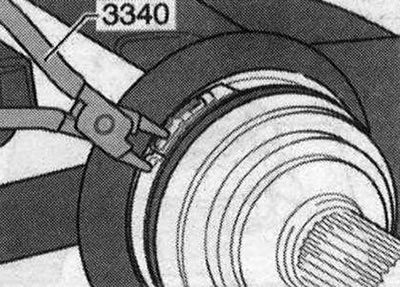
In doing so, make sure that the jaws of the pliers fit tightly against the corners of the «arrow B»…


(The original text of the material can be found on the website «AUDIMANUAL.RU»)
The article was checked by auto expert Timur Bazhenov
This article is available at russian, bulgarian, belarusian, ukrainian, serbian, croatian, romanian, polish, slovak, hungarian

Share information:
Previous articles
Audi Q Q5 Type 8R: Rear suspension
Next articles

Removal the drive shaft
Removal the wheel bearing assembly
Removal the hub bearing housing
Steering knuckle, wheel bearing module, shock absorber,…
Removal an inner CV joint with a diameter of 100 or 107 mm
Disassembly and assembly of CV joints
Tire Pressure Monitoring System (TPMS)
Tire pressure sensor


Similar articles on other Audi car models:
Removal and installation the outer joint of the wheel drive shaft Audi 80 B2 (1979-1986)
Removal and installation the outer joint of the front wheel… Audi 100 C3 (1982-1990, petrol)
Removal, checking and installation the ball joint Audi A3 Type 8L (1996-2003)
Constant velocity joint outer — repair and inspection Audi A4 B8 (2007-2015)
Removal and installation the timing belt — Diesel engine… Audi A6 C5 (1997-2004)
Removal and installation the outer joint of the drive shaft Audi A8 D2 (1994-2002)
Removal and installation the outer seal of the front door Audi A2 (1999-2005)
Link to this page in different formats


Visitor comments

No comments yet


How much will 38 + 16 =


Q7 4L(2005-2015, diesel) 
  • General information
  • Operating instructions
  • Maintenance
  • Power unit
  • Diesels 3.0 l (BUG, BUN, CAS)
  • Diesels 3.0 l (CATA, CCMA)
  • Diesels 3.0 l (CJGA/CJGC)
  • Diesels 4.2 l (BTR, CCFA/CCFC)
  • Cooling system
  • Fuel and exhaust system
  • Engine management system
  • Starting and charging
  • Transmission
  • Automatic gearbox
  • Drive shafts
  • Chassis
  • Brake system
  • Front suspension
  • Rear suspension
  • Steering system
  • Body
  • Air conditioner
  • Exterior
  • Interior
  • Electrical equipment
  • Equipment and devices
  • Electrical circuits
 
Q5 8R(2008-2017) 
  • General information
  • User manual
  • Power unit
  • Petrol engine 2.0 l
  • Petrol engine 3.2 l
  • Fuel system (petrol)
  • Diesel 2.0 liter (CA)
  • Diesel 2.0 liter (CG/CJ/CM)
  • Diesel engine 3.0 l
  • Fuel system (diesel)
  • Transmission
  • Manual gearbox 0B1
  • Manual gearbox 0B2
  • Automatic gearbox 0B5
  • Automatic gearbox 0B6
  • Chassis
  • Front suspension
  • Rear suspension
  • Brake system
  • Steering
  • Body
  • Exterior
  • Interior
  • Doors, locks and windows
  • Safety system
  • Ventilation and heating
  • Electrical equipment
  • Power devices
  • Equipment and devices
  • Lighting and alarm
  • Audio system
  • Electrical circuits
 
AudiManual.ru © 2017-2026 · Mobile version · Feedback · Sitemap: EN BG BY UA RS HR RO PL SK HU · Site search · News and articles
80 B2 · 80 B3 petrol · 80 B3 · 80 B4 · 100 C3 diesel · 100 C3 petrol · 100 C3 · 100 C4 petrol · 100 C4 · A3 Type 8L · A4 B5 petrol · A4 B5 · A4 B6 petrol · A4 B6 · A4 B7 · A4 B8 · A6 C4 · A6 C5 · A6 C5 Allroad · A8 D2 · Q5 Type 8R · Q7 Typ 4L · Audi A2 ·
This site uses cookies 🍪. Click the button to accept this fact.