
Repair Chevrolet Repair Toyota Repair Honda Repair AvtoVAZ Repair Mercedes-Benz Repair BMW Repair Opel
Home  |  Contacts  |  Sitemap  |    
English Русский
Български
Беларускі
Український
Српски
Hrvatski
Română
Polski
Slovenský
Magyar
AudiManual.ru


  • AUDI 80
  • AUDI 100
  • AUDI A3
  • AUDI A4
  • AUDI A6
  • AUDI A8
  • AUDI Q
  • OTHER
  • ARTICLES
C5 Allroad (1999-2005) C5 (1997-2004) C4 (1994-1997)

Special automatic transmission (4-cylinder engine) (Audi A6 C5)

  • Home
  • Audi A6
  • C5 (1997-2004)
  • Transmission
  • Car gearbox
  • Special automatic transmission (4-cylinder engine)
            0
Caution. The operations for removing and installing a special automatic transmission are similar to those for removing and installing a manual transmission and are given at the beginning of the chapter. In the following, only the operations related to the special automatic transmission in combination with a 4-cylinder engine are given.


Support the weight of the engine with a lifting device using the eyes attached to the cylinder head.

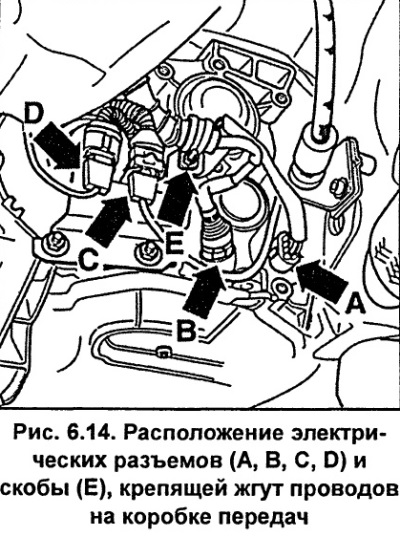
Mark connection points C and D (Fig. 6.14) and disconnect electrical connectors A to D from the gearbox.
Mark connection points C and D (Fig. 6.14) and disconnect electrical connectors A to D from the…


Unscrew the bracket E (Fig. 6.14) securing the wiring harness to the gearbox.

Unscrew the oil cooler pipes from the engine and gearbox.

Caution: To prevent dirt from getting into the pipes, wrap their ends with adhesive tape or close them with suitable plugs.


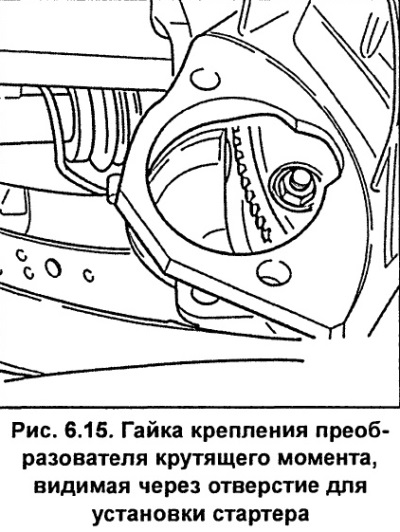
Unscrew the three torque converter mounting nuts (hydraulic transformer) to the drive disk. Using a wrench, turn the engine crankshaft clockwise by the crankshaft pulley mounting bolt to a position where one of the torque converter mounting nuts is accessible through the starter hole. Using a screwdriver or crowbar, secure the drive plate from turning by the flywheel ring gear teeth and unscrew the torque converter mounting nut. Turn the engine crankshaft and unscrew the remaining two nuts in the same way (see fig. 6.15).


Unscrew the three torque converter mounting nuts (hydraulic transformer) to the drive disk. Using a…


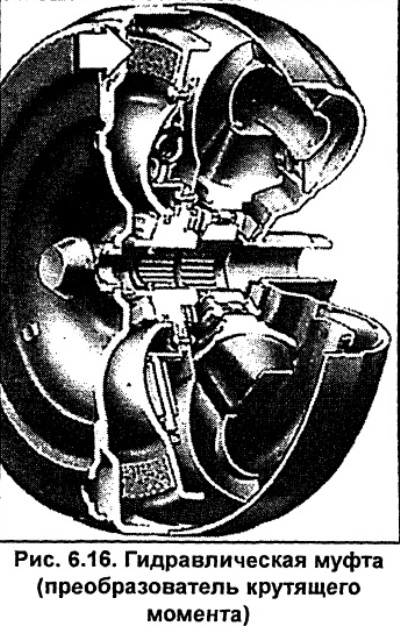
Note: The torque converter is located between the engine and the gearbox and is a hydraulic clutch (see fig. 6.16). A hydrodynamic coupling is used to transmit engine torque by means of a fluid circulating in their working cavity. This device compensates for the difference in engine and transmission speeds, and performs the transition from a stationary state to movement. A hydrodynamic coupling also allows increasing torque. The pump wheel of a hydraulic coupling converts mechanical energy received from the engine into hydraulic energy of the working fluid (ATF), and the reconversion back into mechanical energy occurs on the blades of the turbine wheel. The advantages of a hydraulic coupling include: stepless change in torque and speed, damping of torsional vibrations, absorption of peak moments and power transmission without noticeable wear.

Note: The torque converter is located between the engine and the gearbox and is a hydraulic clutch…


Set the selector lever to position "P" and, pulling up, disconnect the gearbox control cable from the shaft.


Remove the bolt securing the gearshift cable housing and remove the cable.

Move the transmission away from the engine while supporting the torque converter.

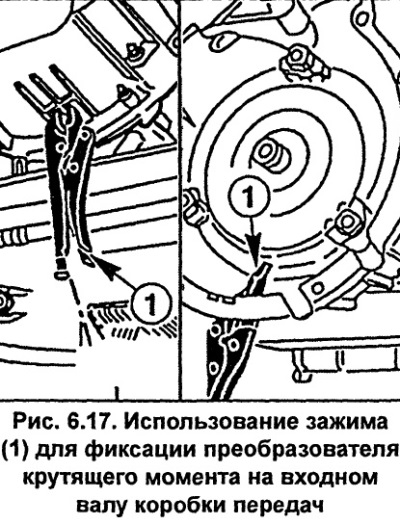
Move the torque converter along the input shaft to the transmission housing and use pliers to secure it in this position (see fig. 6.17).
Move the torque converter along the input shaft to the transmission housing and use pliers to…


Carefully lower the transmission and remove it from under the vehicle.

Installation


Remove the pliers holding the torque converter to the transmission input shaft.

Using three nuts, screw the torque converter to the drive plate and tighten the nuts to a torque of 85 Nm.

Screw in the gearbox mounting bolts to the engine and tighten them to the required torque (see fig. 6.18).
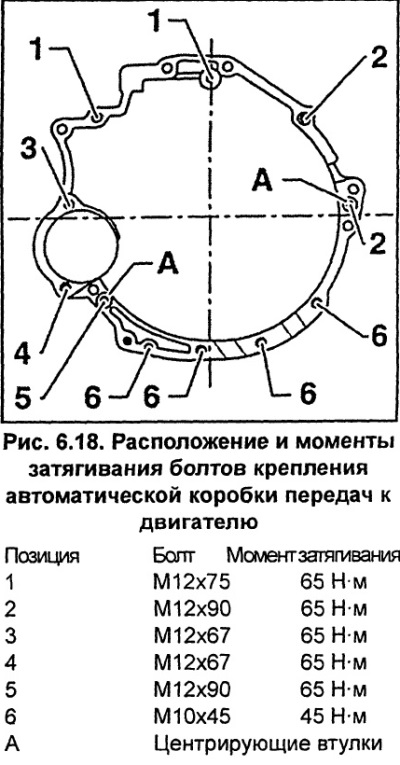
Screw in the gearbox mounting bolts to the engine and tighten them to the required torque (see fig.…


Check that the selector lever is in the "P" position and connect the transmission control cable to the transmission shaft.


Secure and, if necessary, adjust the transmission control cable.

Check the gearbox oil level and top it up if necessary.

(The text is based on materials from the website: AudiManual)
The article was checked by auto expert Alexey Ivanov
This article is available at russian, bulgarian, belarusian, ukrainian, serbian, croatian, romanian, polish, slovak, hungarian

Share information:
Previous articles
Audi A6 C5: Car gearbox
Next articles

Repair of manual transmission
Transmission
General information
Adjusting the gear shift mechanism


Similar articles on other Audi car models:
Vacuum Pump (with Automatic Transmission) — Removal and… Audi 80 B3 (1986-1991, petrol)
Flat gear transmission of a 6-cylinder gasoline engine Audi 100 C4 (1990-1994)
Automatic transmission Audi A3 Type 8L (1996-2003)
Automatic transmission (AT) Audi A4 B6 (2000-2006)
Automatic transmission Audi A8 D2 (1994-2002)
Gearbox removal — vehicles with 4-cylinder diesel engine Audi Q5 Type 8R (2008-2017)
Removal and installation the automatic transmission selector… Audi A2 (1999-2005)
Link to this page in different formats


Visitor comments

No comments yet


How much will 41 + 39 =


A6(C5 AR, 1999-2005) 
  • General information
  • User manual
  • Maintenance
  • Troubleshooting
  • Power unit
  • V6 petrol engines
  • V8 petrol engines
  • Diesel engines
  • Cooling and heating system
  • Injection system (gasoline)
  • Fuel system (diesel)
  • Supply system
  • Exhaust system
  • Ignition system
  • Transmission
  • Clutch
  • Mechanical gearbox
  • Automatic gearbox
  • Chassis
  • Brake system
  • Car suspension
  • Steering
  • Body
  • Body elements
  • Doors, locks and windows
  • Electrical equipment
  • Equipment and devices
  • Power devices
  • Electrical circuits
  • Schemes (petrol engine 2.7 l)
  • Schemes (petrol engine 4.2 l)
  • Schemes (diesel engine 2.5 l)
 
A6(C5, 1997-2004) 
  • General information
  • User manual
  • Maintenance
  • Power unit
  • Engine repair
  • Cooling system
  • Fuel system
  • Engine management
  • Fuel system (diesel)
  • Exhaust system
  • Transmission
  • Clutch
  • Car gearbox
  • Chassis
  • Front suspension
  • Rear suspension
  • Steering
  • Wheels and tires
  • Brake system
  • Body
  • Exterior
  • Interior
  • Electrical equipment
  • Air conditioner
  • Equipment and devices
  • Electrical circuits
 
A6(C4, 1994-1997) 
  • General information
  • User manual
  • Maintenance (gasoline)
  • Maintenance (Diesel)
  • Gasoline engines
  • 4 cylinder engines
  • 5 cylinder engines
  • 6 cylinder engines
  • Diesel engines
  • 4 cylinder engines
  • 5 cylinder engines
  • Engine repair
  • Removal and reassembly
  • Cooling system
  • Single point injection system
  • Multipoint injection system
  • MPI/MPFI injection system
  • Fuel system (diesel)
  • Exhaust system
  • Ignition system
  • Transmission
  • Clutch
  • Manual transmission
  • Automatic transmission
  • Drive shafts
  • Chassis
  • Brake system
  • Front suspension
  • Rear suspension
  • Steering
  • Body
  • Exterior (external elements)
  • Interior (internal elements)
  • Electrical equipment
  • Power devices
  • Lighting and appliances
  • Electrical circuits
 
AudiManual.ru © 2017-2026 · Mobile version · Feedback · Sitemap: EN BG BY UA RS HR RO PL SK HU · Site search · News and articles
80 B2 · 80 B3 petrol · 80 B3 · 80 B4 · 100 C3 diesel · 100 C3 petrol · 100 C3 · 100 C4 petrol · 100 C4 · A3 Type 8L · A4 B5 petrol · A4 B5 · A4 B6 petrol · A4 B6 · A4 B7 · A4 B8 · A6 C4 · A6 C5 · A6 C5 Allroad · A8 D2 · Q5 Type 8R · Q7 Typ 4L · Audi A2 ·
This site uses cookies 🍪. Click the button to accept this fact.