



Table of contents: Pumping is the main method… ↓ Bleeding using a one-way valve kit ↓ Bleeding using a pressure bleeding… ↓ All methods ↓
Warning: Brake fluid is poisonous. Some types of brake fluid are flammable. Brake fluid is hygroscopic.
Any hydraulic system can only work effectively after all the air has been removed from it. The process of removing air from the brake system is called bleeding. When bleeding, use only new, clean brake fluid. Before bleeding, fill the reservoir with brake fluid above the MAX mark and make sure that the brake fluid level does not fall below this mark.
On Audi 100 models not equipped with automatic rear suspension height adjustment, move the lever of the rear brake pressure control valve as close to the rear axle as possible and lock it in this position. Bleeding of the entire hydraulic system must be carried out in the following order with the engine running.
Audi 100 models with electronic differential lock:
- bleed valve on the hydraulic module of the locking system;
- right rear wheel brake;
- left rear wheel brake;
- right front wheel brake;
- left front wheel brake.
All other models:
- right rear wheel brake;
- left rear wheel brake;
- right front wheel brake;
- left front wheel brake.
Pumping is the main method (assistant needed)
1. Remove the plastic cap from the air release valve on the brake of the first wheel and put a rubber tube on it. Lower the other end of the tube into a container filled with brake fluid.
2. Check that the brake fluid level in the reservoir is above the MIN mark and ask an assistant to depress the brake pedal several times.
3. Unscrew the bleed valve (about half a turn), ask an assistant to slowly press the brake pedal and leave it pressed. Wait for the brake fluid to drain. When the fluid flow stops, close the valve, ask an assistant to slowly release the brake pedal and check the fluid level in the reservoir.
4. Repeat step 3 until there are no air bubbles in the escaping brake fluid.
5. Tighten the bleed valve securely, remove the tube and replace the cap.
6. Repeat the bleeding operation on the brakes of the remaining wheels in the required sequence.
Bleeding using a one-way valve kit
1. The rubber tube of such a kit has a one-way valve that prevents air and old brake fluid from getting back into the brake system. The kit may also include a container for collecting old brake fluid.
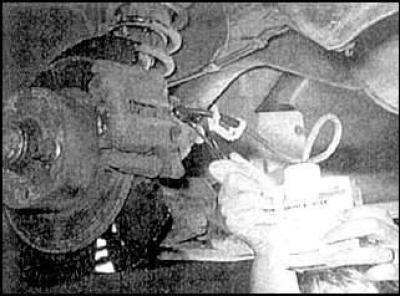
2. After connecting the kit to the bleeding valve, open the valve. Smoothly press the brake pedal and slowly release it. Repeat this operation until all air is removed from the brake system.
Bleeding using a pressure bleeding kit
With the pressure bleeding kit connected to the brake fluid reservoir, bleeding the system is as simple as opening the bleeder valves one at a time to drain the old brake fluid and release air.
All methods
After bleeding is complete, rinse off any spilled brake fluid, tighten the bleeder valves securely, and install the caps on them. Check the brake fluid level again.
[This article was previously published on the resource AUDIMANUAL.ru]