



Note: All chassis mounting bolts with rubber bushings attached should always be tightened with the suspension unloaded.
1. Rubber bushings can only be turned to a limited extent. Therefore, before tightening the bolts, the suspension parts with rubber bushings must be brought to a position corresponding to the normal position of the unloaded vehicle when driving. Otherwise, the bushings are subject to torsion and their service life is reduced. The unloaded position with the vehicle raised is achieved by lifting the corresponding part of the suspension with a transmission jack.
2. Before starting work, measure the distance with the vehicle unloaded (and in the illustration) from the center of the wheel to the lower edge of the wheel arch.
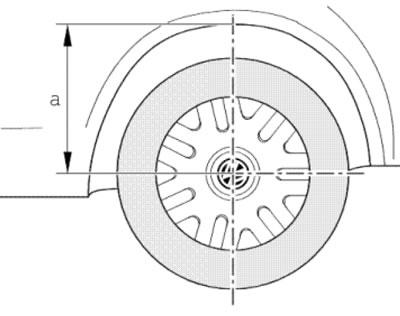
2.2. Distance from the wheel center to the lower edge of the wheel arch
3. Before lifting the car, secure it to the lift legs to prevent the car from slipping.
4. Turn the wheel hub so that one of the holes for the wheel bolts is at the top, and connect the T10149 support to the hub using a wheel bolt (see illustration).
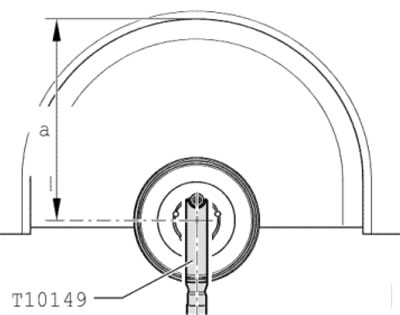
2.4. Unloaded position with the vehicle raised
5. Raise the wheel bearing holder on the transmission jack until the distance (and in illustration 2.4) corresponded to the distance (and in illustration 2.2). This will achieve an unloaded suspension position. Tighten the necessary fasteners, lower the wheel bearing holder and remove the support.