Repair Chevrolet Repair Toyota Repair Honda Repair AvtoVAZ Repair Mercedes-Benz Repair BMW Repair Opel
Home  |  Contacts  |  Sitemap  |    
English Русский
Български
Беларускі
Український
Српски
Hrvatski
Română
Polski
Slovenský
Magyar
AudiManual.ru


  • AUDI 80
  • AUDI 100
  • AUDI A3
  • AUDI A4
  • AUDI A6
  • AUDI A8
  • AUDI Q
  • OTHER
  • ARTICLES
B8 (2007-2015) B7 (2004-2008) B6 (2000-2006) B6 (2000-2006, petrol) B5 (1994-2001) B5 (1994-2001, petrol)

Checking the clutch hydraulics (Audi A4 B5)

  • Home
  • Audi A4
  • B5 (1994-2001, petrol)
  • Transmission
  • Clutch
  • Checking the clutch hydraulics
            0
Table of contents: Execution order ↓ Removal the clutch slave cylinder ↓ Removal the clutch master cylinder ↓ Bleeding the hydraulic clutch system ↓

The clutch control units are visible in the clutch bell of the dismantled engine
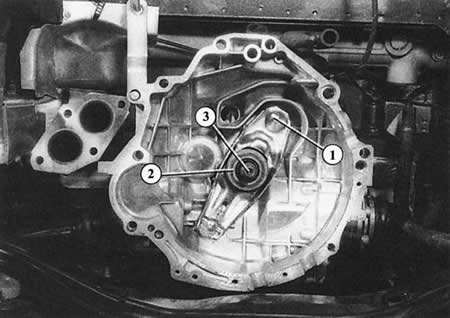


The clutch control units are visible in the clutch bell of the dismantled engine

  • 1 - off lever (the force of the clutch master cylinder acts on it);
  • 2 - release bearing;
  • 3 - gearbox input shaft.

3 - gearbox input shaft.


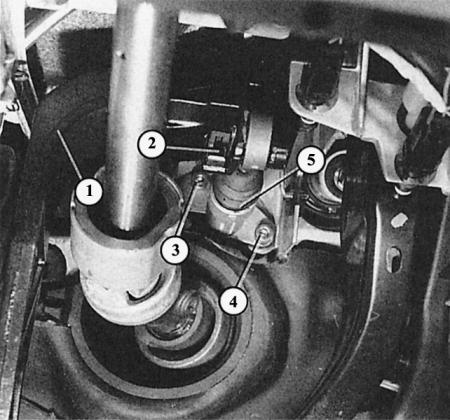
Above the clutch pedal (the lever is marked with the number "1"), the rubber cuff (5) of the clutch slave cylinder and both mounting bolts (3 and 4) are visible. The number "2" marks the locking clamp of the pivot pin, which must be removed during dismantling.

Execution order


1. If the clutch disengages properly, its hydraulic system is in order in any case.


2. But if it turns off poorly or the pedal falls without resistance, then air has probably entered the hydraulic system.

3. Simply bleeding the air will not help here - you need to find the leak and repair it. Now you can bleed the air from the system. Information about other causes of clutch failure can be found at the end of this chapter in the section Help with malfunctions.

4. For preventive inspection of the hydraulic clutch system, look for traces of brake fluid on the slave cylinder (at the top of the clutch pedal) and on the master cylinder (on the gearbox).

5. Oil-soaked clutch cylinders are leaky and must be replaced. Although the origin of the oily dirt on the master cylinder is difficult to determine without thoroughly cleaning this area.

Tip: The clutch hydraulics get their fluid from the brake fluid reservoir, but if there is a leak in this area, the brake system is not in danger. The fluid intake pipe for the clutch hydraulic system is located quite high on the reservoir, so there is always enough fluid left for the brakes.


Removal the clutch slave cylinder


1. Suck out as much liquid as possible from the expansion tank (using a large medical syringe).

2. Remove the instrument panel trim on the bottom left (chapter Salon).

3. Place an old rag under the working cylinder, disconnect the supply hose and allow the remaining fluid to drain into the rag.

4. From the engine compartment side, unscrew the pressure hose to the master cylinder.

5. Unscrew the two Allen bolts securing the slave cylinder.


6. Fold back the pivot pin retaining clamp (connection of the pedal and the working cylinder), squeeze your finger out.

7. Now you can remove the cylinder.

8. When installing a new cylinder, the rod pressing on the piston of the working cylinder must be adjusted so that the clutch pedal is approximately 10 mm higher than the brake pedal.

9. Be sure to check that the return spring presses the pedal properly. At the same time, the pedal in the resting position should not touch its bracket at the top. Otherwise, the piston of the working cylinder in the resting position will not be able to move to the rear stop.

10. To adjust, loosen the lock nut on the push rod and turn the push rod left or right around its axis. Then tighten the lock nut again.

11. Bleed the hydraulic clutch system.

Tip: The clutch pedal in the Audi A4 is equipped with a so-called top dead center spring. It helps when you press the pedal, but returns it to its original position after you remove your foot. If the pedal does not return back, then air has entered the hydraulic system or the pedal or spring is heavy.


Removal the clutch master cylinder


1. Raise and secure the front left side of the vehicle.

2. Unscrew the hydraulic pressure hose from the master cylinder - be careful, this will cause brake fluid to leak out.

3. Place the container underneath.

4. Loosen the mounting bolt on the cylinder, remove the master cylinder back from the gearbox housing.

5. If necessary, help yourself with anti-corrosion spray and a pry bar.


6. Lightly lubricate the surfaces of the new cylinder body with oil, lubricate the pusher with MoS2 paste.

7. Insert the master cylinder into the gearbox housing and press it in until the mounting bolts can be screwed into the threads on the gearbox (25 Nm).

8. Bleed the hydraulic system.

Bleeding the hydraulic clutch system


Anyone who does not have a standard workshop bleeder removes air from the hydraulic clutch system in the same way as from the brake system – almost without fail – in the following way:

1. Open the bleed nipple on the front wheel brake and the nipple on the clutch master cylinder about 1.5 turns each.

2. Connect both nipples with a hose.

3. Now slowly and carefully press the brake pedal several times to force the hydraulic fluid from the front wheel brake through the clutch hydraulics.

4. Do not press the pedal too hard, otherwise the hose will break!

5. Do not lose sight of the fluid level in the expansion tank.

6. If no more air bubbles from the hydraulic clutch system enter the expansion tank, then both nipples are screwed in and the hose is removed.

7. Check the brake fluid level!

(The original article is located on the online resource: audimanual)
The article was checked by auto expert Georgy Rodionov
This article is available at russian, bulgarian, belarusian, ukrainian, serbian, croatian, romanian, polish, slovak, hungarian

Share information:
Previous articles
Audi A4 B5: Clutch
Next articles

Checking the clutch
Clutch actuation
Clutch operation
Clutch — General Information
Help with clutch problems


Similar articles on other Audi car models:
Removal, installation, checking of the clutch Audi 80 B3 (1986-1991)
Checking the clutch Audi 100 C4 (1990-1994, petrol)
Removal, installation and checking the clutch Audi A3 Type 8L (1996-2003)
Checking the oil level and filling Audi A6 C5 (1997-2004)
Checking the exhaust system Audi A8 D2 (1994-2002)
Checking the operation of the master and slave clutch cylinders Audi Q5 Type 8R (2008-2017)
Checking the keyed and riveted connections of the clutch Audi A2 (1999-2005)
Link to this page in different formats


Visitor comments

No comments yet


How much will 24 + 15 =


A4(B8, 2007-2015) 
  • General information
  • Operating instructions
  • Power unit
  • Petrol engines 1.8 l
  • Petrol engines 1.8/2.0 l
  • Petrol engines 3.0 l
  • Petrol engines 3.2 l
  • Fuel system (petrol)
  • Diesel engines 2.0 l (CA*)
  • Diesel engines 2.0 l (CJCB)
  • Diesel engines 2.7/3.0 l
  • Diesel engines 3.0 l
  • Fuel system (diesel)
  • Transmission
  • Manual gearbox 0B1
  • Manual gearbox 0B2
  • Manual gearbox 0B3
  • Manual gearbox 0B4
  • Automatic transmission 0B5
  • Automatic transmission 0B6
  • Automatic transmission 0AW
  • All-wheel drive system
  • Chassis
  • Front suspension
  • Rear suspension
  • Brake system
  • Steering system
  • Body
  • Exterior
  • Interior
  • Seats
  • Doors, locks and windows
  • Security system
  • Heating and air conditioning
  • Electrical equipment
  • Audio system
  • Power devices
  • Equipment and devices
  • Lighting and lamps
  • Electrical circuits
 
A4(B7, 2004-2008) 
  • General information
  • Introduction to manual
  • Troubleshooting
  • Operating instructions
  • Maintenance
  • Power unit
  • Petrol engines 2.0 (ALT)
  • Petrol engines 2.0 (TFSI)
  • Petrol engines 1.8 (MPI)
  • Diesel engines
  • Cooling system
  • Air conditioner
  • Fuel and exhaust system
  • Ignition system
  • Starting and charging
  • Transmission
  • Clutch
  • Manual gearbox
  • Automatic gearbox
  • Drive shafts
  • Chassis
  • Brake system
  • Front suspension
  • Rear suspension
  • Steering
  • Body
  • Exterior
  • Interior
  • Electrical equipment
  • Equipment and devices
  • Lighting and signaling
  • Windscreen wipers and washers
  • Electrical diagrams
  • Electrical diagrams (since 2007)
 
A4(B6, 2000-2006) 
  • General information
  • Vehicle Description
  • User manual
  • Maintenance
  • Power unit
  • Gasoline engine
  • Diesel engine
  • Lubrication system
  • Cooling system
  • Supply system
  • Injection system
  • Exhaust system
  • Ignition and control
  • Transmission
  • Gear box
  • Clutch and drive shafts
  • Chassis
  • Brake system
  • Car suspension
  • Steering
  • Body
  • Heating and ventilation
  • Exterior (external elements)
  • Interior (internal elements)
  • Electrical equipment
  • Power devices
  • Lighting and appliances
  • Electrical circuits
 
A4(B6, 2000-2006, petrol) 
  • General information
  • Introduction to the guide
  • Car care
  • Power unit
  • Engine repair
  • Lubrication system
  • Cooling system
  • Injection and control system
  • Ignition system
  • Power and exhaust system
  • Transmission
  • Clutch and drive shafts
  • Car gearbox
  • Chassis
  • Suspension and wheels
  • Steering
  • Brake system
  • Body
  • Interior
  • Exterior
  • Electrical equipment
  • Equipment and devices
  • Lighting and signaling
  • Power devices
  • Electrical circuits
 
A4(B5, 1994-2001) 
  • General information
  • Introduction to the guide
  • Car care
  • Maintenance (gasoline)
  • Maintenance (diesel)
  • Power unit
  • Gasoline engines
  • Diesel engines
  • Engine overhaul
  • Cooling system
  • Fuel injection (gasoline)
  • Fuel system (diesel)
  • Exhaust system
  • Ignition system
  • Transmission
  • Clutch
  • Mechanical gearbox
  • Automatic gearbox
  • Drive shafts
  • Chassis
  • Brake system
  • Car suspension
  • Steering
  • Body
  • Exterior
  • Interior
  • Doors, locks and windows
  • Heating and ventilation
  • Electrical equipment
  • Power devices
  • Equipment and devices
  • Electrical circuits
 
A4(B5, 1994-2001, petrol) 
  • General information
  • Vehicle description
  • Maintenance
  • Power unit
  • Engine repair
  • Turbocharging
  • Exhaust system
  • Cooling system
  • Ignition system
  • Fuel system
  • Motronic injection system
  • MPI and MPFI injection system
  • Transmission
  • Clutch
  • Gearbox and shafts
  • Chassis
  • Steering
  • Car suspension
  • Brake system
  • Wheels and tires
  • Body
  • Heating and ventilation
  • Body parts
  • Electrical equipment
  • Fuses and relays
  • Power devices
  • Lighting and lamps
  • Tools and devices
  • Electrical circuits
 
AudiManual.ru © 2017-2026 · Mobile version · Feedback · Sitemap: EN BG BY UA RS HR RO PL SK HU · Site search · News and articles
80 B2 · 80 B3 petrol · 80 B3 · 80 B4 · 100 C3 diesel · 100 C3 petrol · 100 C3 · 100 C4 petrol · 100 C4 · A3 Type 8L · A4 B5 petrol · A4 B5 · A4 B6 petrol · A4 B6 · A4 B7 · A4 B8 · A6 C4 · A6 C5 · A6 C5 Allroad · A8 D2 · Q5 Type 8R · Q7 Typ 4L · Audi A2 ·
This site uses cookies 🍪. Click the button to accept this fact.