- AVT 2.0 l. / 66 kW (90 hp)
- AVK 2.0 l./85 kW (115 hp)
- NG 2.3 l./98 kW (133 hp)
- ABC 2.6 l. /110 kW (150 hp)
- AAN 2.8 l./128 kW (174 hp)
Diesel engines:
- AAZ 1.9 l./55 kW (75 hp)
- 1Z 1.9 l./66 kW (90 hp)
This guide is designed to help the car enthusiast to competently discuss and plan car repairs with a professional mechanic or to carry them out on their own. The guide will help you determine what work needs to be done (even if you decide that you can have it done in a workshop), perform diagnostics and provide information on the technical condition, determine the sequence of actions and diagnostics during maintenance or repair. However, we hope that you will use this Guide specifically for performing the work yourself. Performing simple work will take much less time than servicing a car in a workshop, where you need to come twice to leave and pick up the car. And, of course, the most important thing is that you can save some money that would go to paying for the work. To perform maintenance and repairs, you need to have a good set of metric wrenches, screwdrivers and measuring probes, since these simple hand tools are used in most work. Sometimes special tools or special training are needed for repairs. This is stated in the warnings set out in this guide.
The Manual includes drawings and descriptions showing the function of the various parts and their locations. The work is described and photographed in a step-by-step sequence, so that even a beginner can do it.
The Manual consists of 12 Sections. Sections are divided into Parts and Chapters.
There are many illustrations, especially in those parts where a detailed sequence of operations to be performed is given. The text is accompanied by explanatory illustrations. They are numbered with decimal numbers in accordance with the Chapter number and the number of the item in it, for example: 6.4 - the illustration refers to item 4 of Chapter 6. At the beginning of the Manual there is a detailed Table of Contents, which will help you to easily find the question that interests you.
the "left" or "right" of a car is considered relative to the person sitting in the driver's seat facing forward.
Unless otherwise stated, nuts and bolts are loosened by turning counterclockwise and tightened by turning clockwise.
Manufacturers are constantly modifying vehicles, making changes to specifications, specifications and recommendations, and when notified, we incorporate these into our Guide as quickly as possible.
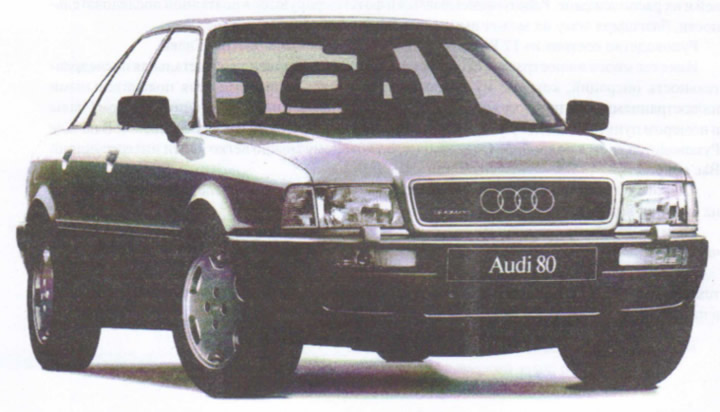
AUDI 80 is synonymous with a successful concept in automotive engineering.
The fourth generation of AUDI 80 cars, born in 1991, acquired a new, emphatically sporty appearance. Even minor shortcomings inherent in previous models were taken into account and eliminated. This gives grounds to assert that the current AUDI 80 car is the most perfect. The new design of the rear suspension and the fuel tank shifted downwards knocked out all the trump cards from the critics. Despite the fact that the base of the body has a new design, the current model has retained much, which brings it closer to the previous models.
The design of the bumpers, which are painted in the body color, has been changed. The outer contour of the wheel arch has become more elongated to the side. With the body unchanged, the rear of the car has acquired a different look. The hood has also been updated, giving the car a complete appearance, characteristic only of AUDI.
The AUDI 90 designation, which was planned for this model series, was abandoned because the car retained all known engine types, from the four-cylinder turbocharged diesel engine with 55 kW, the proven five-cylinder petrol engine and ending with the new six-cylinder engine with 128 kW, which was previously installed in the AUDI 100.