
Repair Chevrolet Repair Toyota Repair Honda Repair AvtoVAZ Repair Mercedes-Benz Repair BMW Repair Opel
Home  |  Contacts  |  Sitemap  |    
English Русский
Български
Беларускі
Український
Српски
Hrvatski
Română
Polski
Slovenský
Magyar
AudiManual.ru


  • AUDI 80
  • AUDI 100
  • AUDI A3
  • AUDI A4
  • AUDI A6
  • AUDI A8
  • AUDI Q
  • OTHER
  • ARTICLES
B4 (1991-1996) B3 (1986-1991) B3 (1986-1991, petrol) B2 (1979-1986)

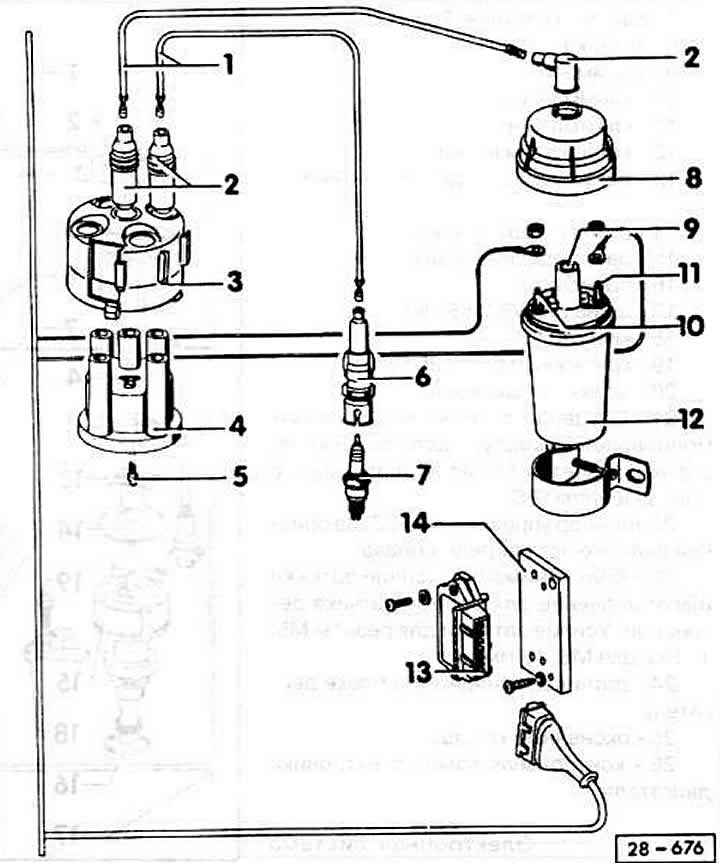
Ignition system TSZ-H (Audi 80 B3)

  • Home
  • Audi 80
  • B3 (1986-1991)
  • Power unit
  • Ignition system
  • Ignition system TSZ-H
            0
1 - ignition wires

1 - ignition wires
2 - Radio interference suppression plug
3 - screen. When suppressing radio interference
4 - distributor cap. Clean before installation
5 - distributor cap corner with spring
6 - spark plug tip
7 - spark plug, 20 Nm
8 - protective cap
9 - terminal 4
10 - terminal 1 (-)
11 - terminal 15 (+)
12 - ignition coil
13 - TSZ system key cascade. Installation position: In the passenger compartment under the trim, front left, in the footwell.
14 - radiator plate


The transistor system (TSZ) is a contactless ignition system. Instead of a breaker contact, the ignition distributor is equipped with a maintenance-free Hall sensor (TSZ-H). An ignition capacitor is not required. The contactless Hall sensor consists of a sensor, a magnet, and rotor screen plates mounted on the distributor shaft.

The Hall sensor controls the operation of the TSZ relay and thus determines the moment of switching on and off the current flow through the ignition coil. In this way, the Hall sensor determines the ignition moments.

When the rotor rotates together with the camshaft, the plates "1" run without touching through the air gap "4" of the magnetic system "2". As the plate moves in the gap of the magnetic system, it induces a magnetic field on the built-in semiconductor sensor "3" (Hall-IC). Because of this, the Hall voltage "UG" drops almost to zero, and the primary current of the ignition coil begins to flow through the TSZ block. When the plate leaves the gap, the primary current is interrupted and ignition occurs.


The number of plates on the rotor always corresponds to the number of engine cylinders. The width of the plate "b" corresponds to the rotation angle at which the output key passes current. This rotation angle does not change during the entire operation of the Hall sensor and does not require adjustment.

To protect the key cascade and ignition coil from overheating, the voltage supply to the ignition coil is switched off when the ignition is on and the engine is not running.

For safety purposes, the ignition coil has a 5.5mm hole with a plug.

It serves to ensure that in the event of a short circuit in the ignition system, the ignition coil sealant has an outlet, preventing an explosion.
The article was checked by auto expert Elisey Ermolaev
This article is available at russian, bulgarian, belarusian, ukrainian, serbian, croatian, romanian, polish, slovak, hungarian

Share information:
Previous articles
Audi 80 B3: Ignition system
Next articles

Ignition system. General information
Ignition system VEZ
Possible malfunctions of the ignition system
Checking the ignition coil
Checking the ignition cable


Similar articles on other Audi car models:
Ignition system repair Audi 100 C4 (1990-1994, petrol)
Ignition System Specifications Audi A3 Type 8L (1996-2003)
Ignition system actuator Audi A4 B5 (1994-2001, petrol)
Ignition system Audi A6 C5 (1997-2004)
General information about the ignition and fuel injection system Audi A8 D2 (1994-2002)
Ignition System — Control Data Audi Q5 Type 8R (2008-2017)
Radio or Navigation System Plus — Activating Security Coding Audi A2 (1999-2005)
Link to this page in different formats


Visitor comments

No comments yet


How much will 13 + 49 =


80(B4, 1991-1996) 
  • General information
  • User manual
  • Maintenance
  • Troubleshooting
  • Power unit
  • Engine
  • Cooling system
  • Heating and ventilation
  • Petrol injection
  • Diesel fuel system
  • Fuel system
  • Exhaust systems
  • Ignition system
  • Transmission
  • Clutch
  • Car gearbox
  • Chassis
  • Brake system
  • Suspension and steering wheel
  • Body
  • Body and trim
  • Electrical equipment
  • Electrical system
  • Electrical circuits
 
80(B3, 1986-1991) 
  • General information
  • Repair characteristics
  • Maintenance
  • Power unit
  • Gasoline engine
  • Diesel engine
  • Engine lubrication system
  • Fuel system (gasoline)
  • Injection system (gasoline)
  • Fuel system (diesel)
  • Ignition system
  • Cooling system
  • Heater
  • Exhaust system
  • Transmission
  • Clutch and gearbox
  • Chassis
  • Steering
  • Brake system
  • Car suspension
  • Body
  • Body elements
  • Electrical equipment
  • Power devices
  • Lighting and appliances
  • Electrical circuits
 
80(B3, 1986-1991, petrol) 
  • General information
  • User manual
  • Maintenance
  • Power unit
  • Engine 4-cylinder
  • Engine 5-cylinder
  • Cooling system
  • Fuel and exhaust systems
  • Ignition system
  • Transmission
  • Clutch
  • Mechanical transmission
  • Automatic transmission
  • Drive shafts
  • Chassis
  • Brake system
  • Suspension
  • Steering
  • Body
  • Exterior
  • Interior
  • Electrical equipment
  • Equipment and devices
  • Electrical circuits
 
80(B2, 1979-1986) 
  • General information
  • User manual
  • Power unit
  • Engine FZ
  • Engine EP, YP, YZ, DT, DS, DZ
  • Transmission
  • Clutch
  • 4 speed gearbox
  • 5 speed gearbox
  • Front wheel drive
  • Chassis
  • Front suspension
  • Rear suspension
  • Steering
  • Brake system
  • Electrical equipment
  • Equipment and devices
  • Electrical circuits
 
AudiManual.ru © 2017-2026 · Mobile version · Feedback · Sitemap: EN BG BY UA RS HR RO PL SK HU · Site search · News and articles
80 B2 · 80 B3 petrol · 80 B3 · 80 B4 · 100 C3 diesel · 100 C3 petrol · 100 C3 · 100 C4 petrol · 100 C4 · A3 Type 8L · A4 B5 petrol · A4 B5 · A4 B6 petrol · A4 B6 · A4 B7 · A4 B8 · A6 C4 · A6 C5 · A6 C5 Allroad · A8 D2 · Q5 Type 8R · Q7 Typ 4L · Audi A2 ·
This site uses cookies 🍪. Click the button to accept this fact.