



Note: Please note the notes at the beginning Section 14.
1. The crankshaft installation details are shown in the illustration.
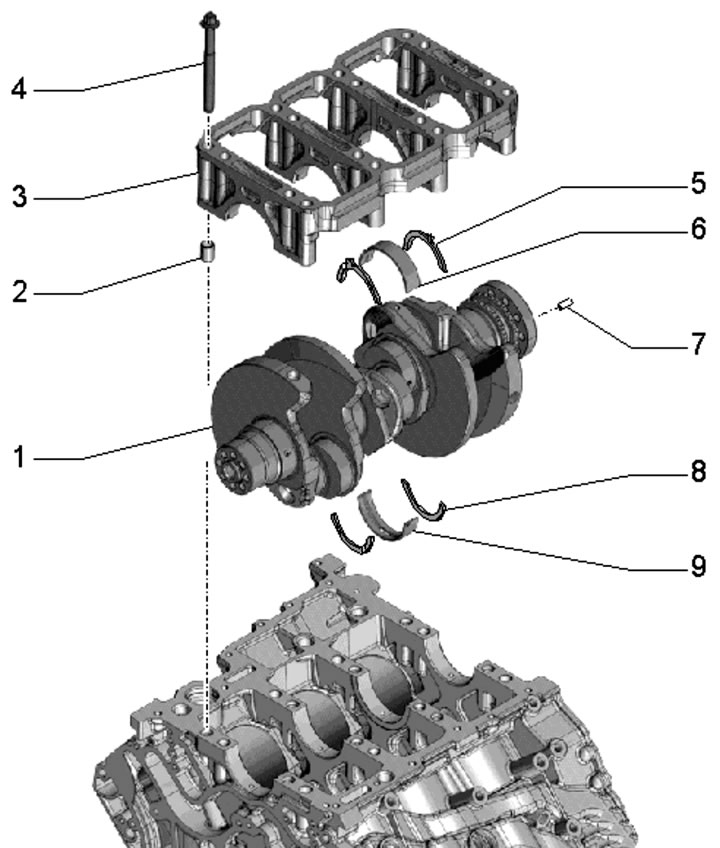
34.1. Crankshaft installation details:
1 - Crankshaft;
2 - Centering bushings of the bed 3, 4 pcs., inserted into the cylinder block;
3 - Shaft bed 1;
4 - Bed mounting bolt 3 (see illustration 14.2), subject to replacement;
5, 8 - Thrust washers, installed only on bearing #3, oil grooves facing outward;
6 - Lower main bearing shell (in bed 3), without oil groove;
7 - Centering sleeve of the drive disk, inserted into the crankshaft;
9 - Upper main bearing shell (in the cylinder block), with oil groove.
2. After removing the crankshaft bed, use new bolts to secure it. Before installing the bed, make sure that there are two centering pins in the cylinder block. Tighten the bed mounting bolts in the following sequence (1-16 in Illustration 14.2) in three approaches: first with a force of 30 Nm, then with a force of 50 Nm, and finally pull to an angle of 180°.
3. The main bearing shells are marked by thickness with colored dots. The inserts of the required thickness are installed at the factory. Liners worn down to the nickel layer should be replaced. You can determine which color dotted bearing to use by looking at the letters: G - yellow, B - blue, R - red. The letters for selecting the upper bearings are located on the cylinder block, next to the corresponding bearing (see illustration 34.3a), and the letters for selecting the lower liners are located on the crankshaft cheek (see illustration 34.3b).
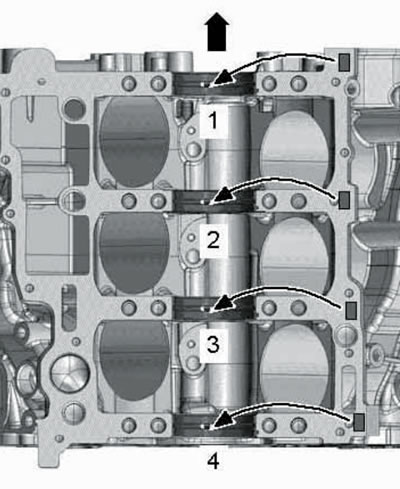
34.3a. Marking for selecting upper main bearing shells.
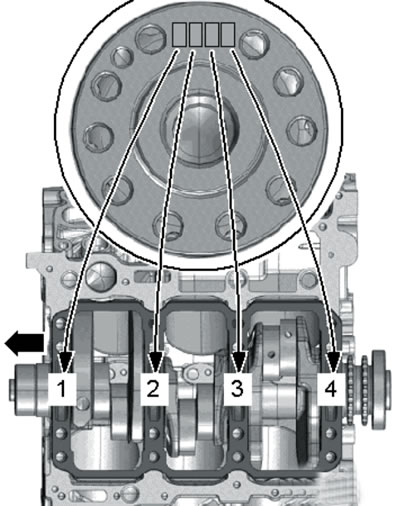
34.3b. Marking for selecting lower main bearing shells.
Note: The arrow in the illustrations indicates the direction of the crankshaft pulley.
4. The location of the centering bushings in the crankshaft bed is shown in the illustration.
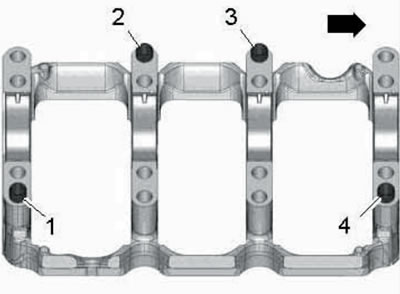
34.4. Location of centering bushings.
5. The parts of the connecting rod and piston group are shown in the illustration.
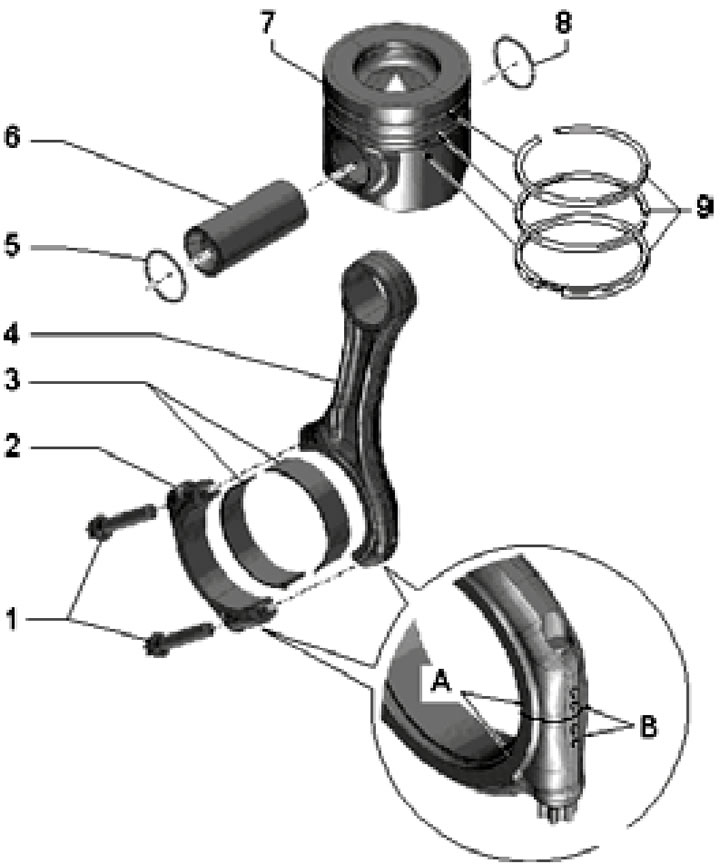
34.5. Connecting rod and piston group parts:
1 - Cover fastening bolts 2, subject to replacement, tighten with lubricated threads and mating surface: 35 Nm, then tighten to an angle of 90°;
2 - Connecting rod bearing cap, installed only in one position and only on a pair of connecting rods; with the mark "B" indicating belonging to the cylinder and the protrusion "A" on the timing drive side;
3 - Connecting rod bearing shells;
4 - Connecting rod with mark "B" and protrusion "A" (see point 2), can only be replaced as a complete assembly with cover 2;
5, 8 - Retaining ring, subject to replacement;
6 - Piston pin, to facilitate removal, heat the piston to 60°C;
7 - Piston, arrow should point towards the crankshaft pulley;
8 - Piston rings are installed at 120° intervals between locks, the "TOP" mark should face the piston bottom.
Liners worn down to the nickel layer should be replaced. Oil injectors (2 in illustration 14.5) for cooling the pistons are fastened with bolts (1) with a force of 9 Nm.
6. The wider areas on the connecting rod bearing caps should face the nearest main bearing (see illustration 14.6).
7. When installing new parts of the connecting rod and piston group or a "short" cylinder block, a new cylinder head gasket should be selected (separately for each head). The thickness of the gasket is determined based on the maximum protrusion of any of the pistons in a given cylinder bank when that piston is at TDC. Depending on the maximum protrusion of the pistons, a gasket with one, two, or three holes is used (1 in illustration 31.33), see Specifications.
8. To remove the pistons with connecting rods, remove the engine, cylinder head and upper section of the oil pan. Mark the connecting rods relative to their caps to avoid confusion during installation. Unscrew the connecting rod bearing cap mounting bolts and pull the pistons and connecting rods upward.