



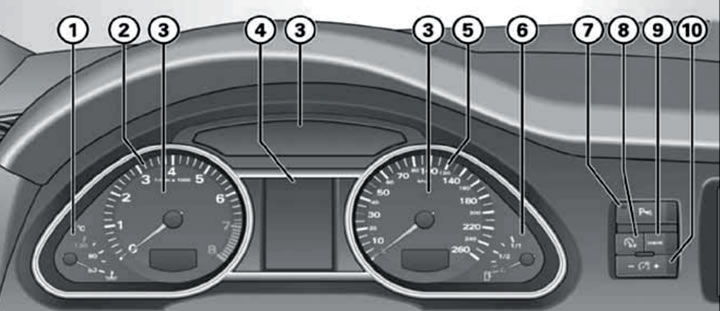
7.1. Instrument cluster details:
1. Coolant temperature gauge;
2. Tachometer with clock/date display (the time is set by radio signal or manually: via the MMI display menu);
3. Locations of control lamps and indicators;
4. Multifunctional display;
5. Speedometer with odometer display and resettable trip meter;
6. Fuel gauge;
7. Parking assistance switch;
8. Button "0.0" for resetting the resettable odometer;
9. "Check" button;
10. Instrument lighting brightness control buttons.
When the exterior lights are on, the instrument lighting brightness is adjusted by a photoresistor relative to the value set by buttons (10). In high ambient light, the instrument lighting brightness cannot be adjusted using these buttons. When the outside lights are off and the ignition is on, only the instrument scales and arrows are illuminated. As the light level decreases, the brightness of the instrument lighting decreases to remind the driver to turn on the parking lights or headlights.
If the instrument cluster is faulty, "dEF" is displayed instead of the resettable odometer reading, and if the immobilizer does not recognize the correct key when attempting to start the engine, "SAFE" appears.
The "CHECK" button is intended for:
- With ignition off - to turn on the time/mileage indicators for 30 seconds;
- When the ignition is on, and at a speed of no more than 5 km/h, the vehicle's fault monitoring system is forced to turn on;
- To display the yellow or red warning symbol of the malfunction monitoring system again (if there are warnings);
- While driving - setting the 1st level speed warning threshold (short press) or reset this value (long press).
- The fault monitoring system is designed to continuously monitor a number of functions and display warnings on the display (4) about any detected faults. Warnings are divided into minor ones, indicated by a yellow warning symbol, and major ones, indicated by a red warning symbol. Any warnings are accompanied by an audible signal, and some by an explanatory message.
The multifunctional display (4) is designed to display the following information:
- Audio system data;
- Current speed (digital speedometer);
- Navigation system data;
- Door/trunk ajar warnings;
- Checking the lamps for proper operation, with indication of the faulty lamp;
- Mileage and time until next maintenance;
- Information messages;
- Speed alarm;
- Outside air temperature;
- Trip computer data (with two memory channels);
- Selected transmission mode;
- Tire inflation pressure control.
Some warning lights and indicators are displayed only on the instrument cluster display.
Note: Depending on the vehicle's equipment, some indicator lamps may not be present in the same type of instrument cluster.
Some indicator lights come on briefly when the ignition is turned on in order to check the proper functioning of the corresponding systems and the lights themselves, and should go out after the check is completed. If any of these warning lights do not come on when the ignition is turned on or do not go out after a few seconds or after the engine is started, this may indicate either a malfunction of the light itself or a malfunction of the system it controls.
Below is a table describing the purpose of the control lamps and indicators.
| EPC | Indicator 2* for a malfunction in the petrol engine management system, yellow. |
 | Indicator 2* of work (continuous glow) or malfunction (flashing) of the diesel engine pre-heater, yellow color. |
 | Control lamp 2* of the charging system, red. Turns on when the battery is not charging. When illuminated along with the cooling system indicator light, this indicates a fault with water pump 1*. The same indicator light, but yellow, may appear on the instrument cluster display, indicating a decrease in battery power. |
 | ESP system indicator light, yellow. Lights continuously if the ESP/ASR/ABS is faulty or disabled (manually or according to system requirements). Flashing indicates that ESP/ASR is activated - release the accelerator pedal and take road conditions into account when choosing your driving style. When programming sensors (after disconnecting the battery). The ESP warning light goes out only after driving a short distance. |
 | SRS system indicator lamp 2*, red. |
 | Left/right turn signal and hazard warning lights, green; rapid flashing indicates a faulty turn signal lamp on a vehicle without a trailer. The indicator does not turn on if the turn signal lamps on the trailer or on the vehicle with the trailer are faulty. |
 | Trailer direction indicator, green. The indicator does not turn on if the turn signal lamps on the trailer or on the vehicle with the trailer are faulty. |
 | Engine Malfunction Indicator Lamp 2* (exhaust gas control/toxicity reduction systems), yellow color. |
 | Yellow indicator lamp for adaptive air suspension to warn of critical ground clearance. Continuous illumination indicates jacking mode is engaged, a system error that could lead to reduced comfort and ground clearance, or an ESP malfunction. Flashing indicates ground clearance is too high (for example, after unloading a heavy load), do not start driving until the indicator light stops flashing. Flashing together with the green indicator lamp of the adaptive air suspension - too low ground clearance (for example, after loading a heavy load), do not start driving until the indicator lights stop flashing. |
 | Green indicator lamp for adaptive air suspension to warn of too low ground clearance. Brief activation - activates "Dynamic" mode or turns on the ignition with "Dynamic" mode engaged. Flashing along with the yellow adaptive air suspension indicator light - ground clearance is too low (for example, after loading a heavy load), do not start driving until the indicator lights stop flashing. |
 | Warning light for non-attached front seat belts, red. |
 | High beam indicator, blue. |
 | Temperature control indicator, green. |
 | Control lamp 2* ABS, yellow. When illuminated while driving, this indicates a malfunction of the ABS and electronic differential lock (EDS). When illuminated along with the brake system warning light, this indicates a failure of not only the ABS control function but also a malfunction of the brake system 1*. |
 | Parking brake indicator lamp, red. Lights up when the parking brake is applied with the ignition on, and also for 30 seconds when the ignition is off. |
 | Brake system malfunction indicator lamp, red 1*: brake fluid level too low, ABS/ESP or parking brake malfunction. |
 | Cooling system control lamp 1* (overheating or low coolant level), red color. |
 | Warning lamp 1* for low engine oil level or pressure, red. |
 | Control lamp 1* for electronic steering column lock malfunction, red. |
 | Control lamp 2* for electronic ignition switch malfunction, red. On models with the system "Advanced Key" do not turn off the engine by pressing the button "Engine stop", because after this it will not be possible to start the engine. |
 | System key missing indicator "Advanced Key", yellow color. When the engine was running, the key was no longer detectable inside the car. If the engine is turned off, it will not be possible to start the engine and lock the car without detecting the key. |
 | Light sensor/rain sensor malfunction indicator, yellow. |
 | Brake pad wear indicator 2*, yellow. |
 or BREMS LIGHT or BREMS LIGHT | Brake light malfunction indicator, yellow. |
 | Outdoor lighting malfunction indicator (except for brake lights), yellow color. |
 or or  | Low washer fluid indicator, yellow. |
 | Fuel reserve indicator, yellow. It turns on for the first time when there are 10-12 liters of fuel left in the tank. |
 and and  | Indicators of exceeding the set speed (1) or maximum speed (2), yellow and red. |
 | Indicator 1* for low engine oil level, yellow. |
 | Indicator 2* of engine oil level sensor malfunction, yellow. |
 | Indicator 2* of diesel particulate filter overflow, yellow. To regenerate the filter, contact a service station or drive the car for at least 15 minutes at a speed of at least 60 km/h and at least 2000 rpm. |
 | Headlight leveling malfunction indicator, yellow. |
 | Adaptive headlight malfunction indicator, yellow. |
 | Indicator 2* of electronic ignition switch malfunction, yellow. |
 | Windscreen wiper malfunction indicator, yellow. |
 | Towing hitch malfunction indicator, yellow. |
 | Low battery indicator for the key, yellow. |
 | Indicator 1* moderate (no more than 0.3 bar) or a critical drop in tire inflation pressure, yellow or red, respectively. |
| TPMS | Tire inflation pressure monitoring system access lack indicator, yellow. |
1* If this warning lamp comes on while driving, stop the vehicle as soon as possible, turn off the engine and correct the fault.
2* If this warning light comes on while driving, contact a service station as soon as possible.
[The original version is on the portal: audimanual]