



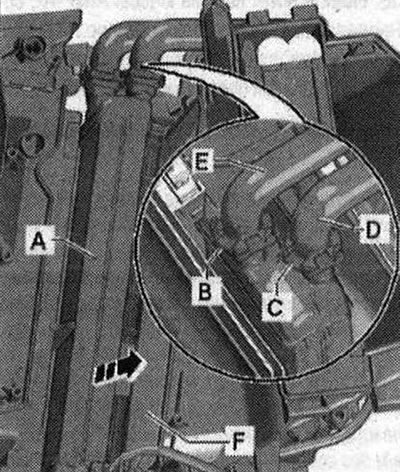
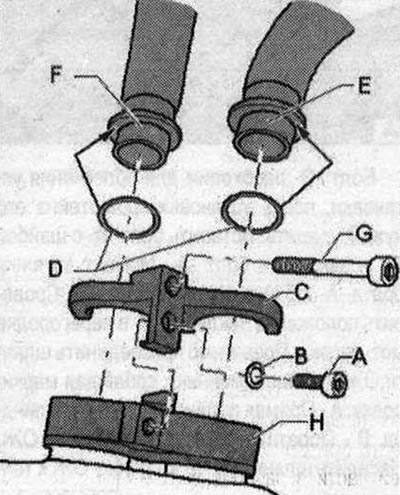
Instructions: Factory heat exchanger due to limited space with front panel installed (and installed air conditioning) due to the presence of the "B" and "C" brackets, it is not possible to reinstall or it can be installed, but with insufficient reliability. If it is necessary to reinstall the factory heat exchanger (original part) it is necessary to remove the front panel and the air duct to the deflector for "defrosting". Put on the ring seals, lightly lubricated with coolant (as described for installation of heat exchanger), on the coolant pipes "D" and "E" and press the coolant pipes "D" and "E" (with O-ring seals) from above in the heat exchanger connections -. Hold the coolant pipes "D" and "E" in the heat exchanger and install the clamps "B" and "C". Further assembly is similar to the description for the spare heat exchanger.
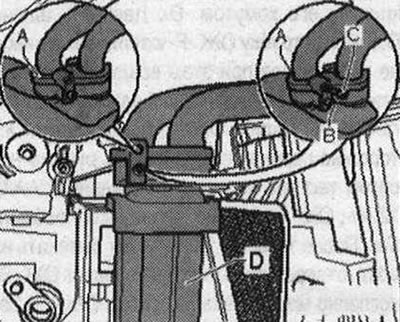
Prepare for heat exchanger removal. Release pressure in the coolant circuit by opening the expansion tank cap. Mark the location of the coolant hoses "A" (pre-feed line from cylinder head) and "B" (return line to water pump). The heat exchanger is positioned according to a specific coolant flow direction, so the coolant hoses must be connected correctly on all sides. Clamp the cooling system hoses "A" and "B" using hose clamps. Cover the areas under the coolant hose connections "A" and "B" in the water drain box, for example, with absorbent paper. Remove the coolant hoses "A" and "B" from the air conditioner heat exchanger fittings.
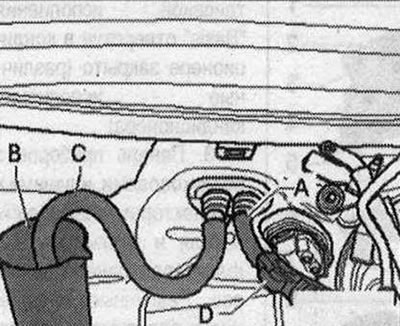
Attach a piece of hose (A and C) to both connections to the heat exchanger. Place container B under the other end of hose C. Carefully blow coolant from the heat exchanger through hose A with an air gun D (into container B).
Remove clamps "B" and "C" from the connections of heat exchanger "A". Disconnect both coolant pipes "D" and "E" from the connections of heat exchanger "A". Remove heat exchanger "A" in the direction of the arrow "arrow". The figure shows the heat exchanger with the connections of the factory version. If the heat exchanger has already been replaced once, then both coolant pipes in the installed spare heat exchanger are held by the fastener "A". On this heat exchanger, unscrew bolt "B". Then screw in the longer bolt "C" (thread M5), according to the figure, until it stops and unscrew the fastener "A" from the connection with this bolt.
Installation
Installation is in the reverse order, while the following instructions must be observed: cover the installed heat exchanger, according to the design of the climate control system and the vehicle, with seals made of foam material included in the delivery set, "A" and "D".
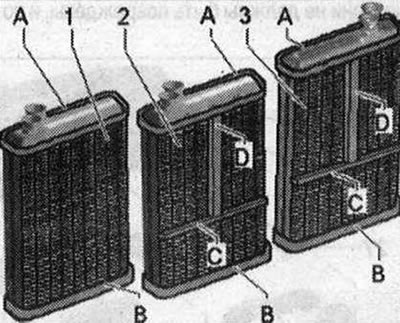 1. Heat exchanger for cars with climate control, "Basis" installation; 2. Heat exchanger for cars with climate control, "Komfort" installation; 3. Heat exchanger for cars with climate control, "Komfort" installation, right-hand drive.
Check heat exchanger seals, use only heat exchangers with undamaged and firmly glued seals. On cars with climate control, "Komfort" installation, it is possible to set different temperatures for the right and left sides, as well as behind the rear seats; seals "C" and "D" separate the air ducts in the air conditioner for the left and right sides. There is a color marking on the heat exchanger, to which the seal "C" should be glued. Stick the seal "D", according to the picture, in the center of the heat exchanger. Seal "C" has different lengths (short version, shown in the figure, or long version for the entire length of the heat exchanger). If the heat exchanger is supplied with a long strip of seal "C", stick it around the perimeter of the heat exchanger. An incorrectly glued seal may shift during installation. If the seal is damaged or incorrectly installed, cold air may get onto the heat exchanger; in vehicles with climate control, the "Komfort" installation may not provide clean insulation in various areas. With the heat exchanger "A" removed (through the heat exchanger shaft) check the air conditioner and evaporator "F" for contamination. Remove dirt or residual leaked coolant from the air conditioner (for example, after removing a leaky heat exchanger). Check the cleanliness and integrity of both connections "A" and "B" of heat exchanger "C". Lightly lubricate both connections "A" and "B" of heat exchanger "C" with silicone grease.
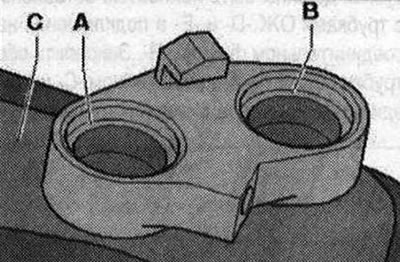
Silicone grease is available as a spare part, e.g. under part number G 000 405 A2. Lightly moisten new seals "D" (supplied with heat exchanger) OJ (or lightly lubricate with silicone grease). Place new seals "D" on both coolant pipes "E" and "F" to the heat exchanger.
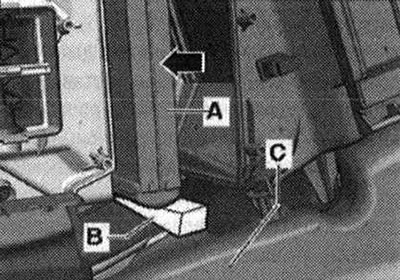
Insert heat exchanger "A" into the air conditioner. Support heat exchanger "A", for example, with a plastic wedge "B" to the central tunnel "C" so that it does not fall down when inserting the coolant pipes.
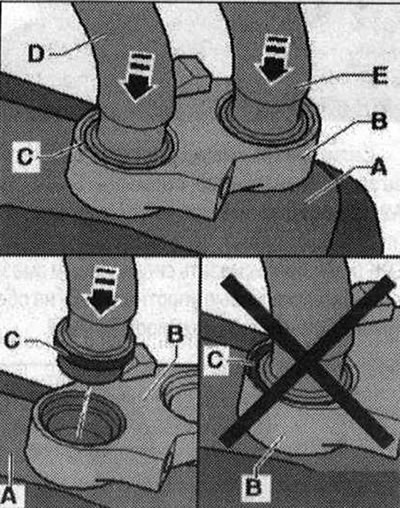
Screw in the long bolt "G" (with M5 thread), according to the figure, into the "C" mount until it stops. Insert both coolant pipes "E" and "F" with the "D" seal into the heat exchanger pipes on the connecting flange "H" and press them until they stop. Do not skew the coolant pipes "D" and "E" when inserting them into the heat exchanger pipes. Check the fit of the "C" seals between the coolant pipes "D" and "E" and the connections on the connecting flange "B" of the heat exchanger "A". Incorrectly installed or pinched "C" seals will lead to leaks. The "C" seals in both pipes must be fully inserted with the coolant pipes "D" and "E" into the connections on the connecting flange "B". Secure both coolant pipes "E" and "F" with the "C" bracket on the connecting flange of the heat exchanger "H".
Bolt "G" is necessary for easier installation, after installing the bracket it must be removed. Insert bolt "A" with washer "B" and tighten bolt "A". Tightening torque of bolt "A" is 2.5 N·m. Remove bolt "G". Check the position of the lining "H" in the bulkhead of the engine compartment. Correctly connect the coolant hoses to the heat exchanger, observing the markings: A - Direct feed from the cylinder head. B - Return line to the coolant pump. Put coolant hose "A" on the coolant pipe to the heat exchanger (observe the markings) and secure it with clamp "D". Place coolant hose "B" on coolant pipe "F" to the heat exchanger, without blocking air hole "G". Remove the hose clamp from coolant hose "A". Pour coolant into the expansion tank. Carefully pump, for example, with a hand pump of a cooling system tester "V.A.G 1274/", coolant from the expansion tank into the heat exchanger. After the coolant starts to flow out of the air hole "G", put the coolant hose "B" according to the marking on the coolant pipe "F". Secure the coolant hose "B" with the clamp "E" at the marked place. Remove the hose clamp from the coolant hose "B". If necessary, add coolant to the expansion tank.
Instructions. The cooling system is now completely bled. If for some other reason there is still air in the cooling system, it is necessary to bleed it again after installing all the elements.
Check the heat exchanger connections for leaks: carefully increase the pressure in the cooling circuit using, for example, the hand pump of the cooling system tester "VAG 1274/". Check the coolant circuit for leaks, especially the connection between the pipes and the heat exchanger. When bleeding the coolant circuit, it is necessary to completely remove air from the heat exchanger. If there are still air pockets in the heat exchanger, customers may complain about insufficient heating power in winter or different air temperatures at the outlet of the deflectors with the same adjustment in normal mode. Depending on the equipment of the car and the engine, heat insulation is installed on the coolant hoses; they must not be damaged and must be reinstalled after completion of the work. Install all removed components in the reverse order (preliminary work before removing the heat exchanger). Connect the ground cable of the battery "A", following the instructions for connecting the battery. Perform basic setup and diagnostics of the executive bodies of the climate control system.
[Information obtained from this resource: AudiManual.ru]