



With the vehicle standing on its wheels, loosen the wheel mounting bolts.
Raise the relevant part of the car and secure it on stands, unscrew the bolts and remove the wheel.
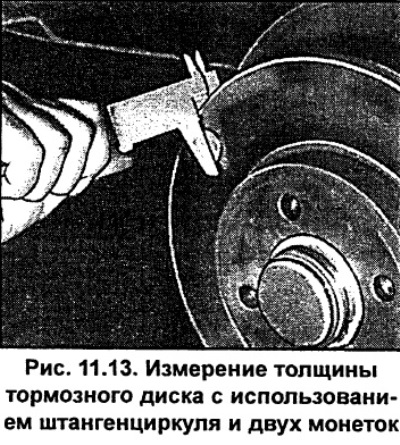
Use a micrometer to measure the thickness of the brake disc. You can also measure the thickness of the brake disc with a caliper. Since there is a step around the perimeter of the brake disc, when measuring the thickness of the brake disc using a caliper, place two coins under the jaws of the caliper (see fig. 11.13). To determine the true thickness of the brake disc, subtract the thickness of two coins from the caliper reading.
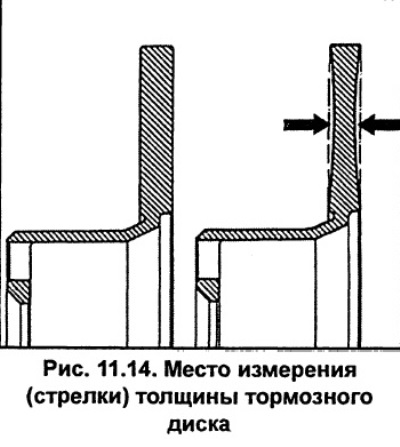
Attention. The thickness of the brake disc must be measured at several points around the circumference of the brake disc. The smallest of the measured values must be taken as the true thickness of the brake disc (see fig. 11.14).
The dimensions of the brake discs are given in "Technical data" given at the beginning of this chapter.
If the thickness of the brake disc is less than the maximum permissible value, the disc must be replaced.
If there are scratches or cracks deeper than 0.5 mm, the brake disc must be replaced.
Apply a thin layer of grease to the flange that centers the wheel disc. Install the wheel, aligning the previously applied marks, and secure it with bolts. Lower the car to the ground and tighten the wheel mounting bolts to a torque of 120 Nm.