



The pressure in the circuits is created by the brake pedal through the master brake cylinder.
The brake fluid reservoir is located in the engine compartment above the master cylinder and supplies brake fluid to the entire brake system.
The brake booster in a car with a petrol engine works due to the suction vacuum created by the engine. The force of pressing the brake pedal is amplified by the vacuum in the intake manifold through the valve system. In cars with a diesel engine, the vacuum for the brake booster is created by a vacuum pump. The vacuum pump is flanged to the engine cylinder block on the left rear and is driven by the intermediate shaft.
The brake discs are equipped with a floating caliper. This design requires only one piston to press both brake pads against the brake disc.
The parking brake acts on the rear wheels via a cable drive.
Attention
- When driving on a wet road, it is recommended to press the brake pedal from time to time to remove harmful moisture and dirt from the brake discs. Due to centrifugal force, water is thrown off the brake discs during movement, but a thin film of fats, silicones, rubber residues, grease and dirt remains on them, which reduce the effectiveness of braking. When stopping the car after driving in the rain, at the end of the movement it is recommended to dry the brakes by pressing the brake pedal.
- Soot deposits on the brake pad surfaces and rainwater penetrating into the pads cause scratches on the brake discs. As a result, the brake performance may deteriorate.
ABS/EBV/ASR/ESP
ABS: Anti-Blokier-System — an anti-lock braking system that prevents the wheels from locking during sudden braking. This reduces the braking distance, especially with low traction on the road surface in rain and snow. The force of adhesion between the wheels and the road in this case is greater when the wheels continue to rotate during braking. In addition, even with full braking, the car remains controllable.
EBV: Bektronische Brems-kraftverteilung — an electronic brake force distributor that distributes the braking force to the rear wheels using the ABS hydraulic system. The brake force distributor functions as a mechanical pressure regulator, but is more efficient and has a larger adjustment range. When driving in a straight line, all braking power is transferred to the rear brakes. For stable cornering with braking, the supply of brake fluid to the rear brakes is limited. Based on signals from the ABS wheel speed sensors, the EBV control unit determines when the car is cornering. When cornering, the braking force on the rear wheels is reduced. This transfers maximum lateral force to the rear wheels, reducing the likelihood of skidding the rear of the car.
EDS: Elektronischen Differentialsperre — electronic differential lock — when starting off and accelerating, the slipping wheels are braked. At the same time, higher torque is transmitted to the wheels with the best grip on the road.
The electronic differential lock operates when the vehicle starts moving and automatically switches off when the vehicle speed exceeds 40 km/h. In this case, the increase in traction force consists in the fact that in the starting mode the system does not have a negative effect on the vehicle's driving mode and control comfort.
ASR: Antriebs-Schlupf-Regelung — a system for reducing the torque transmitted to the drive wheels by diverting engine power reduces the drive torque when both drive wheels slip by reducing engine power.
When EDS specifically applies the brakes to improve traction, the ASR provides additional contact with the engine management system if necessary, and when the drive wheels begin to slip, engine power is limited so that only the torque required to move the vehicle is transmitted.
The purpose of ASR is to increase active safety by maintaining stable movement and control of the vehicle, including when cornering, regardless of the degree of pressure on the accelerator pedal. ASR operates from the moment of starting up to the maximum speed of the vehicle.
ESP: Elektronisches Stabilitat-sprogramm — an electronic stabilization program that automatically applies the brakes to prevent the car from skidding laterally. The electronic stabilization system combines the anti-lock braking system and the anti-skid systems. The electronic stabilization system also measures the speed of the body around the vertical axis, the acceleration values in the transverse plane, the pressure in the brake drive system, and the angle of rotation of the front wheels. Based on the amount of rotation of the front wheels and the speed of the car, the direction of movement of the car is determined and is constantly compared with the actual direction of movement of the car. In the event that the car begins to skid or drift, the stabilization system automatically applies the brakes to a certain wheel.
Notes regarding ABS/EBV/EDS/ASR/ESP
The emergency shutdown system ensures that the system is switched off in the event of any malfunction or low voltage in the vehicle's electrical network (less than 10 V). The electronic control unit also performs an auto-diagnostic function, warning the driver by lighting a control lamp about the registration of a malfunction of electrical circuits or system elements. If the ABS system is faulty, the brakes are nevertheless in good working order and function as if this system is not in the car.
Notes on safety
If the ABS and brake system warning lights are on while driving, the rear wheels may lock up during sudden braking because the brake force distributor is not working.
If one or more indicator lights in the instrument cluster come on while driving, do the following:
- stop the car, turn off the engine and start it again;
- check the voltage at the battery terminals, if the voltage is below 10.5 V, charge the battery;
- check the reliability of the fastening of the wire clamps on the battery terminals and for the absence of unreliable contact;
- raise the vehicle, remove the wheels, check the wires leading to the speed sensors for external damage. Further inspection of the ABS/EBV/EDS/ASR/ESP devices should be carried out at a service station.
Attention
- If the indicator lights come on immediately after starting the engine and go out again after a while, this indicates that the battery voltage was low and then increased as a result of charging from the generator.
- Before performing welding work using electric arc welding, disconnect the electrical connector of the electronic control device. Disconnect the connector only with the ignition off. When performing painting work, do not expose the control device to temperature loads: short-term - no more than +95°C, long-term - no more than +100°F (no more than 2 hours) +85°C.
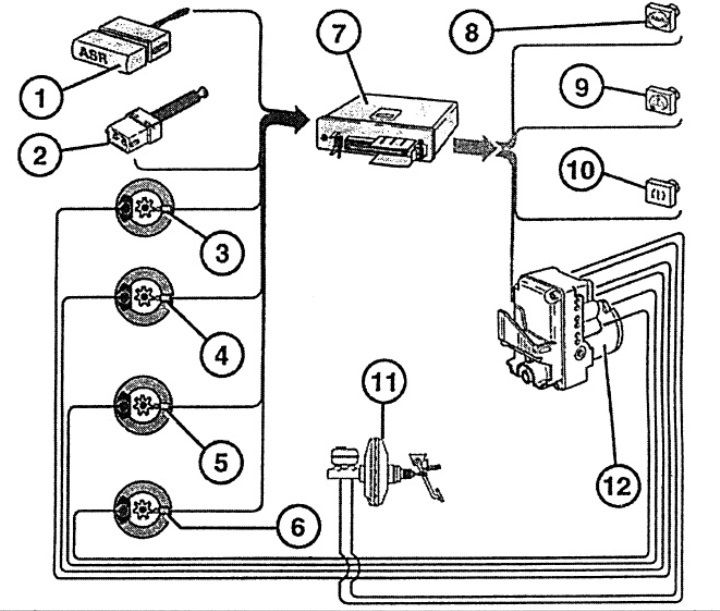
Fig. 11.1. Brake system diagram
1 - ASR switch,
2 - brake light switch,
3 - rear left wheel speed sensor,
4 - rear right wheel speed sensor,
5 - right front wheel speed sensor,
6 - left front wheel speed sensor,
7 - ABS/EBV/EDS/ASR/ESP control unit,
8 - ABS/EDS control lamp,
9 - ASR/ESP control lamp,
10 - brake fluid level indicator lamp,
11 - master brake cylinder, brake booster and brake pedal,
12 - hydraulic block.
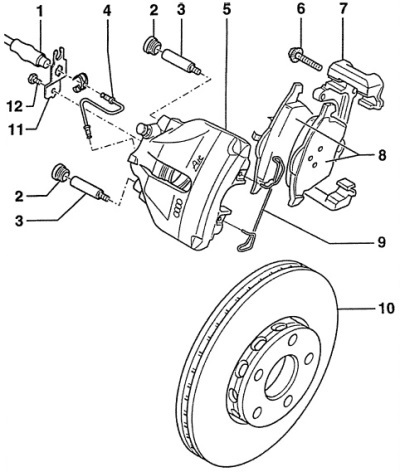
Fig. 11.2. Front brake Teves FN-3
1 - brake hose,
When replacing brake pads, do not unscrew the brake hose.
2 - protective cap,
3 - guide pin, 25 Nm,
4 - brake pipe, 15 Nm, Screw the brake pipe to the caliper.
When connecting the brake pipe and brake hose, hold the hex key on the brake hose. Check that the locking tabs are correctly positioned in the bracket recesses.
5 - support,
6 - bolt with ribbed head base, 120 Nm,
Before screwing in, clean the ribbed base of the bolt head.
7 - caliper holder,
8 - brake pads,
The outer brake pads have adhesive backings covered with a film that must be removed before installation.
It is necessary to replace all brake pads on one axle of the vehicle at the same time.
9 - locking spring,
The spring is installed in two holes of the caliper.
10 - brake disc,
If replacement is necessary, replace both front brake discs. The caliper must be removed before removing the brake disc.
11 - bracket,
12 - bolt, 10 Nm.