



Intake valve seat
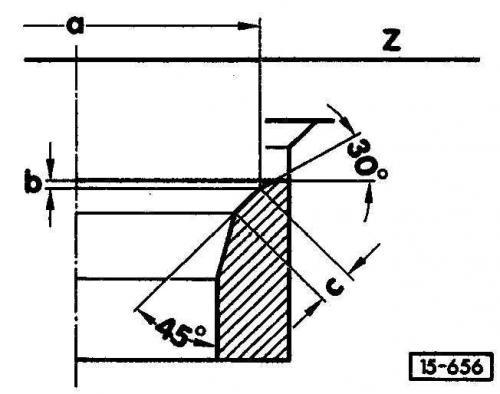
Exhaust valve seat
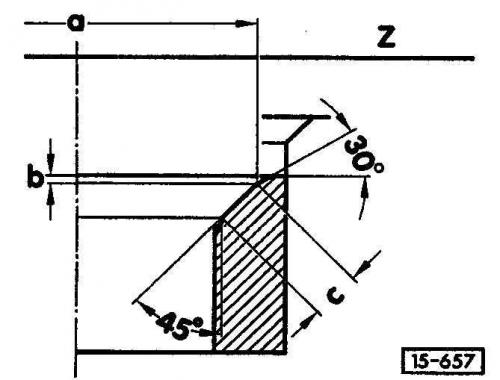
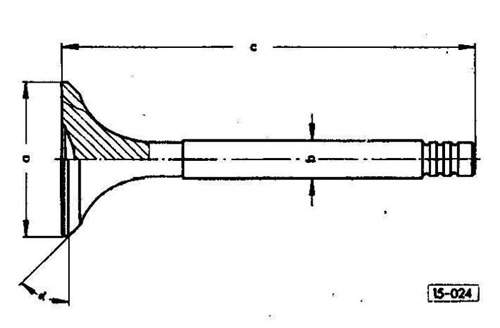
Valve dimensions
Valve seats with signs of wear or combustion influence can be reworked as long as the maximum permissible rework dimension is maintained. If this dimension is exceeded, the hydraulic valve clearance compensator will no longer function. In this case, the cylinder head must be replaced. Valve seats are always reworked to ensure a flawless appearance of the working surface. Valve seats can be repaired using normal workshop tools. Reamers are required for finishing. Since handling these tools requires a certain amount of skill, the work should be carried out in a workshop.
Warning: The outlet seats are additionally provided with a constriction. When processing, be sure to pay attention not to damage the constriction radius.
Determining the maximum allowable size of additional processing
1. Insert the valve and press it firmly against the seat.
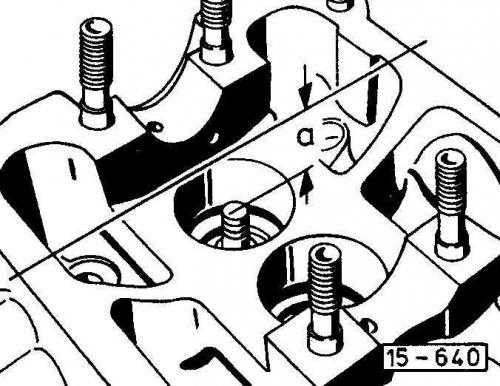
2. Measure the distance – a – between the end of the valve stem and the plane of the contact surface of the cylinder head.
3. Minimum allowable distance values are a (see table).
In order to obtain the maximum permissible size of additional processing, it is necessary to subtract the minimum permissible value from the measured distance – a.
So:
(E mm = measured distance – a) = (E mm = minimum permissible distance value – a) = (E mm = maximum permissible reworking size (b)).
Minimum allowable distance values are a
| Engine | Inlet valve | Exhaust valve |
|
2.8 l (30 valves)
|
32.2 mm 1)
|
33.0 mm
|
|
2.6/ 2.8 l (12 valves)
|
33.8 mm
|
34.1 mm
|
1) Middle Inlet Valve: 33.2mm
Valve seat chamfer angle and width
| Engine | Inlet valve | Exhaust valve |
|
a =
|
39.2 mm (/)
|
32.4 mm (/)
|
|
c =
|
2.0 mm
|
2.4 mm
|
b – maximum allowable size of additional processing (is calculated)
Z – lower contact surface of the cylinder head
300 – upper correction angle
450 – valve seat chamfer angle
6-cylinder petrol engine: a = max 3.5 mm; b = min. 0.5 mm; a = 450.
[The original publication in its entirety is posted on the website «AudiManual»]