



Table of contents: Mandatory equipment: sound signal… ↓ Before starting to move, be sure to… ↓
The signaling devices of the car are an important tool that allows you to inform other road users of your intentions. If, for example, you are about to change direction, you activate the direction indicators; when you press the brake pedal, the brake light warns the drivers of the vehicles behind. Before you begin to overtake within a built-up area, you briefly activate the light signal. If necessary, the sound signal is used.
Mandatory equipment: sound signal and emergency alarm system
Technical requirements for operation stipulate that each vehicle must be equipped with an audible signal to give warning signals. Two-tone audible signal (fuse S40) is located at the front left, between the bumper and the inner part of the wing. The two-tone horn is screwed to the holder; it can only be removed and installed when the car is raised. After removing the headlight and pulling the sensor for the safe parking system out of the front bumper, unscrew nut 1 and remove the horn from the holder. To replace the horn, remove and reconnect the connector plug 2.
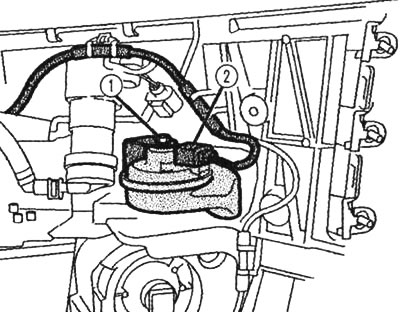
Removal the horn: Disconnect the detachable connection 2, unscrew the nut 1, remove the horn from the holder.
In addition to other signaling devices, the car must be equipped with an emergency light signaling system in order to protect the parked car in an emergency. Since the emergency signaling system must work even when the ignition is off, its switch is powered directly from the positive terminal of the battery. In contrast, the turn signals are powered only when the ignition is on.
Before starting to move, be sure to check the signaling devices
Emergency light signaling system: With the ignition off, press the hazard warning light switch on the upper steering column trim. All four flashing lights and the indicator in the switch should light up in the same rhythm.
Direction indicators: Turn on the ignition, press the direction indicator lever. Both indicators on the corresponding side of the car, as well as the indicator in the control instrument, should flash in the same rhythm.
Brake lights: Place the car with its back against the wall of the garage, press the brake pedal. Red light should be reflected on the wall. You can also check the serviceability of the brake signal while driving in a column. Look through the rearview mirror to see if the light from the brake signal lights is reflected in the headlights or paintwork of the car following you. If both lights do not work, first check the fuse (S14) and the brake signal switch.
Light signal: If you pull the turn signal switch toward the steering wheel with the ignition on, the high beam and high beam indicator should light up. If the light signal does not work, despite the fact that the headlights are on when the lighting is on, first check whether there is voltage on both red wires (terminal 30) that go to the switch on the steering column. If voltage is supplied, the light switch in the lever switch is probably faulty.