



Warning! Dust, as a product of friction lining wear, may contain asbestos, which is hazardous to health. DO NOT blow it off with compressed air or inhale it. DO NOT use gasoline or gasoline-based solvents to remove dust. Use a special clutch cleaning fluid or methyl alcohol to wash the dust into a container. After wiping the clutch with a rag, put it together with the wear products washed off with a special fluid in a container, marking it.
Removal
1. Remove the gearbox as described in chapter 7A.
2. Before removing the discs, mark the position of the clutch basket relative to the flywheel with a marker or chalk.
3 Working in a diagonal sequence, gradually loosen the basket-to-flywheel mounting bolts with a hex key, loosening them half a turn at a time until the spring weakens and the bolts can be loosened by hand. After loosening the bolts two or three turns, check to see if the basket is stuck on the guide pins; separate it from the flywheel with a screwdriver if necessary. After this, unscrew the bolts and remove the basket.
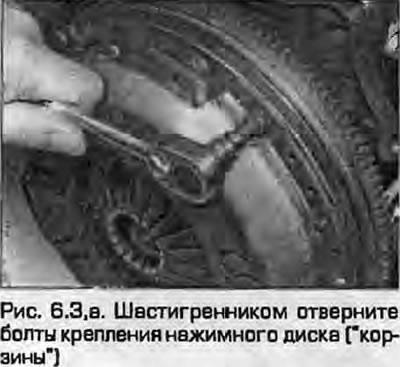 |
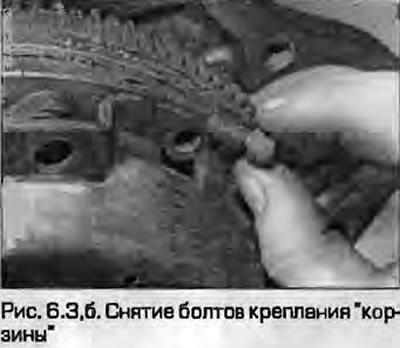 |
4. After removing the basket, remove the friction disc, remembering which side to install it back on.
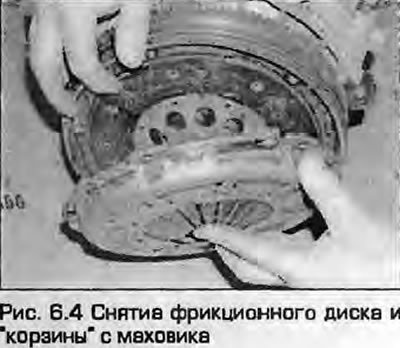
Examination
5. Before cleaning the clutch, read the warning at the beginning of this chapter. Remove dust using a clean cloth in a well-ventilated area.
6. Check the wear of the diaphragm spring petals (Fig. 6.6). If they are worn down to half, the basket must be replaced.
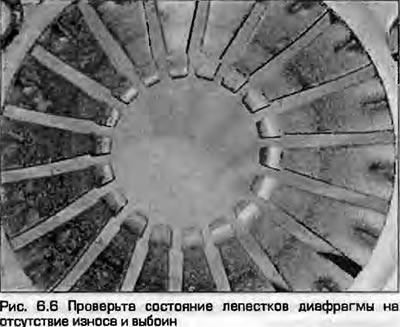
7. Check the contact surfaces of the clutch friction disc for signs of wear, damage and contamination. If the friction material has cracks, burnt areas, pits, dirt, oil (shiny black spots), worn, replace the friction disc.
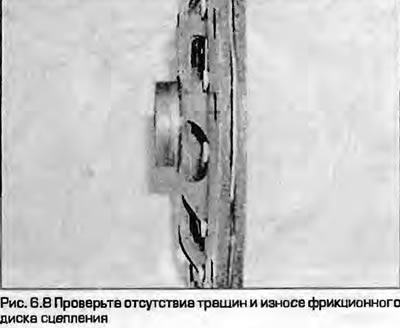
8. If the friction linings are intact, check the disc hub (Fig. 6.8). The rivets should not be damaged, the torsion springs of the torsional vibration damper should not be broken or loose in their sockets, the splines should not be worn or damaged. If defects are found, replace the disc.
9. Check the contact surfaces of the flywheel and pressure plate. They must be absolutely flat, smooth, without burrs or cracks, without signs of overheating. If defects are found that cannot be eliminated with sandpaper, it may make sense to grind the flywheel, otherwise replace the part.
10. Before assembly, clean all parts from dirt and dust. Apply a thin layer of high-temperature grease to the splines of the friction disk hub. If a new clutch pressure plate is installed, it can be coated with preservative grease. Grease can only be removed from the contact surface of the disk; removing it from other parts reduces the service life of the "basket".
Installation
11. Install the TEK friction disc so that the protruding part of its hub faces outward from the flywheel. The disc should also be marked by the manufacturer indicating which side to install it on. If necessary, use a drift (Fig. 6.11).
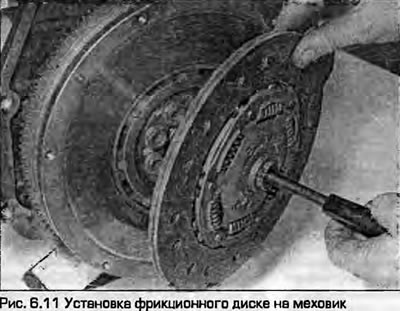
12. Install the clutch basket onto the flywheel using the guide pins, aligning the marks made during removal (if the old basket is installed).
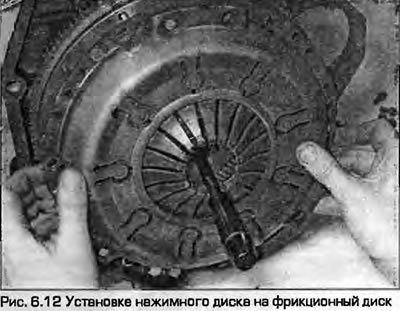
13. Screw in the basket mounting bolts, tightening them only by hand so that the friction disc can be moved.
14. Now you need to center the friction disk so that when installing the gearbox, its primary shaft passes through the splines in the disk and ends up in the center of the crankshaft. You can center the friction disk using a screwdriver by inserting it into the central hole of the disk and crankshaft and moving the disk until the centers of the holes are aligned. This task can be made easier by using a mandrel in the shape of the primary shaft of the gearbox, which can be purchased from a dealer or ordered to be made in a lathe shop. Good results can be obtained by winding the appropriate amount of electrical tape on a suitable piece of round stick or a long bolt that fits tightly into the hole of the crankshaft.
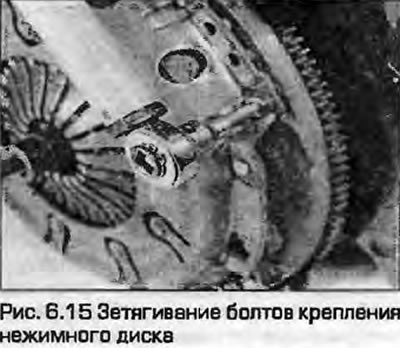
15. After centering the friction disc, gradually tighten the pressure plate mounting bolts in a diagonal sequence to the specified torque. After tightening the bolts, remove the centering mandrel (Fig. 6.15).
16. Check the smoothness of the release bearing and, if necessary, replace it as described in paragraph 7.
17. Install the gearbox as described in chapter 7A.