



Table of contents: Compressor at zero flow ↓ Intake pressure ↓ High pressure (pressure in the high… ↓ Compressor housing pressure ↓ Compressor at maximum performance ↓
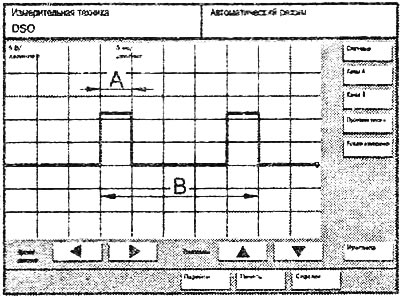
The compressor regulating valve N₂80 is continuously regulated by the E87 climate control and display unit. This causes a change in the pressure in the compressor housing. The oscillating disc changes its tilt and, thus, the working volume. External factors are evaluated to regulate the compressor: the temperature set by the driver, weather conditions and the thermal load in the system. This analysis is part of the E87 climate control and display unit's tasks. It evaluates the rectangular signal from the high-pressure sensor G65, which depends on the pressure in the refrigerant circuit. The pulse width "A" increases as the pressure increases. The pulse width "A" and the distance "B" give the duty cycle value, which is processed in the E87 climate control and display unit. A high duty cycle value means high cooling intensity and vice versa. The E87 climate control and display unit calculates the duty cycle of the PWM signal for controlling the N₂80 regulating valve taking into account various parameters. The duty cycle determines the flow area of the regulating valve (i.e. flow through the control valve). The evaporator temperature from the G2 65 sensor is the reference signal for compressor regulation.
Distinguishing features: external adjustment via regulating valve N₂80; hollow pistons; belt drive (electromagnetic clutch missing).
Belt drive: When the unit is switched off, the compressor continues to operate. However, its efficiency is less than 2%. Since there is no electromagnetic clutch, it is no longer possible to check the air conditioning system by inspection and listening.
Compressor at zero flow
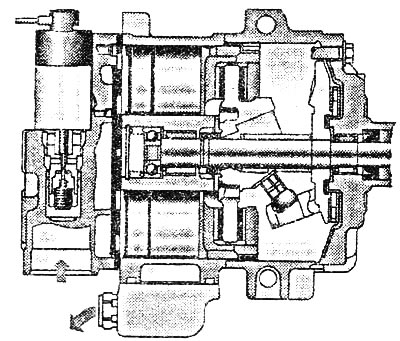
The compressor's working volume is varied by changing the tilt of the oscillating (skew) washer. When the compressor is not in operation, the oscillating washer is in a vertical position (the piston stroke is less than 2%). The change in the position of the oscillating washer is regulated by changing the ratios of the various pressures in the compressor.
Intake pressure
The pressure in the low pressure circuit of the system, i.e. the pressure of the refrigerant before the compressor.
High pressure (pressure in the high pressure circuit)
The refrigerant pressure behind the compressor is the primary pressure that changes the position of the swash plate to increase performance.
Compressor housing pressure
Back pressure in the compressor housing, combined with the force of the swash plate return spring, changes the position of the swash plate to reduce capacity.
The control valve under their influence is responsible for the balance of these pressures. The main influence on the final balance of forces is exerted by the pressures in the compressor housing and the high-pressure circuit. High pressure acts on the piston in the compression chamber and tries to bring the oscillating washer to an inclined position, i.e., a position of large working volume. The pressure in the housing gives a force that tends to give the oscillating washer a vertical position.
Compressor at maximum performance
The solenoid control valve N₂80 has a slide valve and a pressure element. The inlet pressure determines the position of the pressure element and thus how far the slide valve is extended. If a higher cooling intensity is requested, the E87 control and display unit activates the control valve. In this case, the slide valve moves downwards and reduces the flow area at the point where the high-pressure circuit (dark green color) connects to the cavity inside the housing (yellow). As a result, high pressure begins to prevail (the pressure in the case drops) and through the piston brings the rocking washer into an inclined position.
If a lower cooling intensity is required, the flow section of the hole between the high-pressure circuit and the housing cavity increases. This leads to equalization of the pressure in the compression chamber and the compressor housing. As a result, the return spring brings the rocking washer to the zero feed position. The duty cycle of 40'0 Hz can force the control valve N₂80 to hold the spool in the "floating" position, which achieves optimal pressure regulation.
(The original article is posted on the resource: «AudiManual.ru»)