



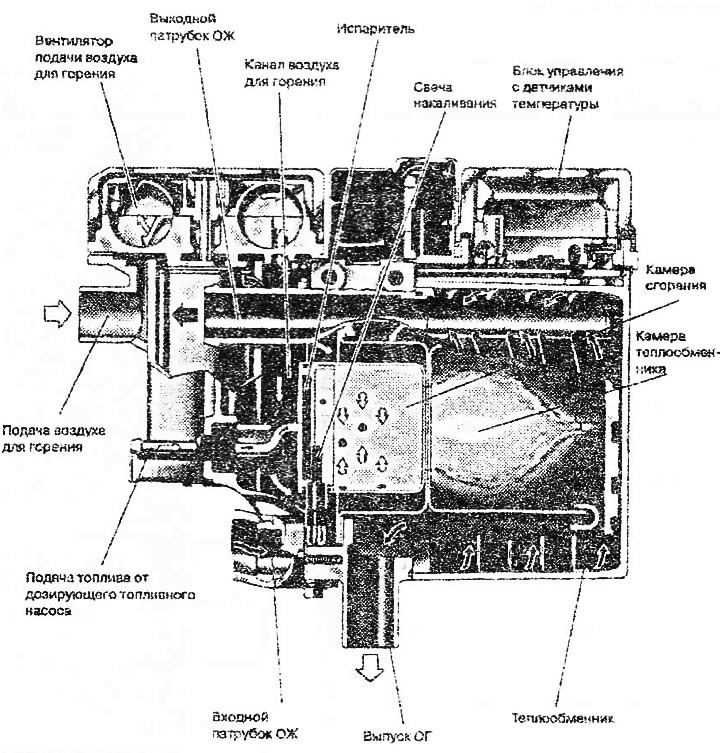
1. Coolant heating circuit
The coolant for heating enters through the inlet pipe. It passes through the heat exchanger and after heating is supplied through the outlet pipe to the engine heater circuit.
2. Combustion air supply
The combustion air supply fan takes in outside air and delivers it through a duct into the combustion chamber.
3. Fuel supply
The fuel metering pump sucks in fuel and delivers it through an internal pipeline to the so-called evaporator.
4. Combustion process
The fuel is mixed with air in the combustion chamber. The resulting fuel-air mixture is ignited by a glow plug. The ignited mixture forms a flame that breaks out into the heat exchanger chamber. Here, the heat energy of the flame is transferred to the walls of the heat exchanger.
5. Exhaust system
Exhaust gases are discharged from the heat exchanger chamber through an outlet pipe and a separate exhaust system to the outside.
6. Management
The system is switched on and off by the engine control unit via the control unit built into the system in accordance with the switching on and off criteria (for example, coolant temperature). Temperature sensors monitor various temperature parameters in the system, such as flame temperature or coolant temperature, which are then regulated accordingly by the control unit.
(The original material is located on the website: «audimanual»)