



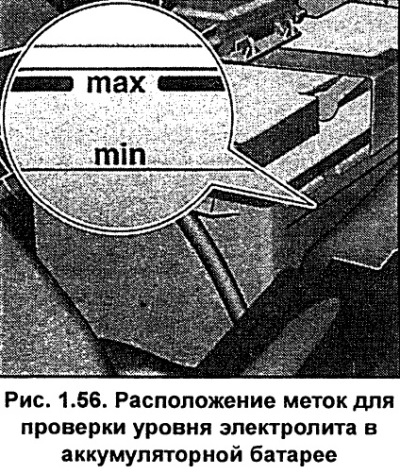
When the electrolyte level drops, add distilled water to the appropriate jars up to the MAX mark. This should be done before the electrolyte drops below the MIN mark.
Do not fill the electrolyte above the required level, otherwise the electrolyte will leak out through the ventilation hole. This may cause damage to the paintwork and corrosion of the body.
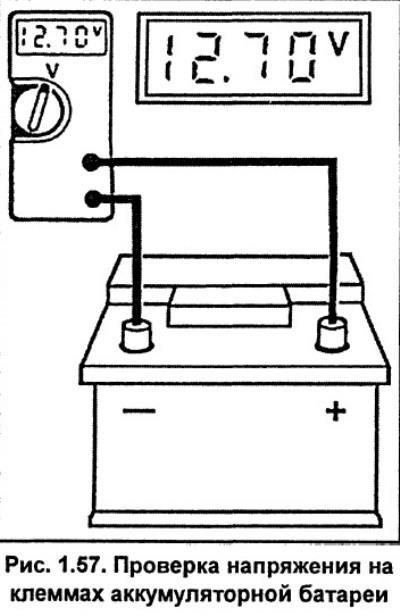
Use a voltmeter to check the voltage at the battery terminals (see fig. 1.57).
The density of the electrolyte in the battery must be checked every 3 months in order to determine the battery's load capacity.
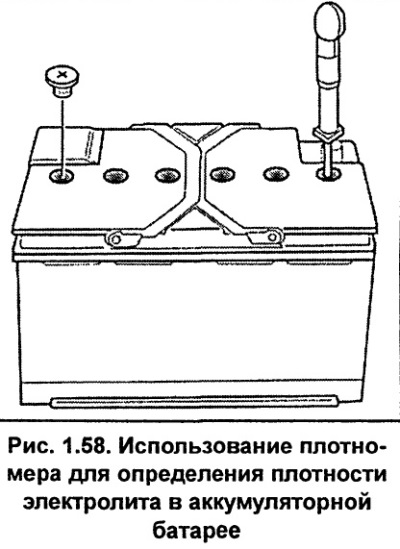
Unscrew the plugs from the battery cans.
The test is carried out using a density meter.
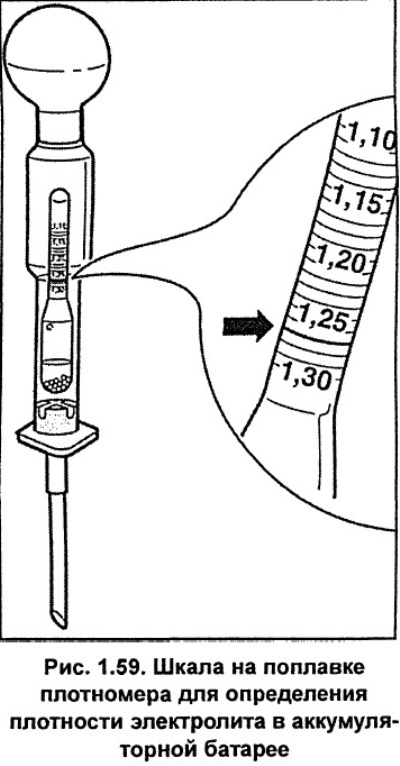
Fill the densitometer with electrolyte and use the scale on the float to determine its density (see fig. 1.58).
When determining the specific gravity of the electrolyte, the battery temperature must be taken into account. If the electrolyte temperature is below 15°C, subtract 0.007 from the measured specific gravity for every 10°C below this temperature. For every 10°C above 15°C, add 0.007.
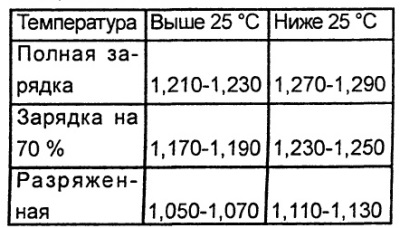
The density of the electrolyte in the battery must be within the following limits.
Measure the specific gravity of the electrolyte in each can. A difference in specific gravity of 0.04 or more between any two cans indicates electrolyte loss or plate sulfation.
If the electrolyte density between any two cans differs by more than 0.04, the battery must be replaced. If the electrolyte density is lower than required, but the same in all cans, the battery must be charged.
After topping up and checking the density of the electrolyte, the corresponding battery jars should be tightly closed with plugs.
[The article is a reprint of material from AudiManual]