
Repair Chevrolet Repair Toyota Repair Honda Repair AvtoVAZ Repair Mercedes-Benz Repair BMW Repair Opel
Home  |  Contacts  |  Sitemap  |    
English Русский
Български
Беларускі
Український
Српски
Hrvatski
Română
Polski
Slovenský
Magyar
AudiManual.ru


  • AUDI 80
  • AUDI 100
  • AUDI A3
  • AUDI A4
  • AUDI A6
  • AUDI A8
  • AUDI Q
  • OTHER
  • ARTICLES
C5 Allroad (1999-2005) C5 (1997-2004) C4 (1994-1997)

Master Brake Cylinder — Removal and Installation (Audi A6 C5)

  • Home
  • Audi A6
  • C5 Allroad (1999-2005)
  • Chassis
  • Brake system
  • Master Brake Cylinder — Removal and Installation
            0
Table of contents: Removal ↓ Installation ↓
The main brake cylinder is the main one in the brake system. It is non-separable, cannot be repaired and in case of malfunction is replaced as a set (see illustration 9.0).

Removal


1. Disconnect the bypass hose 1 supplying brake fluid from the reservoir to the clutch master cylinder and plug it with a suitable plug (see illustration).
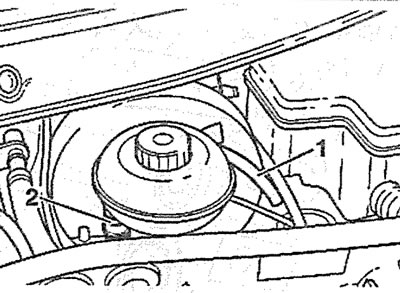
9.1. Disconnect the bypass hose 1 supplying brake fluid from the reservoir to the clutch master…

9.1. Disconnect the bypass hose 1 supplying brake fluid from the reservoir to the clutch master cylinder and plug it with a suitable plug


2. Disconnect plug 2 of the brake fluid level in the reservoir (see illustration 9.1).

Drain as much brake fluid as possible from the reservoir. To do this, connect a hose with a container for collecting the fluid to the left front wheel brake bleed nipple, open the nipple and, "pumping" the brake pedal, drain the fluid. After draining, tighten the nipple.

3. Disconnect both brake lines 1 from the master cylinder and plug their openings with suitable plugs (see illustration).
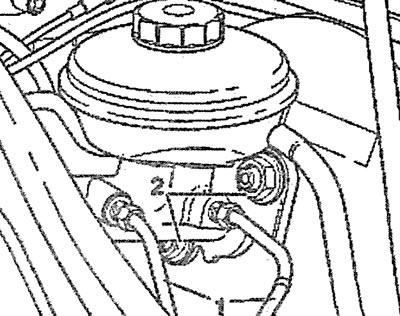
9.3. Disconnect both brake lines from the master cylinder 1

9.3. Disconnect both brake lines from the master cylinder 1


4. Unscrew the 2 nuts securing the cylinder to the vacuum booster and carefully disconnect the cylinder from the booster (see illustration 9.3).

5. Remove the master brake cylinder together with the reservoir and, if necessary, separate them.

Installation


Installation of the master brake cylinder is performed in the reverse order of removal.

6. Install a new sealing ring between the brake booster and the brake master cylinder.

7. Fill the reservoir with new brake fluid, bleed the brake system and clutch hydraulics, see the relevant chapter.

[This publication is borrowed from the resource «AudiManual»]
The article was checked by auto expert Alexey Ivanov
This article is available at russian, bulgarian, belarusian, ukrainian, serbian, croatian, romanian, polish, slovak, hungarian

Share information:
Previous articles
Audi A6 C5 Allroad: Brake system
Next articles

Brake master cylinder and brake booster
Brake caliper — overhaul
Brake caliper C38/C43 — design description
Brembo 18 Brake Caliper — Design Description
Brake booster vacuum — removal and installation
Parking brake lever — removal and installation
Parking brake cables — removal and installation


Similar articles on other Audi car models:
Master Brake Cylinder — Removal and Installation Audi 80 B4 (1991-1996)
Removal and installation the brake master cylinder Audi 100 C3 (1982-1990, petrol)
Removal and installation the cylinder head (petrol) Audi A3 Type 8L (1996-2003)
Master Brake Cylinder — Removal, Repair and Installation Audi A4 B5 (1994-2001)
Removal and installation the engine Audi A8 D2 (1994-2002)
Removal and installation the brake master cylinder, vacuum… Audi Q7 Typ 4L (2005-2015, diesel)
Removal and installation the clutch master cylinder Audi A2 (1999-2005)
Link to this page in different formats


Visitor comments

No comments yet


How much will 16 + 19 =


A6(C5 AR, 1999-2005) 
  • General information
  • User manual
  • Maintenance
  • Troubleshooting
  • Power unit
  • V6 petrol engines
  • V8 petrol engines
  • Diesel engines
  • Cooling and heating system
  • Injection system (gasoline)
  • Fuel system (diesel)
  • Supply system
  • Exhaust system
  • Ignition system
  • Transmission
  • Clutch
  • Mechanical gearbox
  • Automatic gearbox
  • Chassis
  • Brake system
  • Car suspension
  • Steering
  • Body
  • Body elements
  • Doors, locks and windows
  • Electrical equipment
  • Equipment and devices
  • Power devices
  • Electrical circuits
  • Schemes (petrol engine 2.7 l)
  • Schemes (petrol engine 4.2 l)
  • Schemes (diesel engine 2.5 l)
 
A6(C5, 1997-2004) 
  • General information
  • User manual
  • Maintenance
  • Power unit
  • Engine repair
  • Cooling system
  • Fuel system
  • Engine management
  • Fuel system (diesel)
  • Exhaust system
  • Transmission
  • Clutch
  • Car gearbox
  • Chassis
  • Front suspension
  • Rear suspension
  • Steering
  • Wheels and tires
  • Brake system
  • Body
  • Exterior
  • Interior
  • Electrical equipment
  • Air conditioner
  • Equipment and devices
  • Electrical circuits
 
A6(C4, 1994-1997) 
  • General information
  • User manual
  • Maintenance (gasoline)
  • Maintenance (Diesel)
  • Gasoline engines
  • 4 cylinder engines
  • 5 cylinder engines
  • 6 cylinder engines
  • Diesel engines
  • 4 cylinder engines
  • 5 cylinder engines
  • Engine repair
  • Removal and reassembly
  • Cooling system
  • Single point injection system
  • Multipoint injection system
  • MPI/MPFI injection system
  • Fuel system (diesel)
  • Exhaust system
  • Ignition system
  • Transmission
  • Clutch
  • Manual transmission
  • Automatic transmission
  • Drive shafts
  • Chassis
  • Brake system
  • Front suspension
  • Rear suspension
  • Steering
  • Body
  • Exterior (external elements)
  • Interior (internal elements)
  • Electrical equipment
  • Power devices
  • Lighting and appliances
  • Electrical circuits
 
AudiManual.ru © 2017-2026 · Mobile version · Feedback · Sitemap: EN BG BY UA RS HR RO PL SK HU · Site search · News and articles
80 B2 · 80 B3 petrol · 80 B3 · 80 B4 · 100 C3 diesel · 100 C3 petrol · 100 C3 · 100 C4 petrol · 100 C4 · A3 Type 8L · A4 B5 petrol · A4 B5 · A4 B6 petrol · A4 B6 · A4 B7 · A4 B8 · A6 C4 · A6 C5 · A6 C5 Allroad · A8 D2 · Q5 Type 8R · Q7 Typ 4L · Audi A2 ·
This site uses cookies 🍪. Click the button to accept this fact.