Table of contents: Replacing fuses ↓ Additional fuses ↓
Each electrical device in a car requires only a certain, precisely defined amount of current. In accordance with this current consumption in a given electrical circuit, the cross-section of its wire was naturally determined. If the current consumption in this electrical circuit increases, for example, due to an additional consumer being connected or as a result of a short circuit, the wire is overloaded. In this case, the wire heats up or even glows if the current supply is not interrupted in time. This is what fuses do.
To prevent the Audi from being completely de-energized in the event of a fault, fuses are integrated into the various electrical circuits. However, the electrical circuits between the battery, generator, starter and ignition switch are not monitored by fuses.
Replacing fuses
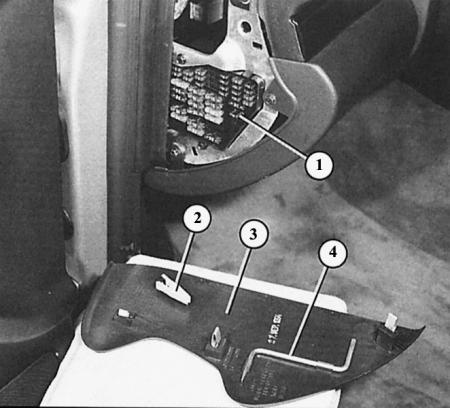
1. If one of the plug fuses needs to be replaced, you can use the small plastic pliers attached to the fuse box cover for this purpose (on the left end side of the dashboard).
2. Please note that the Audi A4 has smaller fuses (miniature fuses), than in previous models.
3. If the new fuse blows immediately, find out if the fuse you installed is too weak.
4. If this is not the case, then use the fuse table to determine the connected consumers and check them one by one. The corresponding electrical diagram will help you with this.
5. In case of doubt, disconnect all consumers and reconnect them one by one. The consumer, when connecting which the fuse burns out, was faulty.
Additional fuses
With certain extended configurations, auxiliary fuses are placed on the 8-slot support for additional relays on the left under the dashboard. In this case, most often we are talking about so-called thermal fuses. These are fuses that, when the electrical circuit is overloaded, interrupt the current flow for a certain time and then restore the connection again.
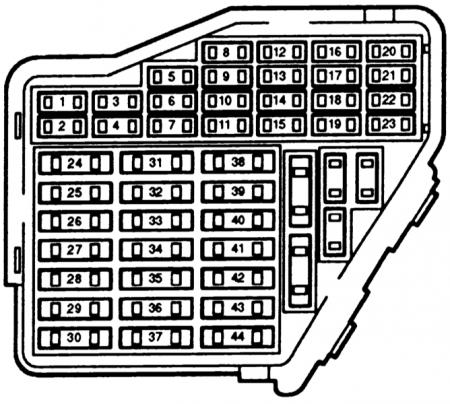
Inside the trim (3) on the left end side of the instrument panel, in a clip, there are small plastic pliers (2) for removing the fuses, and a crank (4) for emergency operation of the sliding roof. The figure below shows the arrangement of the fuses in the box (1).