



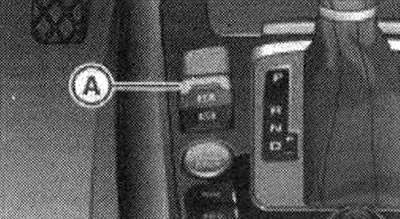
Center console: parking brake
The electromechanical parking brake is a replacement for the handbrake. To apply the parking brake, pull button "A". The indicator light on the button lights up. Press the brake or accelerator pedal and simultaneously press the button to release the parking brake. The indicator light on the button goes out. Your car is equipped with an electromechanical parking brake. The parking brake mainly serves to prevent the car from rolling away unintentionally, and is thus a replacement for the handbrake. In addition to the usual functions of a conventional handbrake, the electromechanical parking brake also provides various safety and comfort functions.
When starting off
The integrated start-off assist system, which automatically releases the parking brake, is an additional aid for the driver while driving. When starting off on inclines, the start-off assist system prevents the car from rolling back on its own. The braking force of the parking brake is released once sufficient traction force has been generated on the wheels.
Emergency braking function
The emergency braking function ensures that the vehicle is braked even if the regular braking system fails.
Control lights

If the parking brake is applied with the ignition on, the indicator lights on the instrument panel and on the button will light up

If the parking brake is applied with the ignition off, the indicator lights on the instrument panel and on the button will light for approximately 20 seconds
Attention. When the vehicle is stationary and the engine is running and the gear is engaged, do not under any circumstances inadvertently add gas or disengage the clutch. Otherwise, the vehicle will immediately start moving - risk of accident!

Caution! The appearance of the control lamp on the instrument panel indicates a malfunction of the brake system. By pressing the SET button, the following instructions for the driver can be additionally displayed.
Note: The parking brake can be applied at any time, even when the ignition is off. The ignition must be on to release the parking brake. Noise when releasing and applying the parking brake is normal and should not be a cause for concern. The parking brake periodically performs a test cycle when the ignition is off. The noise this produces is also normal.
Caution: Vehicle parked too steep (warning: the angle of the car is too great)
This instruction to the driver appears when the parking brake is applied if the inclination angle has been exceeded by approximately 30%. It is possible that in this case the braking force of the parking brake will not be sufficient to prevent the car from rolling away spontaneously.
Please release parking brake (release the parking brake)
Please note that for safety reasons, the automatic release of the parking brake does not operate unless the driver's seat belt is secured in the seat belt buckle.
Press brake pedal to release parking brake (press the brake pedal to release the parking brake)
This driver message appears if the button for releasing the parking brake has been pressed. The parking brake can only be released if the brake pedal is depressed and the button, or the automatic, is pressed to release the parking brake via the hill-start assist system.
Parking brake malfunction! (parking brake)
This driver message appears together with the yellow indicator light if there is a functional fault with the parking brake.
Auto release function: System fault (hill Start Assist System: Malfunction)
This instruction to the driver appears in the event of a functional malfunction of the hill start assist system.
The automatic function of releasing the parking brake when starting off is broken.
The parking brake must be released manually by pressing the button. Have the fault repaired at a specialist facility.
Caution! The appearance of the control lamp on the instrument panel indicates a malfunction of the brake system. By pressing the SET button, you can additionally display the following and instructions for the driver, explaining the cause of the malfunction in more detail.