



- prolonged rocking of the body when driving on uneven road surfaces;
- increasing body vibration when driving on uneven road surfaces;
- uneven and unstable movement of the wheels (bouncing) when driving in a certain speed range, including on turns;
- deviation from the intended trajectory of the vehicle during braking;
- unstable cornering and skidding of the car;
- increased wear of tires, characterized by wear of their pattern;
- the appearance of clicks and extraneous noise when the vehicle is moving. Clicks and light impacts can also be caused by other suspension faults, in particular, loosening of threaded connections, failure of hub bearings or wear of constant velocity joints of drive shafts.
To check the technical condition of the shock absorber, remove it from the car.
Inspect the shock absorber housing and rod. There should be no mechanical damage on the housing, and no signs of corrosion on the rod. Set the shock absorber in a vertical position and check its operation by moving the shock absorber rod along the entire stroke length and up and down by 50–100 mm. In all cases, the shock absorber rod should move smoothly, with noticeable resistance. If the rod moves jerkily or is damaged, the shock absorber must be replaced.
The gas-filled shock absorber rod may spontaneously extend from the shock absorber. The absence of spontaneous extension of the rod from the shock absorber does not indicate a malfunction. In this case, the operating mode of the gas-filled shock absorber corresponds to the operating mode of the hydraulic shock absorber. The shock absorber performs its functions even in the absence of excess gas pressure, but additional noise may appear when the piston moves.
Check for shock absorber fluid leaks. A small amount of oil leakage is acceptable while maintaining normal shock absorber functionality. If the fluid leakage from the shock absorber extends only to the lower spring support, this is considered normal. If the fluid leakage from the shock absorber is minor, the shock absorber rod sealing ring is lubricated, which increases its service life.
If there are significant fluid leaks, the shock absorber must be replaced.
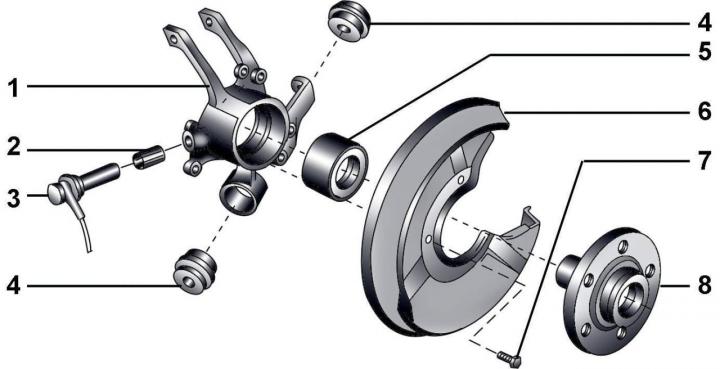
Fig. 12–22. Rear steering knuckle: 1 – steering knuckle; 2 – clamping sleeve; 3 – ABS sensor; 4 – rubber bushing; 5 – bearing; 6 – mudguard; 7 – bolt, 10 Nm; 8 – wheel hub
When installing, it is necessary to use a new bushing 2 (Fig. 12–22), having first applied G 000 650 grease to the hole in the steering knuckle.