
Repair Chevrolet Repair Toyota Repair Honda Repair AvtoVAZ Repair Mercedes-Benz Repair BMW Repair Opel
Home  |  Contacts  |  Sitemap  |    
English Русский
Български
Беларускі
Український
Српски
Hrvatski
Română
Polski
Slovenský
Magyar
AudiManual.ru


  • AUDI 80
  • AUDI 100
  • AUDI A3
  • AUDI A4
  • AUDI A6
  • AUDI A8
  • AUDI Q
  • OTHER
  • ARTICLES
Type 8L (1996-2003)

Checking the shock absorber (Audi A3 8L)

  • Home
  • Audi A3
  • Type 8L (1996-2003)
  • Chassis
  • Rear suspension
  • Checking the shock absorber
            0
The following signs indicate a faulty shock absorber:
  • Additional vibrations of the body when driving on uneven roads.
  • Increase in the amplitude of body vibrations with successive road irregularities.
  • Wheels bounce when driving on a normal road.
  • Involuntary turning of the car when braking. May be a consequence of other reasons.
  • Instability on turns due to poor traction on the road surface.
  • Increased tire wear with tread pattern peaks being cut off.
  • A rumbling noise is also a sign of faulty shock absorbers. This noise can also be caused by other reasons, such as loosening of mounting bolts and nuts, failure of wheel bearings and constant velocity joints. Therefore, always check the condition of the shock absorbers before replacing them.

The shock absorber can be checked manually. However, an accurate check of the shock absorber operation is only possible with a shock tester or a special testing machine.

Manual check


1. Remove the shock absorber.
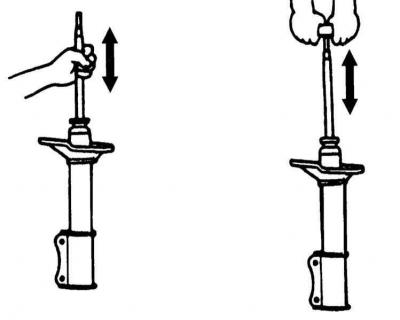
1. Remove the shock absorber.


2. Set the shock absorber to the working position, extend and compress it. Throughout the entire stroke, the shock absorber should move smoothly and evenly.


3. In gas-filled shock absorbers, the piston rod returns to its original position automatically when there is sufficient gas pressure. If the piston rod does not return, this does not mean that the shock absorber must be replaced. Its operating principle corresponds to that of a conventional shock absorber as long as there is no significant oil leakage. The damping effect of the shock absorber is also maintained in the absence of gas pressure. However, its noise characteristics deteriorate.

4. If the shock absorber is functioning normally, minor traces of leaked oil are not grounds for replacing it. The basic rule here is the following: if the oil coming out of the rod seal is visible, but it does not extend beyond the lower spring plate, then the shock absorber is in good condition. Minor oil leaks even have some advantage, since they lubricate the seal, which helps to increase its service life.

5. If there are significant oil leaks, the shock absorber must be replaced.

[Content source: the specified website audimanual.ru]
The article was checked by auto expert Nikita Rudakov
This article is available at russian, bulgarian, belarusian, ukrainian, serbian, croatian, romanian, polish, slovak, hungarian

Share information:
Previous articles
Audi A3 Type 8L: Rear suspension
Next articles

Removal and installation wheel bearing/hub assembly
Removal and installation the shock absorber and spring
Rear suspension device
Shock absorber disposal


Similar articles on other Audi car models:
Checking the shock absorber Audi 80 B3 (1986-1991)
Checking the front suspension shock absorber Audi 100 C4 (1990-1994)
Checking shock absorbers Audi A4 B5 (1994-2001, petrol)
Checking the shock absorber Audi A6 C5 (1997-2004)
Checking the shock absorber Audi A8 D2 (1994-2002)
Spring strut with upper support, shock absorber fork, upper… Audi Q5 Type 8R (2008-2017)
Engine — Checking Oil Level Audi A2 (1999-2005)
Link to this page in different formats


Visitor comments

No comments yet


How much will 42 + 21 =


A3(8L, 1996-2003) 
  • General information
  • User manual
  • Maintenance
  • Power unit
  • Engine repair
  • Lubrication system
  • Cooling system
  • Supply system
  • Fuel injection system
  • Exhaust system
  • Ignition system
  • Transmission
  • Manual transmission
  • Automatic transmission
  • Clutch and drive shafts
  • Chassis
  • Brake system
  • Front suspension
  • Rear suspension
  • Steering
  • Body
  • Ventilation and heating
  • Exterior (external elements)
  • Interior (internal elements)
  • Doors, covers and windows
  • Electrical equipment
  • Power devices
  • Lighting and appliances
  • Electrical circuits
 
AudiManual.ru © 2017-2026 · Mobile version · Feedback · Sitemap: EN BG BY UA RS HR RO PL SK HU · Site search · News and articles
80 B2 · 80 B3 petrol · 80 B3 · 80 B4 · 100 C3 diesel · 100 C3 petrol · 100 C3 · 100 C4 petrol · 100 C4 · A3 Type 8L · A4 B5 petrol · A4 B5 · A4 B6 petrol · A4 B6 · A4 B7 · A4 B8 · A6 C4 · A6 C5 · A6 C5 Allroad · A8 D2 · Q5 Type 8R · Q7 Typ 4L · Audi A2 ·
This site uses cookies 🍪. Click the button to accept this fact.