



Table of contents: Instrument cluster warning lights ↓ EPC Engine Management ↓ Pre-heating system ↓ Trailer Direction Indicators ↓ Parking light/headlights ↓ Ground clearance adjustment ↓ Electronic Stability Program (ESP) ↓ Electronic anti-theft lock ↓ High beam ↓ Direction indicators ↓ Engine electronics ↓ Airbag system ↓ Anti-lock braking system (ABS) ↓ Malfunction of the entire brake… ↓ Electronic Differential Lock (EDS)… ↓ Parking brake ↓ Battery discharge ↓ Fasten your seat belt reminder ↓
Instrument cluster warning lights
Indicator lamps indicate the status of certain functions/malfunctions.
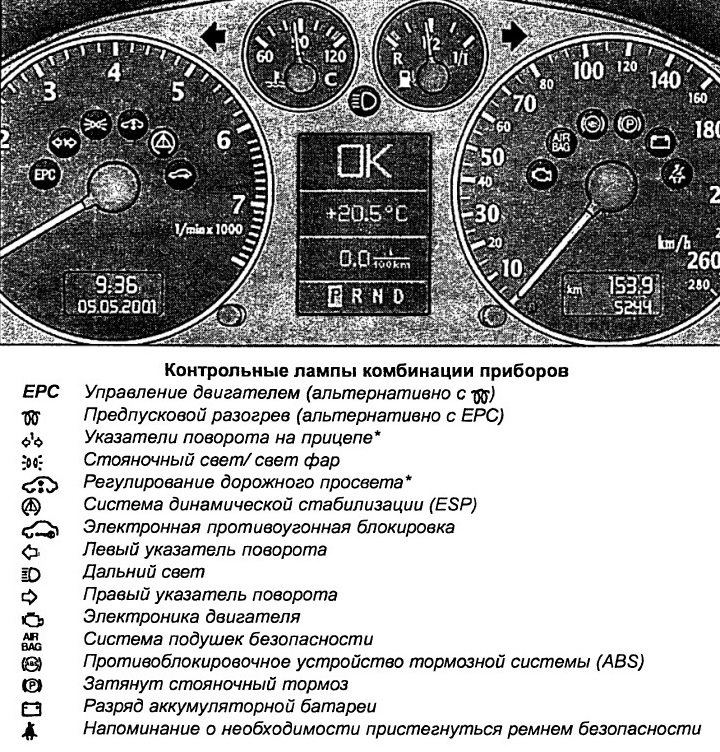
Note: A number of functions are monitored by the fault monitoring system. Functional disturbances are displayed on the instrument cluster display as red symbols (priority 1 - danger) or yellow symbols (priority 2 - warning).
EPC Engine Management
Cars with gasoline engines
The control lamp monitors the petrol engine management system.
EPC control lamp (Electronic Power Control) lights up to monitor the system function when the ignition is turned on.
Note: If the indicator lamp lights up while driving, it indicates a malfunction in the engine management system. Contact a specialist company immediately to have the engine checked.
Pre-heating system
Diesel Engine Cars
The control lamp lights up during the engine pre-heating process.
The control lamp lights up to indicate that the engine is pre-heated. Start the engine as soon as the lamp goes out. When starting a warmed-up engine, as well as at an outside temperature above +8°C, the control lamp lights up for only about 1 s.
Note
- If the glow plug indicator lamp comes on while driving, it indicates a malfunction in the engine management system. Check the engine immediately.
- The reason why the control lamp does not light at all when the ignition is turned on may be a malfunction in the pre-heating system. Check the engine.
Trailer Direction Indicators
When driving with a trailer, the indicator lamp flashes together with the direction indicators.
The indicator lamp flashes when the direction indicators are switched on if the trailer is correctly connected to the vehicle.
If the turn signal light on the vehicle itself or on the trailer is faulty, the indicator light does not flash.
Parking light/headlights
The indicator lamp lights up when the parking lights or headlights are on.
Ground clearance adjustment
Vehicles with ride height control
The indicator lamp lights when the device adjusts the height of the rear of the vehicle.
The indicator lamp lights up for a few seconds to check the function after the ignition is turned on.
Flashing of the indicator lamp after the function check indicates that the rear of the vehicle has dropped below a certain level after a long period of standing. This is normal. The indicator lamp goes out after the ride height adjustment process is completed.
If the indicator lamp lights continuously, it indicates a fault in the ride height adjustment device or indicates that the vehicle is extremely tilted relative to the rear axle. If the device is faulty, the vehicle's ground clearance is reduced and driving comfort is reduced. Have the fault rectified immediately by an Audi dealer.
Caution: Do not drive while the light is flashing, as this may cause low-lying vehicle components to come into contact with uneven road surfaces, which may result in damage to these components.
Electronic Stability Program (ESP)
The control lamp monitors the function of the electronic dynamic stabilization system.
Functions of the control lamp:
- The lamp flashes while driving when the ESP device is operating.
- The lamp lights up to check the function when the ignition is turned on and should go out after approximately 2 seconds.
- The lamp lights up when there is a malfunction of the ESP.
- The lamp lights up when the ESP device is turned off
- The lamp also lights up when the ABS fails, since the ESP device works together with the ABS.
If the indicator lamp lights up immediately after starting the engine, the ESP may be switched off by the system. In this case, you can switch on the ESP by switching the ignition off and then on. The lamp goes out and the device is completely ready for use.
Electronic anti-theft lock
The control lamp signals the exchange of data between the car and the original ignition key.
When the ignition is turned on, an automatic request for vehicle key data occurs. A positive result of data exchange is confirmed by a short illumination of the control lamp
When using a non-original key, the control lamp starts to flash for a long time. In this case, it is impossible to operate the car.
High beam
The indicator lamp lights up when the high beam is on.
The indicator lamp lights up when the high beam is switched on or when the intermittent light signal is used.
Direction indicators
The indicator lamp flashes together with the direction indicators.
Depending on which direction indicators are switched on, the left or right indicator lamp flashes. When the hazard warning lights are switched on, both direction indicator lamps flash simultaneously. If one of the direction indicators fails, the indicator lamp flashes twice as fast.
This does not apply to driving with a trailer. If any of the turn signal lights on the vehicle itself or the trailer is faulty, the indicator lamp does not flash.
Engine electronics
The warning light indicates a malfunction in the engine electronics. Contact an Audi dealer as soon as possible and have the cause of the malfunction eliminated.
Airbag system
The control lamp monitors the operation of the airbag system and seat belt tensioners.
The indicator lamp lights up for a few seconds when the ignition is turned on.
The system is faulty if the indicator lamp does not go out after the ignition is turned on or lights up, flashes/flickers while driving, and does not light up when the ignition is turned on.
Attention. If the system is faulty, have it checked immediately at a specialized facility. Otherwise, there is a risk that the airbag system or seat belt tensioners will not operate as intended in an accident.
Anti-lock braking system (ABS)
The indicator lamp monitors the operation of the ABS and the electronic differential lock (EDS).
The indicator lamp lights up for a few seconds when the ignition is switched on/during engine start-up and should go out after the automatic control process has finished.
The ABS device is faulty if:
- The indicator lamp does not light when the ignition is turned on.
- The indicator light does not go out after a few seconds.
- The control lamp lights up while driving.
In this case, the vehicle can only be braked using the normal braking system, i.e. without ABS. Contact your Audi dealer as soon as possible.
If the ABS is faulty, the ESP indicator light also comes on.
Malfunction of the entire brake system
If the ABS warning light comes on together with the brake system warning light, then in this case there is a failure not only of the ABS control function, but also a malfunction of the brake system.
In the event of a functional malfunction of the brake system, a symbol appears on the instrument cluster display.
Electronic Differential Lock (EDS) Malfunction
The EDS works together with the ABS. A failure of the EDS is indicated by the ABS indicator lamp lighting up. Contact an Audi dealer as soon as possible.
Attention
- If the brake system indicator lamp f lights up together with the ABS indicator lamp, stop immediately and check the brake fluid level in the filler tank. If the brake fluid level falls below the "MIN" mark, do not continue driving - risk of accident! Seek qualified assistance.
- If the brake fluid level is normal, the cause may be a faulty ABS. If the ABS control function fails, the rear wheels may lock relatively quickly when braking. Under certain circumstances, this may cause the rear axle of the vehicle to skid - risk of skidding! Drive carefully to the nearest specialist facility and have the fault repaired.
Parking brake
The indicator lamp lights when the parking brake is applied.
The indicator lamp lights up when the parking brake is applied and the ignition is on. It should go out when the parking brake is released.
Battery discharge
The control lamp signals a generator defect or a malfunction of the vehicle's electrical equipment.
The indicator lamp lights up when the ignition is turned on and should go out after the engine starts.
If the lamp lights up while the car is moving, it is usually still possible to drive to the nearest Audi dealership. However, since this continuously discharges the battery, all power consumers except the most necessary ones should be switched off. In addition, the voltage of the on-board network can be monitored using a voltmeter.
Caution! Additional warning symbol lights up in the instrument cluster while driving (cooling system malfunction) indicates a malfunction of the water pump of the cooling system - risk of engine damage! Stop immediately and turn off the engine.
Fasten your seat belt reminder
The warning light reminds you to fasten your seat belt.
The indicator light comes on for a few seconds after the ignition is switched on to remind you to fasten your seat belts.
(The original version of the article is posted on the website «audimanual.ru»)