Repair Chevrolet Repair Toyota Repair Honda Repair AvtoVAZ Repair Mercedes-Benz Repair BMW Repair Opel
Home  |  Contacts  |  Sitemap  |    
English Русский
Български
Беларускі
Український
Српски
Hrvatski
Română
Polski
Slovenský
Magyar
AudiManual.ru


  • AUDI 80
  • AUDI 100
  • AUDI A3
  • AUDI A4
  • AUDI A6
  • AUDI A8
  • AUDI Q
  • OTHER
  • ARTICLES
C5 Allroad (1999-2005) C5 (1997-2004) C4 (1994-1997)

Oil pan — removal and installation (Audi A6 C5)

  • Home
  • Audi A6
  • C5 Allroad (1999-2005)
  • Power unit
  • V8 petrol engines
  • Oil pan — removal and installation
            0
Table of contents: Removal ↓ Installation ↓

Removal


Bottom of the oil pan


1. Drain the coolant.

2. Unscrew the drain plug at the bottom of the oil pan and drain the engine oil.

3. Set the upper front cross member to the service position (see paragraphs 5.1-5.15).

4. Unscrew the bolts (see arrows in the illustration) and remove the support.
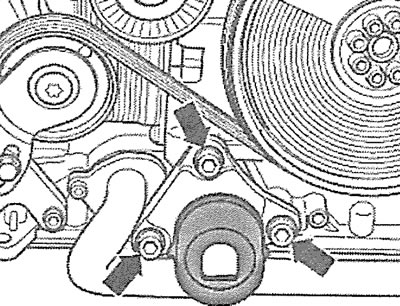
11.4. Unscrew the bolts (see arrows) and remove the support

11.4. Unscrew the bolts (see arrows) and remove the support


5. Unscrew the bolts (see arrows in the illustration) and remove the cooling system pipe.
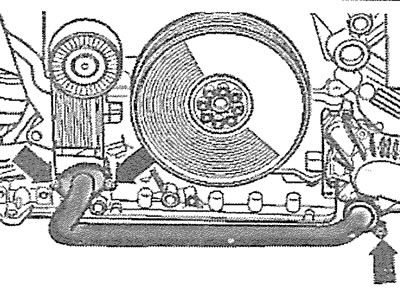
11.5. Unscrew the bolts (see arrows) and remove the cooling system pipe

11.5. Unscrew the bolts (see arrows) and remove the cooling system pipe


6. Unscrew nuts 1-4 of the left and right anti-roll bar mounting cushions (see illustration).
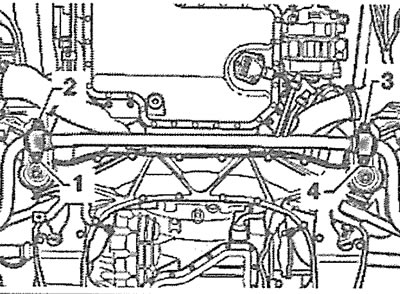
11.6. Unscrew nuts 1-4 of the left and right anti-roll bar mounting cushions

11.6. Unscrew nuts 1-4 of the left and right anti-roll bar mounting cushions


7. Release the wire harness from the holder (see arrow in illustration) at the bottom of the oil pan.
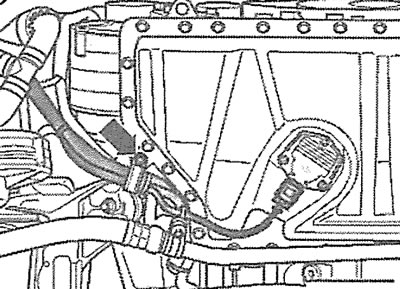
11.7. Release the wire harness from the holder (see arrow) at the bottom of the oil pan

11.7. Release the wire harness from the holder (see arrow) at the bottom of the oil pan


8. Disconnect the engine oil level and temperature sensor plug (see arrow in illustration) and release the sensor wire.
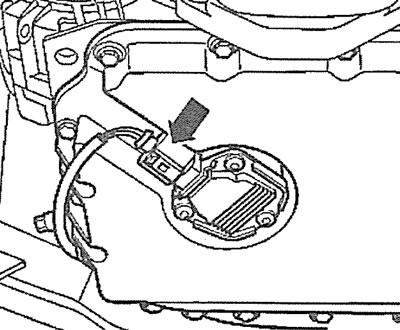
11.8. Disconnect the engine oil level and temperature sensor plug (see arrow)

11.8. Disconnect the engine oil level and temperature sensor plug (see arrow)


9. Unscrew the mounting bolts and remove the lower part 1 of the oil pan (see illustration). Collect the remaining oil in a suitable container.
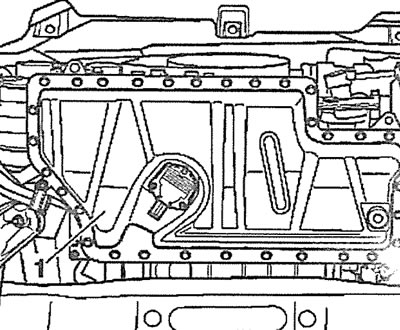
11.9. Unscrew the mounting bolts and remove the lower part 1 of the oil pan

11.9. Unscrew the mounting bolts and remove the lower part 1 of the oil pan


Upper part of the oil pan


Caution! To remove the upper part of the oil pan, the engine must be removed.


10. Remove the engine and mount it on a suitable support or mounting stand (see the relevant chapter).

11. Remove the lower part of the oil pan.

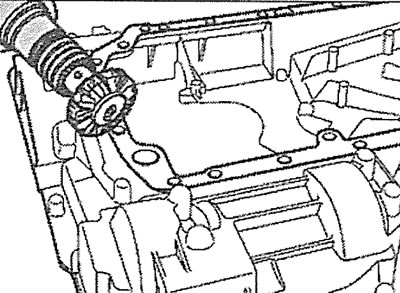
12. Unscrew bolts 1-7 securing the upper part of the oil pan, press it out of the clamping bushings and remove the upper part of the oil pan (see illustration).
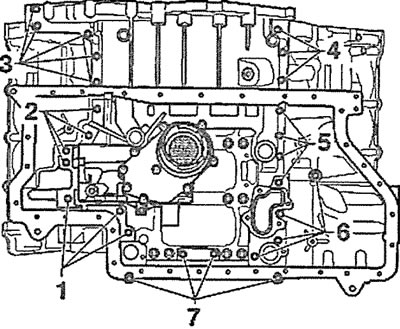
11.12. Unscrew bolts 1-7 securing the upper part of the oil pan, press it out of the clamping…

11.12. Unscrew bolts 1-7 securing the upper part of the oil pan, press it out of the clamping bushings and remove the upper part of the oil pan


Installation


The oil pan is installed in the reverse order of removal.

13. Clean the surfaces to be sealed and remove any remaining sealant using drill attachments (see illustrations 11.13 and 11.13a).
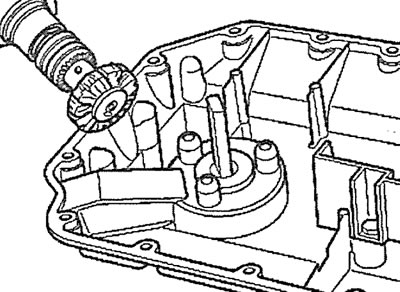
11.13. Clean the surfaces to be sealed and remove any remaining sealant from them using drill…

11.13. Clean the surfaces to be sealed and remove any remaining sealant from them using drill attachments (lower part of the oil pan)
11.13a. Clean the surfaces to be sealed and remove any remaining sealant with a drill attachment…

11.13a. Clean the surfaces to be sealed and remove any remaining sealant with a drill attachment (top of oil pan)


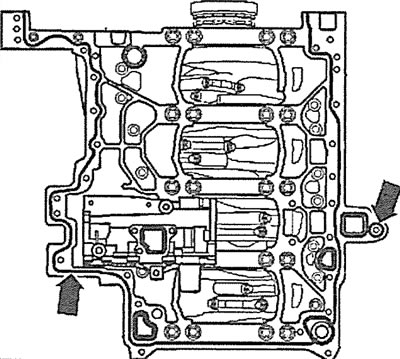
14. Apply to the mating surface of the oil pan before installing it (see arrows in illustrations 11.14 and 11.14a) a layer of sealant approximately 1.5-2.0 mm thick. If you apply more sealant, the excess will get into the engine oil and clog the mesh filter of the oil intake.
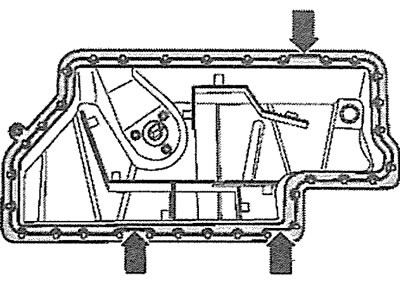
11.14. Apply to the mating surface of the oil pan before installing it (see arrow) a layer of…

11.14. Apply to the mating surface of the oil pan before installing it (see arrow) a layer of sealant approximately 1.5-2.0 mm thick (lower part of the oil pan)
11.14a. Apply to the mating surface of the oil pan before installing it (see arrows) a layer of…

11.14a. Apply to the mating surface of the oil pan before installing it (see arrows) a layer of sealant approximately 1.5-2.0 mm thick (top of oil pan)

Attention! After applying the sealant, the tray should be installed in place no later than 5 minutes later.
The article was checked by auto expert Alexey Ivanov
This article is available at russian, bulgarian, belarusian, ukrainian, serbian, croatian, romanian, polish, slovak, hungarian

Share information:
Previous articles
Audi A6 C5 Allroad: V8 petrol engines
Next articles

Oil pan — design description
Oil pump — removal and installation
Oil pump — design description
Compression in cylinders — check
Oil radiator — removal and installation


Similar articles on other Audi car models:
Engine — removal and installation Audi 80 B3 (1986-1991, petrol)
Toothed drive belt — removal, inspection and installation Audi 100 C3 (1982-1990, diesel)
Removal and installation the lower engine compartment cover Audi A3 Type 8L (1996-2003)
Installation and removal of the cylinder head Audi A4 B5 (1994-2001, petrol)
Removal and installation the engine Audi A8 D2 (1994-2002)
Turbocharger — removal and installation Audi Q5 Type 8R (2008-2017)
Removal and installation the engine Audi A2 (1999-2005)
Link to this page in different formats


Visitor comments

No comments yet


How much will 47 + 18 =


A6(C5 AR, 1999-2005) 
  • General information
  • User manual
  • Maintenance
  • Troubleshooting
  • Power unit
  • V6 petrol engines
  • V8 petrol engines
  • Diesel engines
  • Cooling and heating system
  • Injection system (gasoline)
  • Fuel system (diesel)
  • Supply system
  • Exhaust system
  • Ignition system
  • Transmission
  • Clutch
  • Mechanical gearbox
  • Automatic gearbox
  • Chassis
  • Brake system
  • Car suspension
  • Steering
  • Body
  • Body elements
  • Doors, locks and windows
  • Electrical equipment
  • Equipment and devices
  • Power devices
  • Electrical circuits
  • Schemes (petrol engine 2.7 l)
  • Schemes (petrol engine 4.2 l)
  • Schemes (diesel engine 2.5 l)
 
A6(C5, 1997-2004) 
  • General information
  • User manual
  • Maintenance
  • Power unit
  • Engine repair
  • Cooling system
  • Fuel system
  • Engine management
  • Fuel system (diesel)
  • Exhaust system
  • Transmission
  • Clutch
  • Car gearbox
  • Chassis
  • Front suspension
  • Rear suspension
  • Steering
  • Wheels and tires
  • Brake system
  • Body
  • Exterior
  • Interior
  • Electrical equipment
  • Air conditioner
  • Equipment and devices
  • Electrical circuits
 
A6(C4, 1994-1997) 
  • General information
  • User manual
  • Maintenance (gasoline)
  • Maintenance (Diesel)
  • Gasoline engines
  • 4 cylinder engines
  • 5 cylinder engines
  • 6 cylinder engines
  • Diesel engines
  • 4 cylinder engines
  • 5 cylinder engines
  • Engine repair
  • Removal and reassembly
  • Cooling system
  • Single point injection system
  • Multipoint injection system
  • MPI/MPFI injection system
  • Fuel system (diesel)
  • Exhaust system
  • Ignition system
  • Transmission
  • Clutch
  • Manual transmission
  • Automatic transmission
  • Drive shafts
  • Chassis
  • Brake system
  • Front suspension
  • Rear suspension
  • Steering
  • Body
  • Exterior (external elements)
  • Interior (internal elements)
  • Electrical equipment
  • Power devices
  • Lighting and appliances
  • Electrical circuits
 
AudiManual.ru © 2017-2026 · Mobile version · Feedback · Sitemap: EN BG BY UA RS HR RO PL SK HU · Site search · News and articles
80 B2 · 80 B3 petrol · 80 B3 · 80 B4 · 100 C3 diesel · 100 C3 petrol · 100 C3 · 100 C4 petrol · 100 C4 · A3 Type 8L · A4 B5 petrol · A4 B5 · A4 B6 petrol · A4 B6 · A4 B7 · A4 B8 · A6 C4 · A6 C5 · A6 C5 Allroad · A8 D2 · Q5 Type 8R · Q7 Typ 4L · Audi A2 ·
This site uses cookies 🍪. Click the button to accept this fact.