



Table of contents: Removal ↓ Installation ↓
Removal
The brake pads are equipped with a wear indicator. If the thickness of the brake pads is less than 3 mm, a warning lamp lights up in the instrument cluster.
Loosen the front wheel mounting bolts, lift the front of the car and secure it on stands. Unscrew the mounting bolts and remove the wheel.
Always replace all pads on one axle of the vehicle, even if only one of them is worn. If old brake pads are reinstalled, they must be marked before removal.
If replacement is necessary, replace both front brake discs. The caliper must be removed before removing the brake disc.
Secure it brake disc, screwing in one wheel mounting bolt.
Remove the brake pad wear sensor wire from the bracket in the caliper. To do this, use a screwdriver blade to push the rubber bushing with the wire out of the bracket and turn it 90° first in one direction, then in the other.
Disconnect the brake pad wear sensor electrical connector.
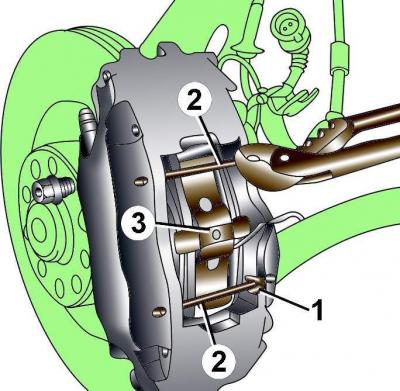
Fig. 15–13. Fastening elements of the front Brembo brake pads: 1 – retainer; 2 – pin; 3 – locking spring
Use pliers to remove the fasteners 1 (Fig. 15–13).
Remove pins 2 towards the vehicle.
Remove the retaining spring 3 of the brake shoes.
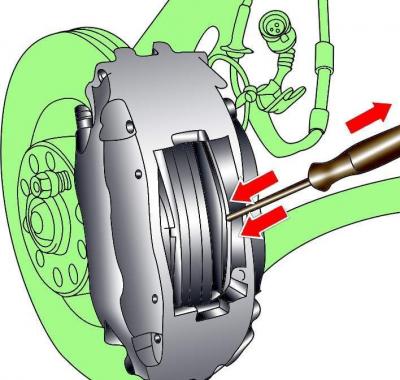
Fig. 15–14. Using a screwdriver to push the inner piston into the caliper
Using a screwdriver blade inserted between the piston and the inner brake shoe, press the piston into the caliper (Fig. 15-14). When the piston is pressed, brake fluid is forced out of the brake cylinder into the expansion tank, so constantly monitor the fluid level in the tank and, if necessary, pump out a small amount from the tank.
Remove the inner brake shoe.
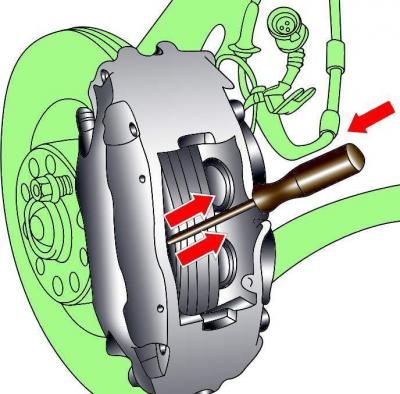
Fig. 15–15 Using a screwdriver to push the outer piston into the caliper
Using a screwdriver blade inserted between the piston and the outer brake pad, press the piston into the caliper (Fig. 15-15).
Remove the outer brake shoe.
Installation
Do not press the brake pedal when the brake pads are removed.
Clean any dust or dirt from the caliper and any rust from the edge of the brake disc. If the pads are still serviceable, clean them with a wire brush and rag.
Check it out brake disc for cracks, especially around the holes for the wheel mounting bolts, as well as for wear or mechanical damage, and replace it if necessary.
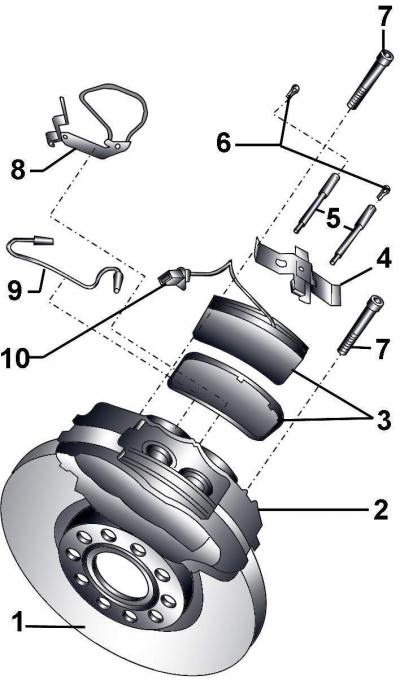
Fig. 15–12. Brembo front brake: 1 – brake disc; 2 – support; 3 – brake pads; 4 – brake shoe retaining spring; 5 – pins; 6 – clamps; 7 – bolt, 110 Nm; 8 – bracket; 9 – brake pipe, 15 Nm; 10 – Brake pad wear indicator connector
When installing, use new bolts 7 (see Fig. 15–12).
Install the brake pads into the front brake caliper.
Install the spring on the brake pads, insert the pins and secure them with the clamps (see Fig. 15–13).
Secure the brake pad wear indicator wire and connect the connector.
Unscrew the wheel and brake disc mounting bolt. Install the wheel and lower the car to the ground. Tighten the wheel mounting bolts to 120 Nm.
Replace the brake pads on the second front wheel in the same way.
Press the brake pedal several times to press the brake pads against the brake disc.
Check the brake fluid level in the reservoir and top up if necessary.
After installing new brake pads, avoid sudden braking for the first 200 km of the vehicle's mileage.
[The original article is located on the online resource: audimanual]