



Table of contents: Useful tips ↓ Checking the battery ↓ Charging the battery ↓ Removal the battery ↓ Installation ↓ Charging system ↓
The battery is located in the right rear of the trunk, under the floor panel.
When the battery terminals are disconnected, the memory units of the control units erase the data on the recorded faults, so before disconnecting the terminals, it is recommended to contact a specialized workshop to recall the faults recorded in the memory. After connecting the battery terminal, it is necessary to activate and reprogram the electric windows, as well as the position of the rear-view mirrors and seats.
If the car has a radio receiver with a code, before disconnecting the terminals from the battery, check whether you have the code to reactivate the receiver. Otherwise, the radio can only be put into operation in a specialized workshop.
A new battery must be equipped with a system for removing gases generated during battery operation.
Battery Care Rules
To maintain high performance of the battery for a long time, it is necessary:
- when the engine is not running, turn off all electrical devices in the car;
- disconnect the wire from the negative terminal of the battery;
- every 15-20 days (after 2500 km of running) clean the battery from dirt to prevent its self-discharge. For the same purpose, it is necessary to eliminate electrolyte leaks and isolate the mounting frame from the body;
- the battery must be securely fastened to the vehicle. Make sure that the cable ends are firmly fastened to the battery terminals, otherwise an explosion may occur;
- the battery can operate continuously in "starter" mode for no more than 15 s; the break between cycles should be at least 60 sec;
- periodically check the voltage produced by the generator with a voltmeter. The readings must be taken directly at the terminals of the battery with the engine running and warmed up. The voltage value should be within 13.8–14.5 V;
- on serviced batteries, it is advisable to check the level and density of the electrolyte every 3,000 km. The electrolyte level is checked using a special mark on transparent cases or using a special glass tube in opaque cases. The electrolyte should cover the upper edge of the plates by 10–15 mm. The density of the electrolyte is checked using a hydrometer. If the density is below 1.23 g/cm³ in winter and 1.19 g/cm³ in summer, recharging is necessary;even if the generator and voltage regulator are in good working order and the electrolyte level is normal, recharging with a charger is necessary once a month in winter and every six months at other times of the year;a battery filled with electrolyte can only be stored fully charged, and the density of the electrolyte must be checked once a month.
Useful tips
The battery is charged with a current equal to 0.1 of the nominal capacity. For example, a 50 A/h battery must be charged with a current of 5 A with the filler plugs unscrewed. Do not fill the battery with electrolyte with a density of more than 1.28 g/cm³. Trying to increase the starting current in this way can damage the battery in a short period of time. For the same reason, the electrolyte level can only be brought up to standard with distilled water. In an opaque serviced battery, the electrolyte level can be measured using a hollow glass tube, closing one end with a finger. In the taken "sample", the height of the liquid column inside the tube will correspond to the height of the excess of the electrolyte level over the upper edge of the plates. You can remove electrolyte leaks or neutralize the effect of electrolyte on surrounding objects using a 10% solution of ammonia or soda. Do not operate a discharged battery, especially in winter. A discharged battery has too much water in the electrolyte, it can freeze and damage the battery case. Do not try to charge a frozen battery with a high current or start the car from an external source. Let the battery thaw, and then try to restore its operation by charging with a low current. Such a battery can still serve. A crack in the can of a serviceable battery does not always require its replacement. Pour out the electrolyte, dry it, wash the crack with gasoline and process it with a file. Mix the sawdust formed when cutting the crack with epoxy glue or putty. Carefully cover the crack with the resulting mixture. After this procedure, pour in the electrolyte no earlier than 24 hours later.
Checking the battery
Check the density of the electrolyte in the battery every 3 months.
The test is carried out using a hydrometer. When determining the density of the electrolyte, its temperature must be taken into account. If the electrolyte temperature is below 15°C, for every 10°C below this temperature, the value of 0.007 is subtracted from the measured density; over 15°C – add 0.007.
The density of the electrolyte in the battery must be within the following limits:
| Temperature,°C | ||
| above 25 | below 25 | |
| Fully charged | 1,210–1,230 | 1,270–1,290 |
| Charged to 70% | 1,170–1,190 | 1,230–1,250 |
| Discharged | 1,050–1,070 | 1,110–1,130 |
Measure the specific gravity of the electrolyte in each can. A difference in specific gravity of 0.04 or more between any two cans indicates electrolyte loss or plate sulfation.
If the electrolyte density between any two cans differs by more than 0.04, the battery must be replaced. If the electrolyte density is lower than required, but the same in all cans, the battery must be charged.
The performance of a maintenance-free battery can only be checked with a voltmeter. The charge level of a battery with a built-in indicator is determined by the color of the indicator. Green color of the indicator corresponds to a full charge, black indicates the need for charging, blue indicates a low electrolyte level in the battery.
Charging the battery
Remove the battery from the vehicle before charging.
Use a charger or a charger-starter to charge the battery. Charge the battery with a current equal to 0.1 of the battery capacity until the electrolyte density increases within 4 hours.
It is not recommended to use high current to quickly charge the battery, as this may cause the battery plates to warp due to overheating.
During battery charging, the electrolyte temperature should not exceed 37.8°C.
Removal the battery
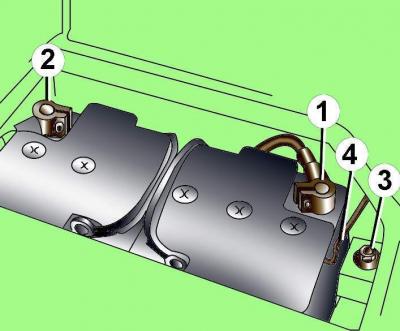
Fig. 18–11. Battery fastening and connection elements: 1 – negative terminal; 2 – positive terminal; 3 – bracket mounting bolt; 4 – gas outlet hose
Switch off the ignition. Remove the right side decorative panel and the trunk floor panel. Disconnect the battery ground bus located in the floor panel. Remove the negative terminal 1 from the battery and move it to the side (Fig. 18-11).
Disconnect the gas outlet hose 4 from the battery.
Unscrew bolt 3 and remove the battery mounting bracket.
Remove the battery from the vehicle.
Installation
Installation is carried out in the reverse order of removal, taking into account the following.
When installing, do not pinch the hose designed to remove gases released during battery operation. The gas outlet pipe has a valve that protects the battery from backfire.
Secure the battery with the bracket and screw in the battery mounting bolt, tightening it to a torque of 20 Nm.
Check that the battery is securely fastened, otherwise the battery life may be reduced.
Connect the positive terminal to the battery first, then the negative terminal, and secure the terminals by tightening the mounting nuts to a torque of 5 N·m.
Turn on the radio and enter the code into it.
Raise the power windows all the way up. Then press all power window switches again for at least 1 second to the closed position to activate the power window control unit.
Set the time on the clock.
Charging system
If the battery charge indicator lamp does not light when the ignition is turned on, check the reliability of the wires to the generator, the serviceability of the indicator lamp and the integrity of its circuit. If the lamp still does not light, check the electrical circuit from the generator to the lamp. If all electrical circuits if they are in good condition, then they are faulty generator and it should be replaced or repaired.
If the battery charge indicator light comes on while the engine is running, stop the engine and check the condition and tension of the alternator drive belt, as well as the connection of the wires to the alternator.
The voltage regulator can be tested as follows.
Connect the voltmeter to the battery and start the engine.
Increase the speed until the voltmeter readings stabilize, which should show 12–13 V, but not more than 14 V.
Turn on the maximum number of electricity consumers (headlights, rear window heater, heater fan). In this case, the voltage generated by the generator with a voltage regulator should be 13-14 V.
If the voltage does not match these values, the cause of the malfunction may be worn generator brushes, weak brush springs, a faulty voltage regulator or diode, a broken stator winding, or defective rotor slip rings.
(Content source: the specified website «audimanual»)