



If the crankshaft has been reground, check for burrs around the lubrication holes. Remove any burrs found with a file or scraper and thoroughly clean the holes and passages of chips.
Using a micrometer, measure the diameter of the main and connecting rod journals of the crankshaft and compare the results with the technical data. Measure the journals at several points both in diameter and in length, this will allow you to identify ovality and taper, if any.
Inspect the seal contact surfaces at each end of the crankshaft for wear or other damage. If the journal is severely worn from the seal, the crankshaft may need to be replaced.
Wear of the connecting rod journal is characterized by metallic knocking sounds during engine operation, especially under load, at low speeds, and a decrease in oil pressure.
Wear of the crankshaft main journals is characterized by strong engine vibration and a metallic knocking sound, which intensifies with increasing engine speed, as well as a decrease in oil pressure.
Even if the main and connecting rod bearings are subject to replacement during a major overhaul of the engine, they must be carefully inspected: their defects can be used to judge the technical condition of the engine.
Bearing failure can be caused by lack of lubrication, contamination, foreign particles, engine overload, or corrosion. The cause of bearing failure must be corrected before the engine is reassembled.
To inspect the bearings, remove them and arrange them in the same order as they were installed on the engine. This will help identify the appropriate crankshaft journal and make troubleshooting easier.
Foreign particles can enter the engine in a variety of ways. Metal particles appear in the engine oil as a result of normal engine wear. Small particles can enter the bearings along with the oil and easily embed themselves in the soft material. Larger particles can scratch the bearing or crankshaft journal. To prevent bearing failure due to this cause, it is necessary to thoroughly clean all internal engine surfaces and keep them clean during engine assembly. It is also recommended to follow the required oil and filter change intervals.
Insufficient lubrication of the crankshaft journals can be caused by many reasons: high oil temperature, engine overload, oil leakage, etc.
The driving style also affects the durability of bearings. With the throttle fully open at low engine crankshaft speeds, the load on the bearings increases and the oil film is squeezed out of the contact area. High loads lead to cracks in the working part of the bearing, which in turn can cause the antifriction layer to separate from the steel base.
Short-distance driving causes bearing corrosion because the engine does not reach a stable operating temperature, which removes water vapor and corrosive gases. When they condense in the engine oil, they form acid and sediment. The acid gets to the bearings along with the engine oil and causes corrosion.
Incorrect selection of bearings during engine assembly also causes bearing failure. Bearings installed with preload leave a gap that is insufficient to ensure proper lubrication.
When installing the crankshaft, the following must be taken into account.
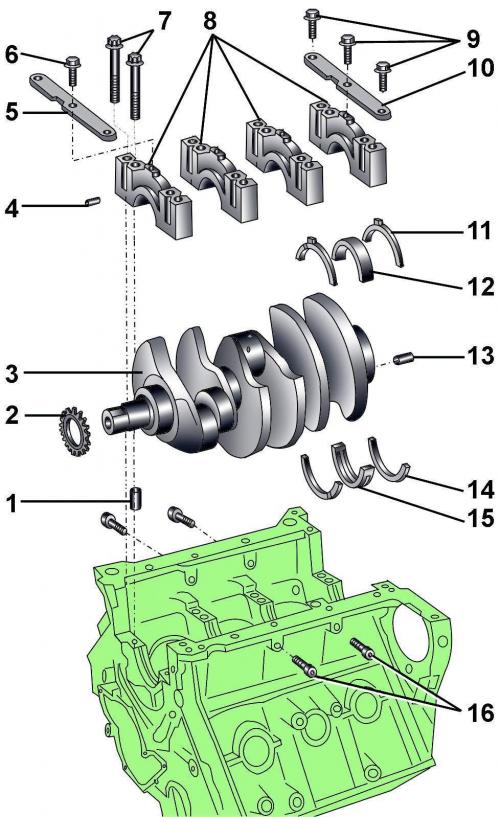
Fig. 3.3–47. Crankshaft: 1 – centering sleeve; 2 – chain sprocket; 3 – crankshaft; 4 – mounting pin; 5 – rack; 6 – bolt, 22 Nm; 7 – bearing cap mounting bolts; 8 – bearing cover; 9 – bolt, 22 Nm; 10 – rack; 11 – thrust half ring; 12 – main bearing shell; 13 – pin; 14 – thrust half ring; 15 – main bearing shell; 16 – bolts
Thrust half rings 11 and 14 (Fig. 3.3–47) are installed only on the fourth main bearing and are used to adjust the axial clearance of the crankshaft.
The lubrication grooves of the thrust half rings must be directed outward.
Insert 12 without a lubrication groove is installed from the side of the bearing cover.
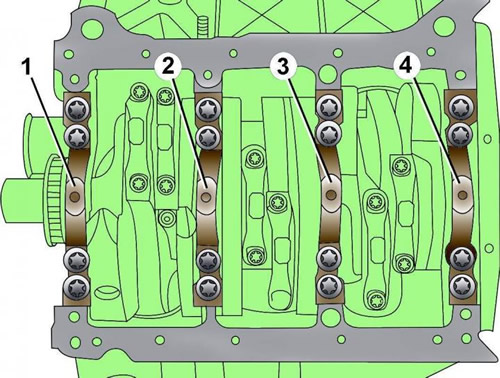
Fig. 3.3–48. Location and numbering of crankshaft main bearings
Main bearing No.1 is located on the belt pulley side, and bearing No.4 is located on the flywheel side (Fig. 3.3–48).
When installing, it is necessary to use new bearing cap mounting bolts.
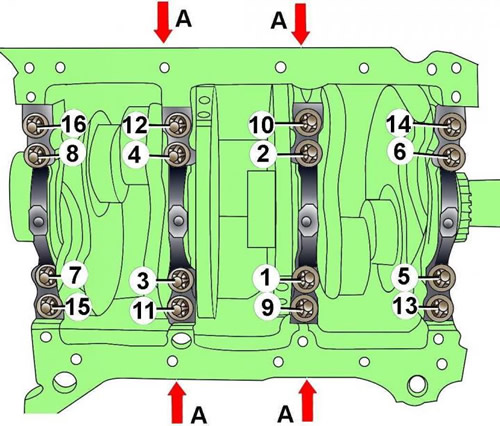
Fig. 3.3–49. Sequence of tightening the main bearing cap bolts
Tighten the main bearing cap bolts in the sequence shown in Figure 3.3–49, in five stages:
- 1st - tighten bolts 1-8 to 60 Nm;
- 2nd - tighten bolts 1–8 to an angle of 90°;
- 3rd - tighten bolts 9-16 to 60 Nm;
- 4th - tighten bolts 9–16 to an angle of 90°;
- 5th - tighten the bolts A torque 28 Nm
Measuring axial and radial clearances of the crankshaft
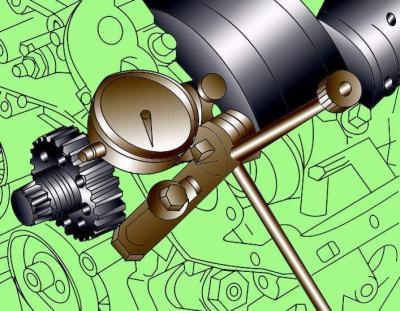
Fig. 3.3–50. Installing a bracket with a dial indicator for measuring the crankshaft axial clearance
Install a bracket with a dial indicator on the engine cylinder block so that the measuring tip of the indicator rests against the crankshaft counterweight (Fig. 3.3–50).
Move the crankshaft along the axis in one direction until it stops and set the dial indicator arrow to 0. Move the crankshaft along the axis in the other direction until it stops and record the value shown by the indicator. The nominal value of the crankshaft axial clearance is 0.090–0.251 mm, the maximum permissible value is 0.30 mm.
To measure the radial clearance in the crankshaft bearings, it is necessary to use a calibrated plastic Plastigage rod.
Unscrew the bolts and remove the main bearing cap and main bearing shell. Clean the shell, cap and crankshaft journal.
Cut a piece of plastic calibrated rod, the length of which is equal to the width of the bearing, and place it along the axis of the crankshaft on the journal of the main bearing.
Install the bearing cover with the liner and secure it with bolts, tightening them to a torque of 30 N·m. Do not turn the crankshaft.
Unscrew the bolts and remove the main bearing cap again. Compare the width of the deformed plastic rod with the measuring scale printed on the plastic rod packaging. Determine the radial clearance using the scale. The nominal value of the crankshaft radial clearance is 0.018–0.045 mm, the maximum permissible value is 0.10 mm.