



Table of contents: General information ↓ Oil viscosity ↓ All-season oils ↓ Oil with enhanced lubricating… ↓ Viscosity grades and oil usage range ↓ Motor oils ↓ Petrol engines ↓ Diesel engines ↓ Oil consumption ↓ Technical data ↓ Tightening torques, Nm ↓
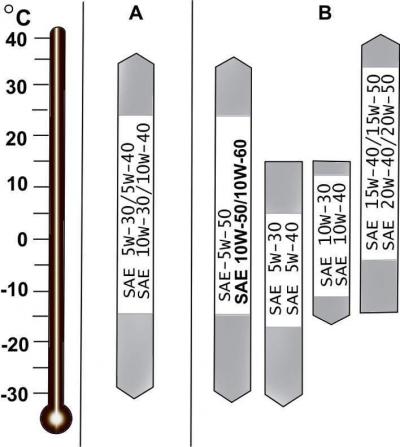
Fig. 6–1. Viscosity of motor oils
General information
Cars use a pressure lubrication system for the engine. Oil from the oil pan is supplied under pressure by the oil pump through a mesh filter and a fine filter. A bypass valve in the oil pump maintains the required pressure in the engine lubrication system. If the pressure in the engine lubrication system exceeds a certain level, the bypass valve opens and some of the oil flows back into the oil pan.
Passing through the oil filter, the purified oil enters the main oil line. It has an emergency oil pressure drop sensor, which, by turning on the control lamp in the instrument cluster, signals low oil pressure. The oil filter has a bypass valve, through which, in the event of severe contamination of the filter, uncleaned oil enters directly into the oil line.
From the main line, oil is supplied under pressure through channels to lubricate the main bearings of the crankshaft and then through channels in the crankshaft to the connecting rod bearings. To cool the pistons, oil is sprayed through nozzles onto the lower part of the pistons.
Oil is supplied through the channels to the cylinder head to lubricate the camshaft bearings and to the hydraulic tappets.
Oil viscosity
Viscosity (Fig. 6-1) characterizes the fluidity of the oil, which depends on the temperature. As the temperature increases, the oil becomes more fluid. This worsens the oil's ability to adhere and withstand high contact pressure. When cooling, the oil thickens, fluidity decreases and internal friction increases. It is necessary to use for the engine motor oil optimal viscosity, which depends on the design, operating mode, degree of wear, ambient temperature and other factors.
When starting a cold engine, the oil must be sufficiently liquid to avoid overloading the engine. In addition, after starting, it must penetrate all lubrication points more quickly.
Oil viscosity is expressed in conventional units – SAE (Society of Automotive Engineers) viscosity grades, for example SAE 30, SAE 10. A high SAE value corresponds to thick oil, a low value characterizes liquid oil.
All-season oils
All-season oils are preferable for use in car engines. The advantage of all-season oils is that they do not need to be selected depending on the season. They are made on the basis of liquid oil (type 10W). When heated, this oil is stabilized by a so-called thickener, which ensures the appropriate lubricating properties of the oil at different temperatures. When using all-season oil, modern brands with a wide temperature range of viscosity should be used, for example SAE 10W–40, 15W–50.
The letter W ("winter") in the SAE designation characterizes the suitability of oil use in winter.
Oil with enhanced lubricating properties
Oils with increased lubricating properties are all-season oils that, in addition to other additives, contain substances that reduce the friction coefficient. The use of such oils reduces fuel consumption by 2%. Special starting components are used in their production (synthetic oils).
Viscosity grades and oil usage range
Since the ranges of use of adjacent SAE classes overlap, short-term temperature fluctuations can be ignored. Mixing oils of different viscosity classes is allowed if oil top-up is required and the ambient temperature no longer corresponds to the viscosity class of the oil poured into the engine.
At air temperatures below –20°C for a long period of time, it is recommended to fill in SAE 5W–20 oil.
CD motor oils, which the manufacturer designates as oils for diesel engines, are not suitable for gasoline engines. There are oils that can be used in two types of engines, in which case both designations are indicated on the oil container, for example SG/CD.
It is not allowed to introduce additional additives into the oil, regardless of their type and purpose.
Motor oils
For modern engines, only HD oils with increased lubricating properties, improved by various additives, should be used. They improve anti-corrosion protection, the best viscosity change, detergent and solvent action, prevent oxidation and slag formation. Detergent and solvent additives not only reduce the formation of residues in the engine, but also have the ability to dissolve these residues and other contaminants in the engine oil and keep them in a suspended state so that they are removed together with the drained oil when it is replaced.
The quality of HD oils is determined by the API system (American Petroleum Institut). European manufacturers also adhere to this system.
Oil grades are designated by two letters. The first letter characterizes the area of application: S (service) is intended for gasoline engines; WITH (commercial) designed for diesel engines.
The second letter identifies the brand of oil in alphabetical order.
The highest grade oils according to API classification are SG for gasoline engines and CD for diesel engines.
Petrol engines
A – all-season oils with improved antifriction properties, specification VW 500 00.
B – all-season oils, specification VW 501 01.
– all-season oils, API–SF or SG specifications.
Diesel engines
A – all-season oils with improved antifriction properties, specification VW 500 00 (for turbocharged diesel engines only when mixed with oil, specification VW 505 00).
B – all-season oils, specification VW 505 00 (unlimited for all diesel engines).
– all-season oils, API-CD specification (for turbocharged diesel engines only if absolutely necessary for topping up).
– all-season oils, specification VW 501 01 (for turbocharged diesel engines only when mixed with oil, specification VW 505 00).
Oil consumption
Oil consumption is the amount of oil required to ensure the combustion process of the fuel-air mixture. Oil consumption does not include oil losses due to leaks in the engine lubrication system. Oil consumption is determined by the temperature and pressure during engine operation. Oil consumption is also affected by the operating conditions of the vehicle and driving style. The maximum oil consumption is 1 l per 1000 km of vehicle mileage.
Warning: Do not flood motor oil above the mark max on the indicator (dipstick), since unburned oil can get into the exhaust system and cause damage catalytic converter.
Technical data
Oil pressure (at temperature not lower than 80°C) at idle/at 3000 мин⁻¹, bar:
- petrol engines 2.8 l 1–2/ 3–5
- petrol engines 3.7 and 4.2 l 1–2.5/ 3–5
- diesel engines 2.5 l 0.8/ 2.0
Tightening torques, Nm
|
Diesel engine 2.5 l
|
|
|
Bottom section of pallet to top section of pallet
|
10
|
|
Coolant drain pipe to the pan
|
10
|
|
Oil drain plug
|
25
|
|
Coolant drain plug to pipe
|
10
|
|
Oil pump to cylinder block
|
22
|
|
Oil pressure line to oil pump
|
10
|
|
Oil pressure line to the upper section of the oil pan
|
10
|
|
Balancing shaft oil line to oil pump
|
10
|
|
Oil line to balance shaft bracket
|
10
|
|
Intermediate sprocket to upper section of oil pan
|
10
|
|
Partition to balance shaft bracket
|
10
|
|
Oil pump sprocket to oil pump
|
22
|
|
Balance shaft sprocket
|
45
|
|
Oil filter bracket to cylinder block
|
10
|
|
Mechanical EGR valve to intake manifold
|
22
|
|
Exhaust gas recirculation system pipe to transition element
|
22
|
|
EGR pipe to front section of intake manifold
|
10
|
|
Oil supply pipe to oil filter bracket
|
10
|
|
Diesel engine 3.3 l
|
|
|
Bottom section of pallet to top section of pallet
|
10
|
|
Oil drain plug
|
50
|
|
Hose clamp
|
2
|
|
Upper section of oil pan to cylinder block
|
14
|
|
Power steering pump and air conditioning compressor bracket
|
40
|
|
Power steering pump to bracket
|
22
|
|
Coolant pipe to upper section of oil pan
|
10
|
|
Guide tube for oil level indicator (dipstick) to cylinder head
|
10
|
|
Chain sprocket to oil pump
|
34,5
|
|
Chain tensioner for oil pump
|
10
|
|
Oil pump mounting bolts
|
30
|
|
Oil pan damper to upper oil pan section
|
10
|
|
Oil filter bracket:
|
|
|
M8 – 22
|
22
|
|
M10 – 45
|
45
|
|
Oil drain plug in the oil filter cover
|
10
|
|
F1 oil pressure drop sensor to oil filter bracket
|
25
|
|
2.8L petrol engine
|
|
|
Bottom section of pallet to top section of pallet
|
10
|
|
Oil drain plug
|
40
|
|
Air duct to intake manifold
|
22
|
|
Oil heat exchanger to upper section of oil pan
|
30
|
|
Upper section of oil pan to cylinder block
|
10
|
|
Upper section of oil pan to gearbox:
|
|
|
bolts M – 8
|
25
|
|
bolts M – 10
|
45
|
|
Oil pickup pipe to oil pump
|
10
|
|
Torque compensator support to upper section of oil pan
|
42
|
|
Oil pump to cylinder block:
|
|
|
m6 bolts
|
10
|
|
m²0 bolt
|
30
|
|
Timing Belt Tensioner Roller to Oil Pump
|
22
|