
Repair Chevrolet Repair Toyota Repair Honda Repair AvtoVAZ Repair Mercedes-Benz Repair BMW Repair Opel
Home  |  Contacts  |  Sitemap  |    
English Русский
Български
Беларускі
Український
Српски
Hrvatski
Română
Polski
Slovenský
Magyar
AudiManual.ru


  • AUDI 80
  • AUDI 100
  • AUDI A3
  • AUDI A4
  • AUDI A6
  • AUDI A8
  • AUDI Q
  • OTHER
  • ARTICLES
D2 (1994-2002)

Replacing and checking the oil level in the automatic transmission (Audi A8 D2)

  • Home
  • Audi A8
  • D2 (1994-2002)
  • General information
  • Maintenance
  • Replacing and checking the oil level in the automatic transmission
            0
Table of contents: Oil change ↓ Checking the oil level ↓ Checking the oil condition ↓
The transmission fluid level in the automatic transmission depends on the oil temperature. Diagnostic equipment is required to accurately measure the temperature, so it is recommended that this work be carried out at a Volkswagen service station. The automatic transmission fluid level usually remains constant unless there are visually visible leaks. In this case, there is no need to check it.

When checking, the transmission oil temperature should be slightly below +35°C, which is achieved shortly after starting the engine. To determine the temperature, VW diagnostic equipment must be connected to the connector. Otherwise, the temperature can only be determined approximately.

When checking, it is necessary to use protective glasses.

Automatic transmission 01K, 01F and 018


Oil change


Install the VAG 1306 oil pan under the gearbox.
Install the VAG 1306 oil pan under the gearbox.


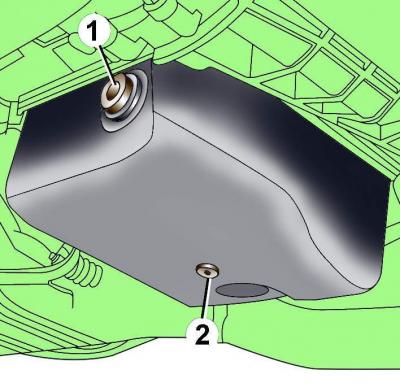
Fig. 2–21. Location of the filler (1) and drain (2) plugs for automatic transmissions 01K and 01F
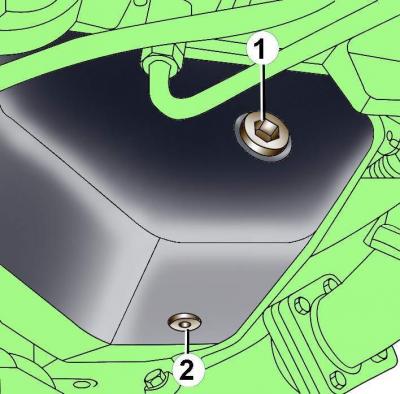

Fig. 2–21. Location of the filler (1) and drain (2) plugs for automatic transmissions 01K and 01F


Fig. 2–22. Location of the filler (1) and drain (2) plugs of the automatic transmission 018


Unscrew plug 2 (Fig. 2–21, 2–22) of the drain hole and drain the oil from the gearbox.

Screw plug 2 back into place with a new gasket and tighten it to a torque of 40 Nm.

Unscrew plug 1 of the oil filler hole.

Hang the VAG 1924 container with G 052 162 A oil above the gearbox, for example at the level of the radiator grille.

Fill with oil from the VAG 1924 container up to the lower edge of the oil filler hole.

Run the engine at idle speed and add oil to the bottom of the oil filler hole.

Remove the VAG 1924 container, screw the plug into the oil filler hole and tighten it by hand.

With the engine idling, press the brake pedal and move the selector lever alternately to all positions, holding in each position for 2–3 s.

Turn off the ignition.

Check the automatic transmission oil level.

Checking the oil level


The oil level should be checked with the vehicle in a horizontal position, with the gearbox warmed up to a temperature of 30°C, and the selector lever moved to the position P. The air conditioner and heating system must be turned off.

Connect the VAG 1551 fault reading device.

Let the engine idle and check the gearbox temperature, which should not exceed 30°C.

When the automatic transmission temperature is between +35 and +40°C, unscrew the threaded plug 1 of the oil filler hole (see Fig. 2–21). The oil level is normal if the oil leaks out slightly (as a result of the increase in level during heating).

If the level is insufficient, add oil into the oil filler hole.

Screw the plug into the oil filler hole and tighten it to a torque of 60 Nm.


Checking the oil condition


When checking the oil level in the automatic transmission, also check the condition of the oil. Compare it with new oil in color, smell and viscosity.

If the oil in the gearbox is dark or almost black with a burnt smell, it means that the friction linings of the gearbox are worn out.

If the gearbox oil is milky, it means that water has gotten into it. This can happen when the car is constantly used for short trips. If the color of the oil does not change after a long trip, it is necessary to change the oil.

The oil may become dark brown and sticky to the touch due to overheating of the gearbox or too high a level in the gearbox. If changing the oil does not help, you should contact a specialized workshop.

If dirt particles or metal shavings are found in the oil when checking the oil level or changing the oil in the automatic transmission, it is necessary to diagnose or repair the automatic transmission at a specialized service station.
The article was checked by auto expert Nikita Rudakov
This article is available at russian, bulgarian, belarusian, ukrainian, serbian, croatian, romanian, polish, slovak, hungarian

Share information:
Previous articles
Audi A8 D2: Maintenance
Next articles

Checking the oil level in a manual transmission
Visual inspection of gearbox tightness
Checking the drive shaft protective cover
Checking the condition of the poly V-belt
Checking the front suspension and steering
Checking the mudguards of the front suspension joints
Checking the shock absorber
Radiator check


Similar articles on other Audi car models:
Automatic transmission — checking the oil level Audi 80 B4 (1991-1996)
Checking the ATF level in an automatic transmission Audi 100 C4 (1990-1994, petrol)
Checking the automatic transmission final drive fluid level Audi A3 Type 8L (1996-2003)
Checking the ATF level in an automatic transmission Audi A4 B5 (1994-2001, petrol)
Checking the automatic transmission fluid level Audi A6 C4 (1994-1997)
Checking the transmission oil level in the manual transmission Audi Q5 Type 8R (2008-2017)
Engine — Checking Oil Level Audi A2 (1999-2005)
Link to this page in different formats


Visitor comments

No comments yet


How much will 43 + 12 =


A8(D2, 1994-2002) 
  • General information
  • User manual
  • Maintenance
  • Power unit
  • Petrol engine 2.8L
  • Petrol engine 3.7L and 4.2L
  • Diesel engine 2.5L
  • Diesel engine 3.3L
  • Ignition and injection (gasoline)
  • Fuel system (diesel)
  • Lubrication system
  • Cooling system
  • Transmission
  • Clutch
  • Car gearbox
  • Drive shafts
  • Cardan gear
  • Car suspension
  • Chassis
  • Wheels and tires
  • Steering
  • Brake system
  • Body
  • Exterior (external elements)
  • Interior (internal elements)
  • Heating and air conditioning
  • Electrical equipment
  • Fuses and relays
  • Lighting and lamps
  • Instruments and switches
 
AudiManual.ru © 2017-2026 · Mobile version · Feedback · Sitemap: EN BG BY UA RS HR RO PL SK HU · Site search · News and articles
80 B2 · 80 B3 petrol · 80 B3 · 80 B4 · 100 C3 diesel · 100 C3 petrol · 100 C3 · 100 C4 petrol · 100 C4 · A3 Type 8L · A4 B5 petrol · A4 B5 · A4 B6 petrol · A4 B6 · A4 B7 · A4 B8 · A6 C4 · A6 C5 · A6 C5 Allroad · A8 D2 · Q5 Type 8R · Q7 Typ 4L · Audi A2 ·
This site uses cookies 🍪. Click the button to accept this fact.