



Table of contents: General check of the ignition system ↓ Checking the power supply ↓ Checking the ignition coil(s) ↓ Checking the ignition switch ↓ Checking the Hall sensor ↓ Checking the engine speed sensor ↓ Checking the knock sensor ↓
General check of the ignition system
For systematic troubleshooting, special devices are needed. These devices are usually available at service stations. Therefore, only the basic checks are described here:
1. Check the voltage and charge state of the battery, refer to the subsection Checking the battery.
2. Check all fuses.
3. Disconnect and reconnect all plug connections related to the electronic engine management system. Check the position of the plug connections and the fixing of the cables in the engine compartment.
4. Check the ground connections for reliability.
5. Check the tightness of hoses and pipes. Pay attention to damage to hoses. Secure loose connections.
6. Check all high-voltage wires for tightness. Damaged insulation can cause spark breakdown to ground.
7. There may be high voltage leaks on the inside of the 1.6L distributor cap. These can be identified by thin black lines between the contacts.
8. To check if there is voltage or current going to the ignition system, follow the guidelines below, but note that the presence of current does not necessarily mean there is sufficient voltage.
Checking the power supply
A voltmeter is required for checking:
Bo–First, check the corresponding fuse (No. 32).
Engines 1.6 l
9. Remove the plug from the ignition system output stage near the ignition coil.
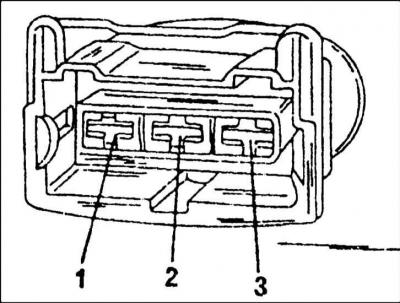
10. Connect a voltmeter between pin 1 positive and pin 3 (ground).
11. Turn on the ignition and check that the voltmeter shows a voltage close to the battery voltage. If this is not the case, then check the wire up to the ignition switch (lock).
1.8L engine without turbocharger
12. Remove the cover in the middle of the engine and disconnect the plug from the output (terminal) cascade.
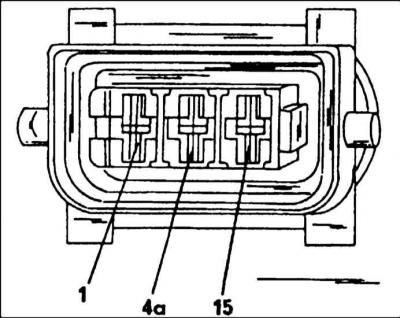
13. Connect the voltmeter to the middle terminal 4a and to the "ground". Turn on the ignition. The voltage should approximately correspond to the battery voltage. If this is not the case, check the wire up to the ignition switch.
1.8L turbocharged engine
14. Do the same with the difference that the voltmeter should be connected between the contact of the black (blue) wire and the brown (yellow) wire. The measurement results should be the same as for a normal engine without a turbocharger.
Checking the ignition coil(s)
Different engines require different operations.
Engine 1.6 l
15. The first thing to do is to check the appearance of the ignition coil. A burnt coil may sometimes have molten mass for filling the coil.
16. To measure, you need an ohmmeter with the ability to measure high resistances.
17. Turn off the ignition and disconnect the wire from the connection.
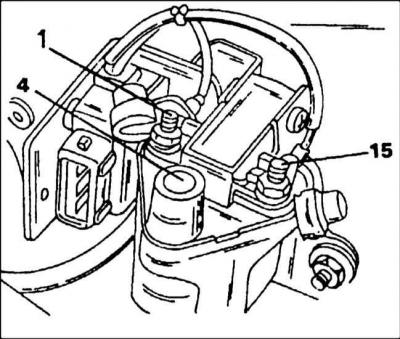
18. Measure the resistance between terminals 1 and 15 with an ohmmeter. The resistance of the primary winding is measured, which should be 0.5–1.5 Ohms.
19. Connect an ohmmeter between terminals 15 and 4. The measured resistance of the secondary winding should be 5–9 kOhm.
20. If the indicated resistance values do not correspond to the measured ones, the ignition coil must be replaced. You can also have the ignition coil checked in a workshop.
1.8L engine without turbocharger
This engine has ignition coils and output stage connected to each other. Only rough check is possible assuming voltage is applied (engine cover removed):
21. Disconnect all plugs from the injectors.
22. Disconnect the plug from the output stage and connect the test lamp to one of the outer contacts and to the "ground". Crank the engine with the starter and check that the lamp blinks.
23. Perform the same test on the other contact. The lamp should blink again.
24. If there is no blinking, the fault may be in the following parts:
- Wire connections;
- Control unit;
- Sensors.
25. To replace it, you need to have the system checked in a workshop to determine the exact cause.
1.8L turbocharged engine
On this engine, check the ignition coils again (the output stage is tested separately).
26. Disconnect all the plugs from the injectors. If, when checking the current and voltage supply, it is determined that one spark plug does not work, then you need to swap the ignition coils. If there is no spark on the other spark plug, then the coil is faulty. To be completely sure of this, you need to connect the spark plug to another coil, since the spark plug may also be damaged.
27. If there is still no result, disconnect the plug of the corresponding cylinder and measure the voltage between the contacts. To do this, connect a voltmeter between both outer contacts of the plug and turn on the ignition. The voltmeter should show the battery voltage. If this is not the case, then there is a break in the power supply circuit to the plug.
28. Connect the control (verification) the lamp to contacts 2 and 3 of the plug and turn on the ignition and starter. If the lamp does not flash, the entire system must be checked in the workshop.
Checking the ignition switch
For 1.8L engines without turbocharger, the commutator has already been checked together with the ignition coils. For other engines, the check is done separately.
Engine 1.6 l
The switch is located next to the ignition coil. To check, do the following:
29. Remove the plug from the output stage and connect a voltmeter between terminals 2 and 3
30. Crank the engine with the starter and check that the voltmeter shows at least 2 V.
31. If this is not the case, it is necessary to replace the ignition coil and output stage together, having previously checked them in a workshop.
1.8L turbocharged engine
The ignition system switch is connected by two plugs, which are checked differently. One plug has 5 contacts, the other 4 contacts. They are installed on the left and right of the switch.
32. Disconnect the plugs from all injectors.
33. Disconnect the 4-pin plug from the output stage (under the air filter housing cover). The plug contacts are arranged in order from left to right. Connect one wire of the LED tester to the "ground".
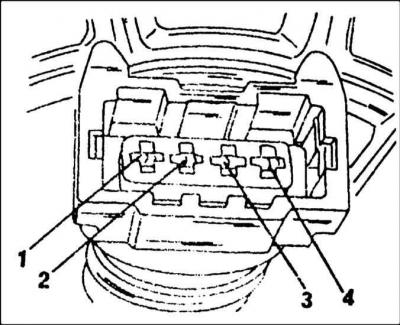
34. Connect the other test lead sequentially to contacts 1, 2, 3 and 4 of the plug, turning on the starter. The LED should blink during all checks. If this is not the case, there are faults. Plug the plug back in.
35. Remove the 5-pin plug. The plug contacts are arranged in order from left to right.
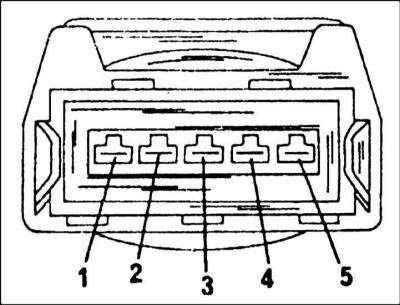
36. Connect the free wire of the LED tester in sequence to contacts 1, 2, 4 and 5, turning on the starter (contact 3 in the plug plays the role of "ground"). The LED should blink during these four tests. This means that the input signal is coming to the switch.
37. If the described check gave a negative result, then the switch needs to be replaced.
Checking the Hall sensor
As already mentioned, the Hall sensor in 1.8L engines is located on the front side of the cylinder head, directly above the timing belt. During normal operation, the electronic engine management system determines the ignition timing for the first cylinder based on the signal from the Hall sensor. If the signal is not received, the cylinders cannot operate for long with detonation control. In this case, the detonation control system does not work, the ignition timing is slightly delayed to prevent detonation. To check the Hall sensor, proceed as follows:
38. Disconnect the injector plugs.
39. After removing the timing belt cover, you can see the Hall sensor. The plug is at the bottom. Pull the rubber bushing on the Hall sensor plug back (the plug remains on the sensor).
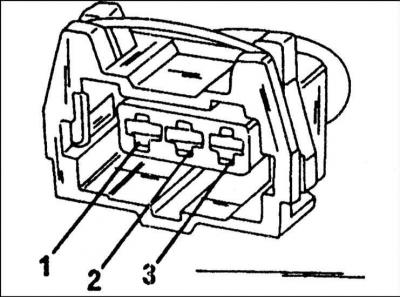
40. Connect the LED voltage tester to pins 1 and 2 on the back. The pins are marked with numbers on the back of the plug for this purpose. Turn on the starter for a few seconds. The LED should flash briefly every second revolution of the engine.
41. Remove the plug from the Hall sensor and turn on the ignition.
42. Connect a voltmeter between pins 1 and 3 of the plug. The voltage value should be 4.5–5.5 V.
43. Now connect the voltmeter between pins 2 and 3 of the plug. The voltage should be 4.3–5.2 V.
44. If the voltage values correspond to the specified ones, but the LED blinks, the Hall sensor must be replaced. If the measured voltage values do not correspond to the specified ones, then the fault is in the wire connections. Have it fixed in a workshop.
Checking the engine speed sensor
The RPM sensor is located above the flywheel ring gear. An ohmmeter is required to check it.
45. Disconnect the plug from the speed sensor (gray plug).
46. On the inside of the plug, connect an ohmmeter to contacts 1 and 2 (No. 1 is on the left). The resistance value should be 480–1000 ohms. If the measured resistance is outside these limits, the sensor must be replaced.
47. If the resistance is normal, connect an ohmmeter between contacts 1 and 3 and between contacts 2 and 3. The ohmmeter should show infinity, otherwise replace the sensor.
48. If all the parts are in good condition, then there may be a broken wire.
Checking the knock sensor
The 1.6L engine has only one knock sensor. Electrical testing of this sensor is not possible. Malfunctions can be determined by interrogating the memory of the diagnostic device using special devices. The plugs are located behind the expansion tank of the cooling system and can be checked for corrosion or other external damage. All other work should be carried out in a workshop.
(Read the original source on the website: AudiManual.ru)