
Repair Chevrolet Repair Toyota Repair Honda Repair AvtoVAZ Repair Mercedes-Benz Repair BMW Repair Opel
Home  |  Contacts  |  Sitemap  |    
English Русский
Български
Беларускі
Український
Српски
Hrvatski
Română
Polski
Slovenský
Magyar
AudiManual.ru


  • AUDI 80
  • AUDI 100
  • AUDI A3
  • AUDI A4
  • AUDI A6
  • AUDI A8
  • AUDI Q
  • OTHER
  • ARTICLES
A2 (1999-2005)

Vacuum hose connection diagram (ATL, BHC engines) (Audi A2)

  • Home
  • Audi
  • A2 (1999-2005)
  • Engine 1.4 l (diesel)
  • Turbocharging system
  • Vacuum hose connection diagram (ATL, BHC engines)
            0
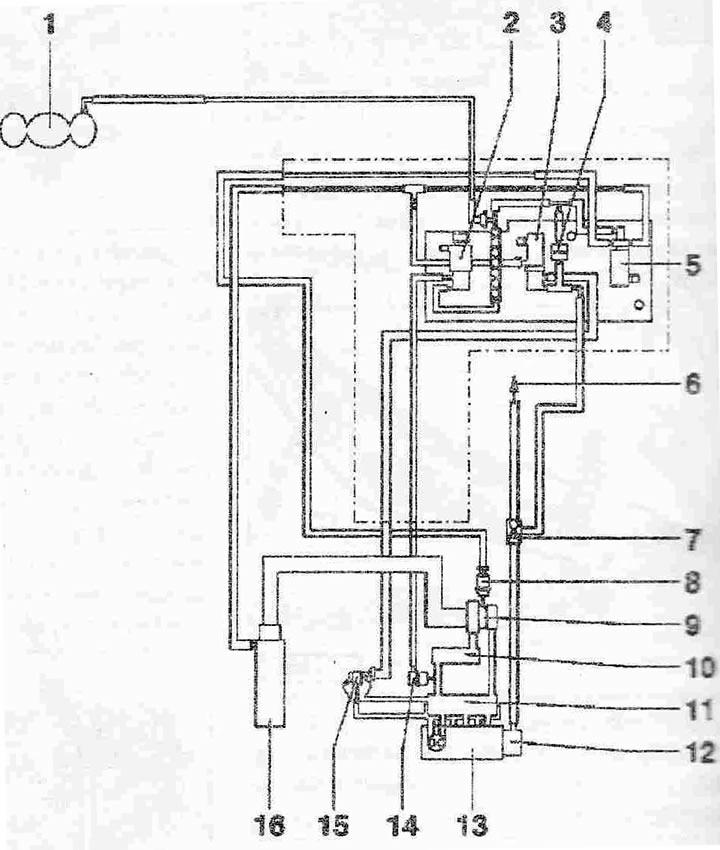
Vacuum hose connection diagram (aTL, BHC engines):

Vacuum hose connection diagram (aTL, BHC engines):
1. Vacuum receiver
2. Throttle valve "N₂11"
3. EGR valve "N18" (only VIS)
4. Check valve. White connector to the boost pressure limiting solenoid valve "N75"
5. Boost pressure limitation solenoid valve "N75"
6. To the brake booster
7. Check valve
8. Power vacuum pneumatic element for regulating boost pressure
9. To the turbocharger
10. Intercooler
11. Intake manifold
12. Tandem fuel and vacuum pump
13. Cylinder head
14. Power vacuum pneumatic element of the intake manifold flap (only BHC)
15. Mechanical EGR valve, intake manifold fitting element can only be replaced as a set with the intake manifold fitting
16. Air filter
The article was checked by auto expert Daniil Ushakov
This article is available at russian, bulgarian, belarusian, ukrainian, serbian, croatian, romanian, polish, slovak, hungarian

Share information:
Previous articles
Audi A2: Turbocharging system
Next articles

Vacuum hose connection diagram (AMF engines)
Checking the turbocharger boost system
Turbocharger of the engine with the letter designation AMF
Removal and installation a turbocharger (AMF engines)
Turbocharger of the engine with the letter designation ATL, BHC
Removal and installation of turbocharger (ATL, BHC engines)


Similar articles on other Audi car models:
Electrical connection diagram for ignition switch, side light… Audi 80 B3 (1986-1991, petrol)
Electrical equipment diagram of AUDI «100» cars with carburetor… Audi 100 C3 (1982-1990, petrol)
Checking the engine with a vacuum gauge Audi A3 Type 8L (1996-2003)
Cooling system — coolant hose connection diagram Audi A4 B8 (2007-2015)
Electrical connection diagram with the housing Audi A6 C5 (1997-2004)
General information about 3.7 and 4.2 liter petrol engines Audi A8 D2 (1994-2002)
Coolant hose connection diagram Audi Q5 Type 8R (2008-2017)
Link to this page in different formats


Visitor comments

No comments yet


How much will 35 + 43 =


Audi A2(1999-2005) 
  • General information
  • Introduction to the guide
  • Maintenance
  • Engine 1.4 l (gasoline)
  • Engine repair
  • Lubrication system
  • Cooling system
  • Exhaust system
  • Engine 1.6 l (gasoline)
  • Engine repair
  • Lubrication system
  • Cooling system
  • Exhaust system
  • Engine 1.2 l (diesel)
  • Engine repair
  • Lubrication system
  • Cooling system
  • Injection and turbocharging
  • Engine 1.4 l (diesel)
  • Engine repair
  • Lubrication system
  • Cooling system
  • Turbocharging system
  • Supply system
  • Fuel injection system
  • Exhaust system
  • Transmission
  • Mechanical gearbox 02J
  • Mechanical gearbox 02T
  • Mechanical gearbox 085 DS
  • Chassis
  • Car suspension
  • Steering
  • Brake system
  • Body
  • Exterior
  • Interior
  • Seats
  • Doors, locks and windows
  • Safety system
  • Heating and air conditioning
  • Electrical equipment
  • Power devices
  • Equipment and devices
  • Wipers and washers
  • Lighting and lamps
  • Breakers and switches
  • Electrical circuits
 
AudiManual.ru © 2017-2026 · Mobile version · Feedback · Sitemap: EN BG BY UA RS HR RO PL SK HU · Site search · News and articles
80 B2 · 80 B3 petrol · 80 B3 · 80 B4 · 100 C3 diesel · 100 C3 petrol · 100 C3 · 100 C4 petrol · 100 C4 · A3 Type 8L · A4 B5 petrol · A4 B5 · A4 B6 petrol · A4 B6 · A4 B7 · A4 B8 · A6 C4 · A6 C5 · A6 C5 Allroad · A8 D2 · Q5 Type 8R · Q7 Typ 4L · Audi A2 ·
This site uses cookies 🍪. Click the button to accept this fact.